 Physix Frontier
Trump Worries About Driving Talent Away: What China's AI Can Do to Seize the Opportunity

Physics Frontier · Information as of October 1, 2026

Trump taking questions from reporters after the AI luncheon. Original page video frame, source Trump Archive, event date US time September 29, 2026.
On September 29, Trump was asked whether China's AI development could surpass the US. He first said he didn't think it would happen, then added, unless the US does something stupid and drives these people to other countries, and that this could indeed happen.
Seen from China, what's worth probing in this remark is: even if talent and technology flow over, what do we rely on to keep them, and turn them into products that can be delivered sustainably?
A just-released set of data gives a more concrete reason for optimism. The International Federation of Robotics disclosed on September 24 that China actually installed 354,000 industrial robots in 2025, accounting for 59% of global installations that year. China already has a massive production floor, where AI teams can find problems, validate technology, and face customer scrutiny.
First, put Trump's remark back in context
This Q&A appeared around 28:10 in the post-luncheon press conference on September 29. The English original uses "these people," doesn't explicitly say "Chinese researchers," and doesn't announce that US talent is flowing back to China.
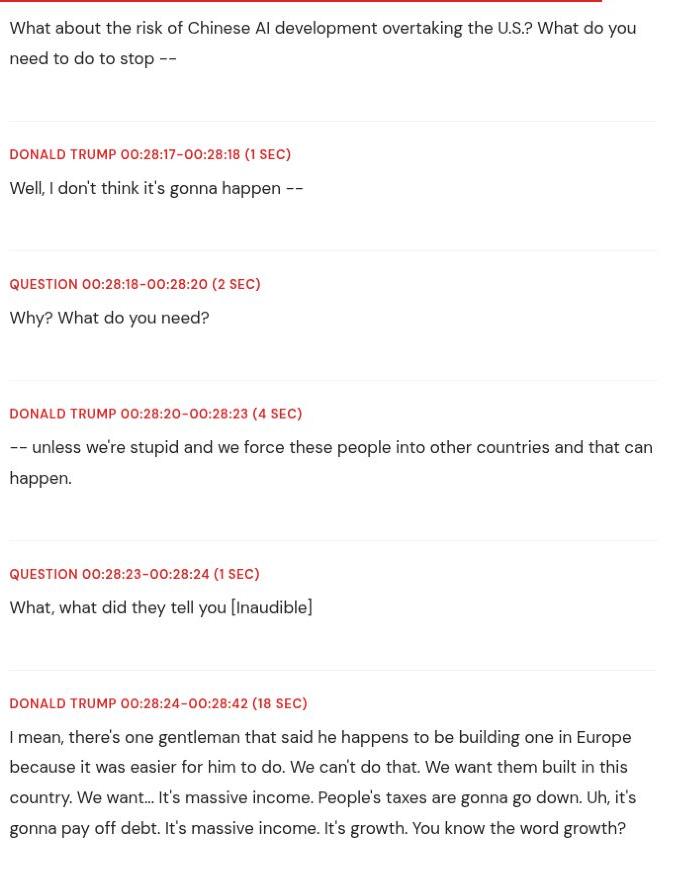
The day's Q&A as archived by Trump Archive. At 28:20 he talks about "driving these people to other countries," then gives the example of someone going to Europe to build a project because it's easier there. Source date September 29, 2026.
Immediately after, Trump gave the example that someone present was building a project in Europe because it's easier there. He wants the project built in the US. Combined with the preceding discussion of data center construction, this is a passage about concern over the flow of people and investment. It's not enough to prove China has already acquired this batch of talent.
But this passage reminds us that AI competition also depends on whether a place lets people get things done. Research conditions, construction costs, and customer demand can all affect where teams and projects go. This is the article's judgment, not to be taken as Trump endorsing China.
China's talent base has evidence. MacroPolo's Global AI Talent Tracker, using NeurIPS 2022 paper authors as sample, found 47% of researchers did their undergraduate studies in China, up from 29% in the 2019 sample. The project released this update in 2024, and the metric is location of undergraduate education, which neither equals nationality nor can be used to count 2026 return numbers.
There are already many places in China that can absorb technology
For physical AI, the production floor is especially important. Physical AI is letting models participate in real tasks through cameras, sensors, and machine motion. For example, recognizing parts, grasping objects, or letting vehicles understand road conditions. It has to face reflective surfaces, misaligned workpieces, and downtime customers won't accept.
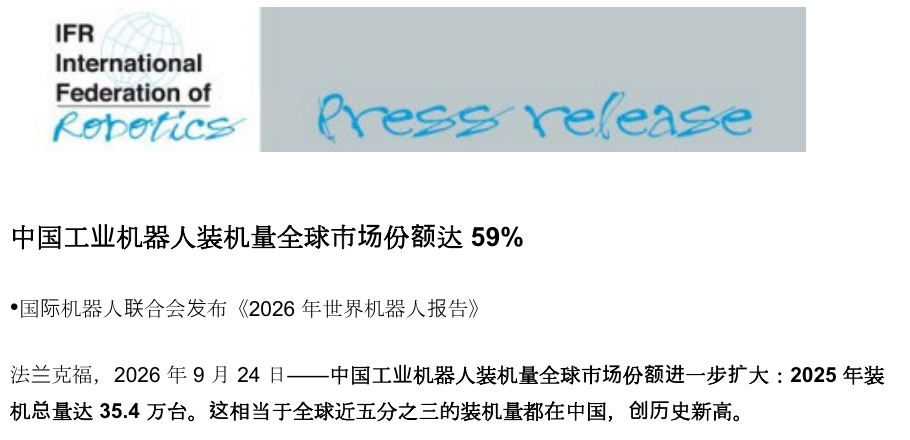
Screenshot of the original page of IFR's Chinese press release, published September 24, 2026. Both 354,000 units and 59% refer to 2025 new industrial robot installations, not robot stock, nor humanoid robot sales.
The value of 354,000 installations is that behind it are a large number of already-running devices, buyers, and maintenance needs. Chinese teams have the opportunity to improve perception, control, and deployment methods in these specific tasks, then hand the solution to the next customer. This is closer to a business than completing a motion once in a demo venue.
This is an industry judgment made from installation data. Traditional industrial robots don't naturally equal embodied intelligence, and factory data won't automatically become usable training data. Whether companies are willing to open data, whether old equipment can be connected, whether it's still reliable when you swap a workpiece — all need to be verified item by item.
The same IFR statistics also show that in 2025 Chinese domestic brands accounted for 55% of domestic new installations, with domestic brand installations growing 15% year-on-year. This shows domestic suppliers have already participated in considerable-scale actual deployment. However, the 55% share is lower than 2024's 57%, so it can't be written as domestic share rising continuously.
The basis for optimism is that China already has a floor where customers, equipment, and suppliers solve problems together. Whether it can translate into AI advantage depends on whether new algorithms can let customers rework less, stop less, and afford the procurement and maintenance costs.
After someone pays, it still depends on whether delivery can be sustained
Baidu's Q2 2026 results released August 18 provide a trackable commercial case. Per company disclosure, April to June AI Cloud Infra revenue was 7.3 billion yuan, up 50% year-on-year; AI Applications revenue was 2.5 billion yuan, up 3% year-on-year. These business category figures come from unaudited management accounts.
This at least shows that part of AI demand has entered revenue, not just stayed in trials and demos. The growth difference between infrastructure and applications is also worth noting, but from a single quarter and different business categories alone, one can't judge the overall profitability of China's AI applications.
In the same disclosure, Baidu said Apollo Go has launched fully driverless commercial operations in Dubai, with passengers able to hail rides through Uber and its own app; London is open-road testing, and Hong Kong Airport Island is also testing. Commercial operations and testing are different stages, and can't be merged into a string of "globally deployed" city names.
Autonomous driving is a real application of physical AI. Chinese teams starting to deliver services overseas is a positive signal. However, the above progress is company disclosure; the announcement didn't separately disclose Apollo Go's revenue, profit, or per-ride cost, so one can't declare the business model already profitable based on it.
For readers following hard-tech investment, the more valuable evidence next is whether paying customers renew, whether deployment replicates to a second site, and whether gross margin and cash recovery improve after revenue increases. Technology being able to complete a task only answers part of the question of whether customers will buy.
Optimism can be built on things that have already happened
China still has areas to fill. Stanford's "2026 AI Index" released April 13 recorded the narrowing gap between US and Chinese models in specific evaluations, while tallying 2025 US private AI investment at 285.9 billion dollars and China's at 12.4 billion dollars. This metric doesn't include some public funds like China's guidance funds, so it can't be used to compare the two countries' total investment, but it's enough to remind us that talent base and industry floor can't replace capital and computing resources.
Therefore, Trump's concern can serve as an observation entry point. China's more assured opportunities come from the already-existing talent education base, actual installation scale, and emerging commercial revenue and overseas services. Each has its boundaries, but put together, they still support a relatively optimistic judgment.
What's worth tracking in the future is whether more Chinese teams can, in factories and on roads, turn a one-time success into a service customers are willing to buy repeatedly. When deployment can be replicated and costs can come down, talent also has more reason to stay. China's pursuit of the initiative in AI development can accumulate from these concrete advances.
Main sources: Trump Archive and Factbase day's Q&A, September 29, 2026; IFR "2026 World Robotics Report" Chinese press release, September 24, 2026, statistics period 2025; Baidu Q2 2026 results announcement, August 18, 2026, statistics period April to June; Stanford "2026 AI Index," April 13, 2026, investment statistics period 2025; MacroPolo Global AI Talent Tracker update, released 2024, sample period 2019 and 2022.

