 Physix Frontier
Nvidia Just Added $150 Billion to Its Buyback

Wujie Frontier · AI Infrastructure Watch
**Nvidia just added a $150 billion buyback
but on the other side is providing up to $105 billion in guarantees for AI infrastructure**
Beyond the $500 billion financing plan, the credit risk of AI data centers has also been written into the financial statements
On one side is a record stock buyback authorization, and on the other is credit support for AI data centers. Put Nvidia's recent financial moves together, and the story is not just "lots of cash, rewarding shareholders." The company is connecting funding, campus construction, and future chip demand into the same infrastructure network.
But several eye-catching numbers are not the same in financial nature. The $150 billion is a new buyback authorization, the $500 billion is a long-term mobilization target for third-party capital, and the $105 billion is an upper limit on guarantee liability triggered in stages for specific projects. They cannot be directly added together, and none of them equals money Nvidia has already spent right now.
First put the three numbers back in their own places
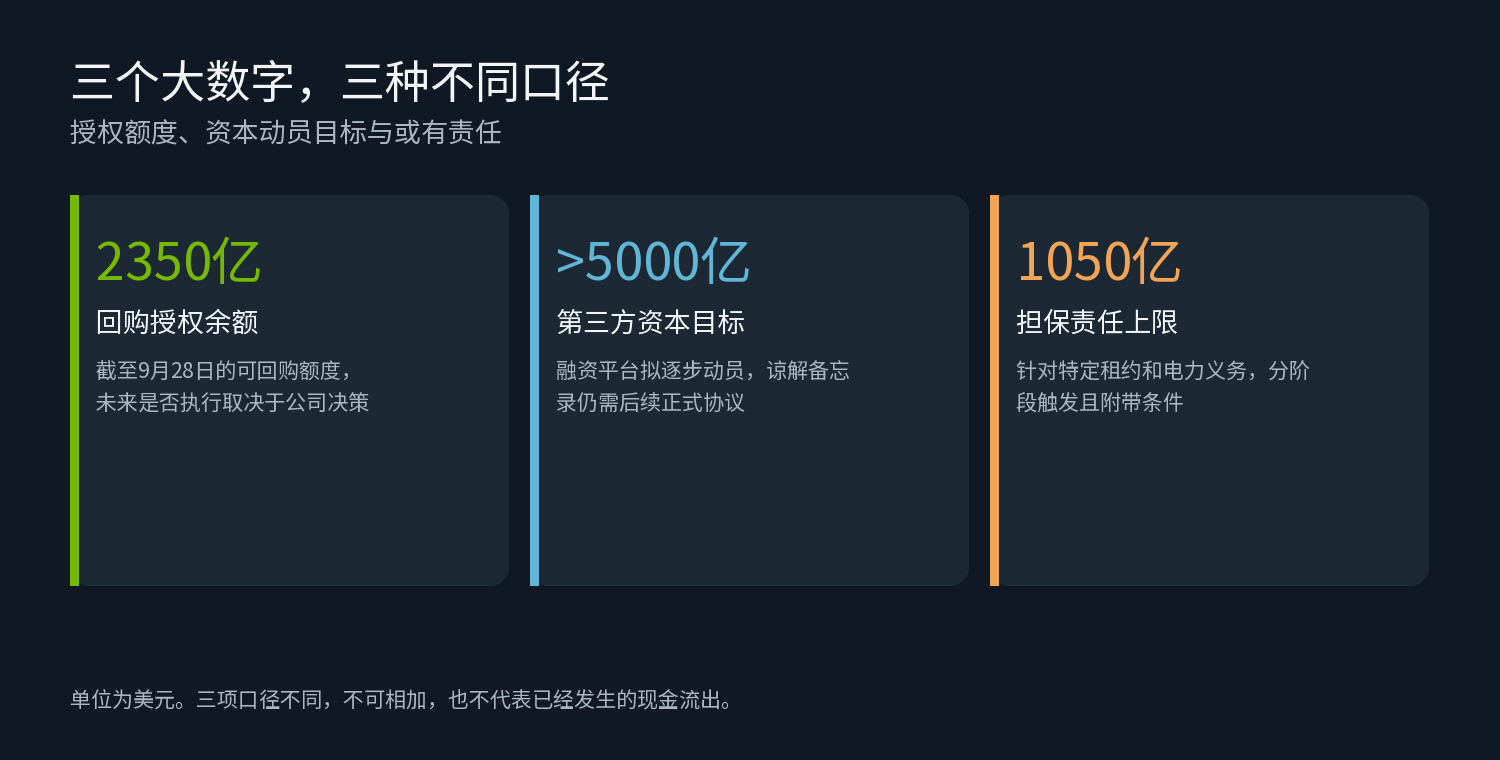
Chart compiled by Wujie Frontier based on company announcements and SEC filings. Amounts in USD.
$235 billion is a quota, not a check
On September 28, Nvidia announced a new $150 billion stock buyback authorization. Adding the previously unexecuted quota, the company's available buyback authorization rose to $235 billion, planned to be executed before the end of fiscal 2028. This scale exceeds Apple's previous publicly disclosed authorization record.
The most important qualifier in the announcement is "authorization." Board approval of a quota does not mean the company must buy back stock up to that quota, nor does it mean the cash has already flowed out. Actual buybacks will proceed according to market conditions and company needs. It gives management a very large checkbook, but when the check is written and for how much is still up to the company.
Of course, the market will read a huge buyback authorization as management being bullish on future cash flow, and may also see it as a strong sentiment signal that reinforces "fear of missing out" buying psychology. But "FOMO" is a market interpretation, not a buyback purpose Nvidia admitted in the announcement.
The latest financial report shows that in the first half of fiscal 2027 ended July 26, Nvidia actually repurchased 203 million shares for about $39.8 billion in cash; operating cash flow in the same period was $74.4 billion. The huge authorization has ample cash flow behind it, and that is a fact. Whether the company executes it fully still depends on cash flow each period, valuation levels, and other capital needs.
$500 billion is a financing entry point for AI construction
In August, Nvidia announced that it signed memorandums of understanding with institutions including Apollo, BlackRock, Blackstone, Brookfield, Goldman Sachs, and KKR, planning to establish an independent financing platform to gradually mobilize more than $500 billion in third-party capital to support AI infrastructure deployment. The company also noted that these preliminary arrangements may not all reach final agreements.
This money is not funds Nvidia borrowed from banks, nor is it orders that have already arrived. According to the company's description, the capital structure is independently underwritten and provided by capital providers, and the platform serves ecosystem partners and customers in building and acquiring AI infrastructure. How much funding the financing platform can ultimately leverage depends on project quality, formal agreements, and capital providers' risk judgments.
The business logic is not hard to understand. AI data center construction needs GPUs, and also land, power, machine rooms, and long-term financing. If customers lack money or cannot obtain long-term financing, even if there is chip demand, they may delay deployment. Helping customers and campuses open up financing channels can increase the probability that infrastructure gets built; after the facilities are completed, Nvidia also has a better chance to continue selling chips and systems.
This creates mutual pull in the business, but it cannot be written as "the funds have already locked in Nvidia chip orders." Whether orders appear and how large they are ultimately still has to be proven by actual procurement and customer revenue.
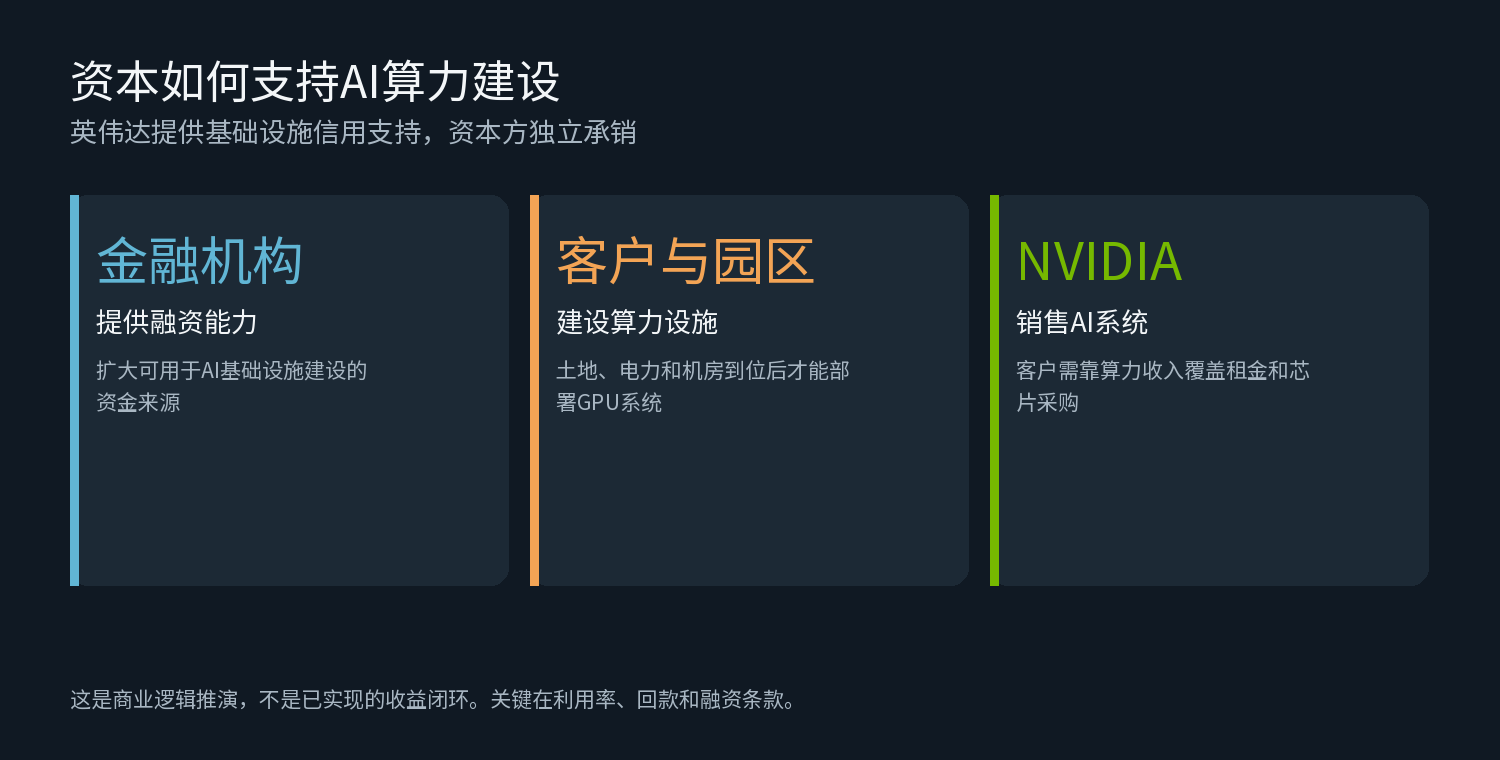
The diagram is a deduction of business logic. Actual financing decisions are independently underwritten by capital providers, and project construction and customer operations still carry uncertainty.
What is more worth watching in the financial statements is the $105 billion guarantee
Nvidia's second-quarter 10-Q disclosed a more specific arrangement whose risk is also easier to overlook. In August 2026, the company signed a guarantee with SB Energy to provide credit support for land, power, and machine room construction at the PORTS Technology Campus in Ohio, involving data centers leased by an OpenAI affiliate for about 4.25 gigawatts of IT load, with a total guarantee cap of $105 billion.
This is not Nvidia paying out $105 billion in one go. The guarantee increases in stages, and the first data centers are expected to begin operation in fiscal 2029; each stage must also meet corresponding conditions, including the campus reaching a deliverable service state. The guarantee corresponds to specified portions of lease and power payments, does not cover the entire cost of the campus, and does not assume all tenant obligations. As the tenant fulfills lease obligations, Nvidia's risk exposure will decline.
This arrangement shows that Nvidia is participating more deeply in the front-end construction of AI infrastructure. It is willing to use its own credit to support key campuses so that customers have a chance to obtain computing resources faster. The potential return is that customers and campuses are more likely to get built; the risk is that if the tenant defaults, the project is delayed, or the financing structure comes under pressure, the guarantee may turn from a paper commitment into an actual obligation.
The company also disclosed in the 10-Q that other guarantees provided for data center leases of some AI cloud partners have a maximum total exposure of about $3.5 billion. Adding the two types of guarantees together, the total summarized on the balance sheet is $108.5 billion, most of which comes from the SB Energy project. When understanding overall risk, the $105 billion item must be read separately to clearly understand its scope and trigger conditions.
Whether buybacks can reduce share count depends on net shares
The authorization amount easily creates a sense of scale, but measuring shareholder returns still depends on actual execution and share changes. The financial report shows that in the first half, Nvidia spent about $39.8 billion to repurchase 203 million shares; in the same period it recognized about $3.954 billion in stock compensation expense and withheld 23 million shares for employee stock plan tax withholding. The two sets of numbers are different in nature and cannot simply be subtracted to be treated as "net buybacks."
A more direct observation window is the diluted weighted average share count disclosed by the company. In the first half, share buybacks, employee equity incentive grants and vesting, and tax withholding all affect the share count. No matter how large the buyback authorization is written, if new issuance and equity incentives offset the buyback effect, improvement in per-share metrics will be limited.
How far the AI train can run ultimately depends on customer payments
The advantage of Nvidia's playbook is that it puts manufacturing supply, capital, campuses, and chip demand into the same business network. Buybacks release cash flow confidence to shareholders, the financing platform tries to expand sources of infrastructure investment, and guarantees solve the credit threshold for individual projects. For an AI industry eager to expand, these moves do help push computing construction forward.
But how long the train can run cannot be judged only by financing targets and buyback authorizations. Observers next need to watch several things: whether the financing platform can move from memorandums of understanding to formal agreements, and how much capital is actually deployed; whether the Ohio campus can be delivered in stages on schedule, and whether tenant computing utilization can climb; whether the revenue of AI cloud and model companies can cover power, depreciation, interest, and rent; and whether Nvidia's actual buybacks and diluted share count continue to improve.
If customers can turn newly added computing power into sustained, recoverable cash revenue, this capital loop may run more and more smoothly. Conversely, if capital expenditure runs ahead of real demand and profitability, credit support will also bring some customer risk into the supplier's own books. Nvidia's cash flow is very strong, and its infrastructure commitments are also growing. In the next stage, what the market really needs to see is whether customers can make money from this batch of computing power and keep paying.

