 Physix Frontier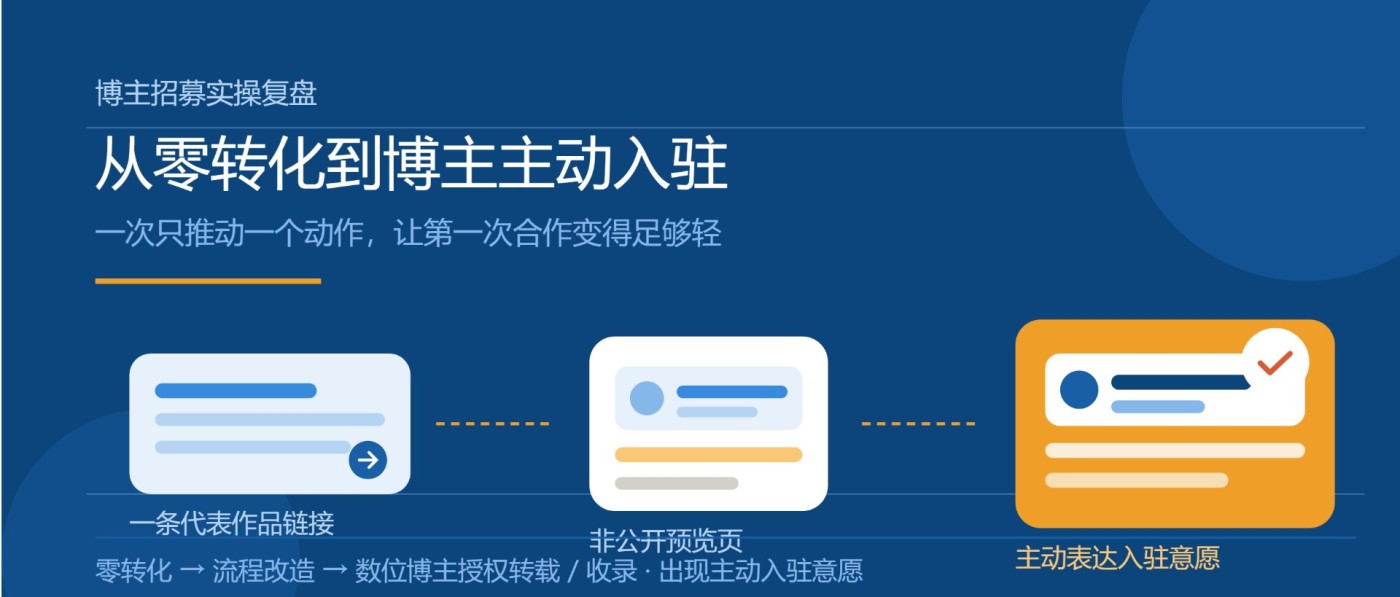
Blogger Recruitment Review: From Zero to Active Creator Onboarding

We contacted tons of bloggers but got zero conversions. Here’s what we changed.
We reached out to a batch of bloggers early on and even got replies and contact info, but no one published content or officially joined up for ages. After reviewing the process, we lowered our initial ask to the bare minimum: just get authorization for one piece of content and go live with it. Suddenly, we had bloggers willing to authorize reposts and even proactively expressing interest in joining.
I. We contacted many bloggers, resulting in near-zero conversion
For a period last year, we were contacting bloggers almost every day. DMs went out, people replied; conversations went well, and we successfully exchanged contact info. The team held weekly progress meetings, and everything seemed to be moving forward.
But when we laid out the records, the problem was obvious: not a single piece of content actually went live, and not a single person completed the onboarding. Replies stayed at a polite level, contact info sat unused in address books, and conversations usually died right after we sent over the platform introduction.
Our initial diagnosis was "not enough volume," so we thought about increasing DMs. Later, we realized this direction was wrong. The real issue wasn't quantity, but process—we never gave them a low-cost, immediately executable next step.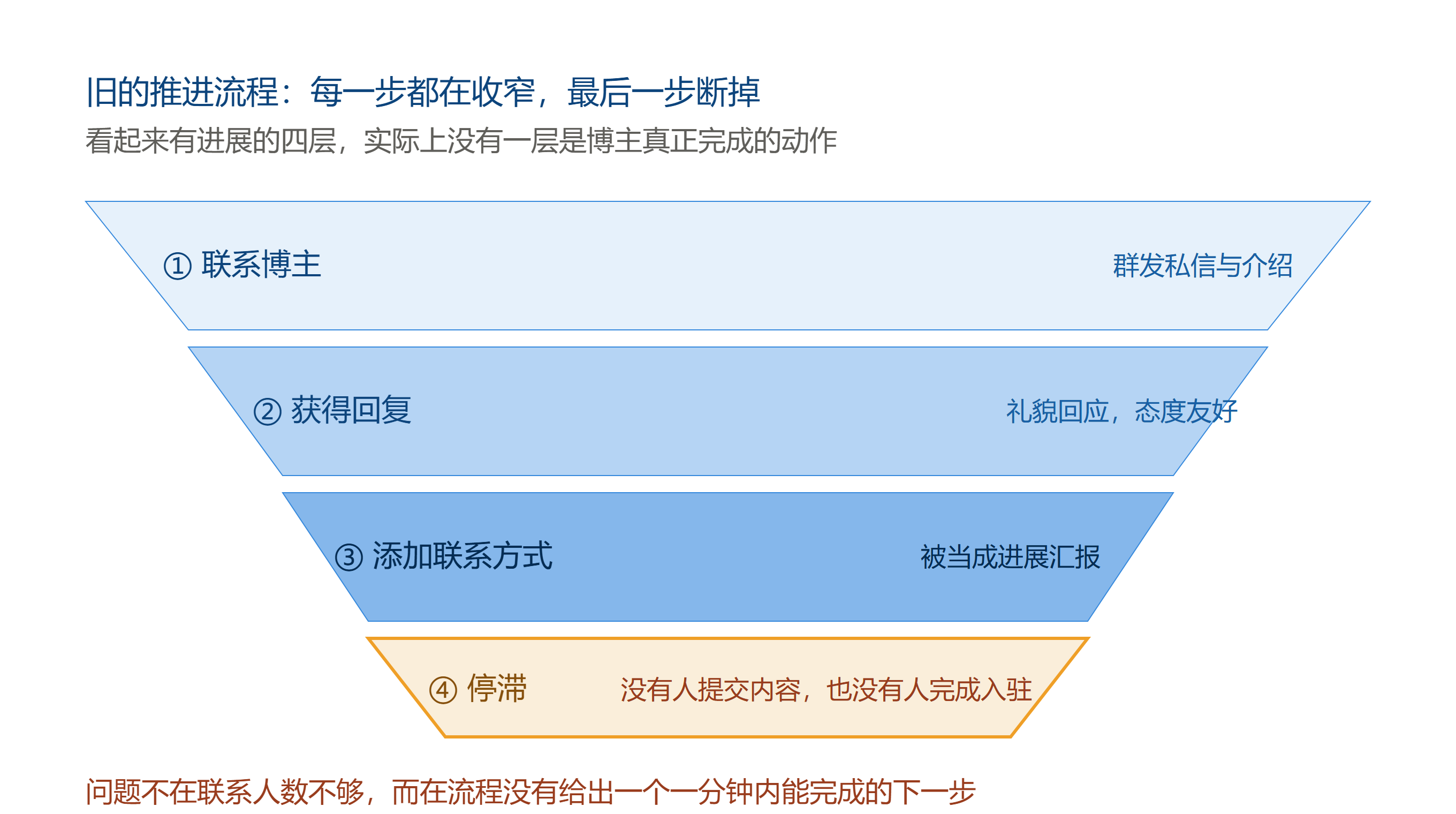 The four levels of the old flow: Contact, Reply, Exchange Contacts, ending in Stagnation. None of these four layers involved an action truly completed by the blogger.
II. Why the old process failed
When we reviewed all the stalled conversations together, we found the failure reasons were very concentrated. They were all process design issues, not a lack of effort from anyone.
(1) Too much information at once
Platform positioning, creator alliance, benefits system, community planning, future commercial partnerships—all crammed into one message. The other party needed to understand the entire project before they could make a judgment. The cognitive load was too high, so many people read it and shelved it.
(2) The first ask was too heavy
Before experiencing any value, they were asked to register, fill out profiles, migrate content, and decide whether to join long-term. This series of actions required a decision within minutes, which most people instinctively postponed.
(3) Value appeared too late
The platform didn't have enough traffic at the time, and the future exposure and commercial partnerships we pitched couldn't be proven immediately. The other party lacked a reason to continue acting, so they just waited and watched.
(4) No clear next step
After exchanging contacts, we kept explaining things but didn't provide a specific action that could be completed in under a minute. The conversation naturally stopped there—not because they rejected us, but because there was no reason to continue.
Key conclusion for this section: The problem isn't necessarily that our pitch wasn't enthusiastic enough, but that the cost and benefit of the first exchange were mismatched. They were giving a lot, while the return remained invisible.
III. Step 1: Redefine what counts as a conversion
How we did it: We changed the definition of "first effective conversion." Previously, we tracked adding WeChat, expressing interest, or registering accounts. Now, we track only one thing—a specific piece of content going live after author confirmation. Claiming a homepage, joining the community, or submitting ongoing posts are counted as second or subsequent conversions, not the first.
Why it worked: Once the definition changed, the team's actions changed. We were no longer misled by polite replies, nor did we feel like we were making progress just because "we added a lot of people."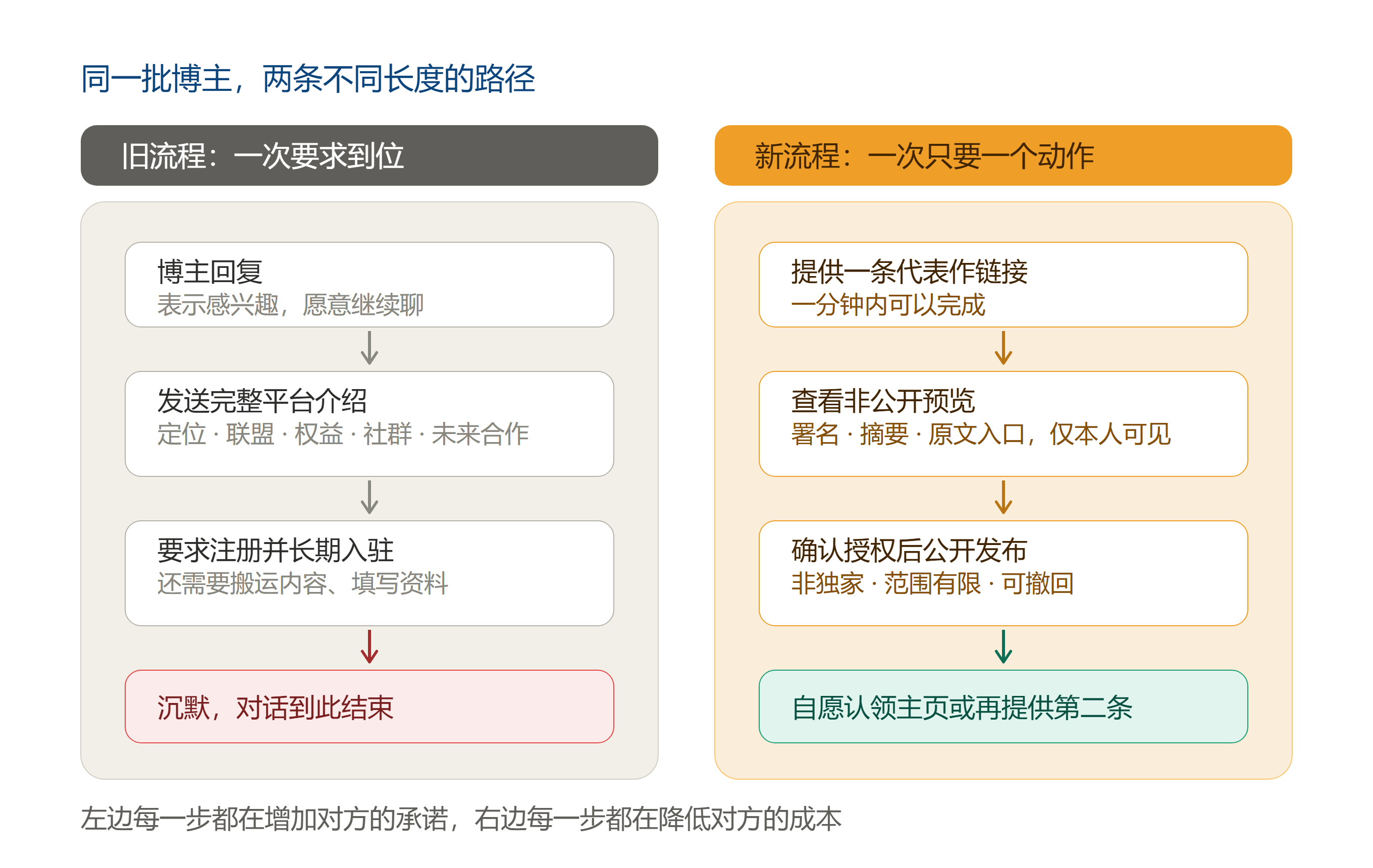 Every step on the left increases the other party's commitment; every step on the right lowers their cost.
IV. Step 2: Lower the barrier for the first action
How we did it: After a blogger replied, we stopped sending long project descriptions and simply asked them to send a link to their most representative existing work. The first participation didn't require rewriting drafts, migrating content, continuous updates, or even registering first.
Why it worked: Sending a link usually takes less than a minute. If the action is light enough, they'll do it casually while their interest is still fresh, rather than postponing the decision.
Actual script used in communication: "My previous intro was a bit complex, let me clarify. You don't need to register, migrate content, or commit to updates this time. Just send me a link to your best work. We'll create a free private preview for you first. It only goes public after you confirm authorization."
V. Step 3: Deliver a private preview first
How we did it: Upon receiving the link, we created an author bio, content summary, attribution, and original source entry within 24 hours. We generated a private page viewable only by the blogger. We asked them to check the attribution, content expression, and display effect, offering two clear options: agree to publish, or request changes.
Why it worked: Abstract platform introductions were replaced with concrete deliverables related to the blogger personally. The platform invested effort upfront, lowering their guard against unfamiliar collaborations and letting bloggers retain control over their content.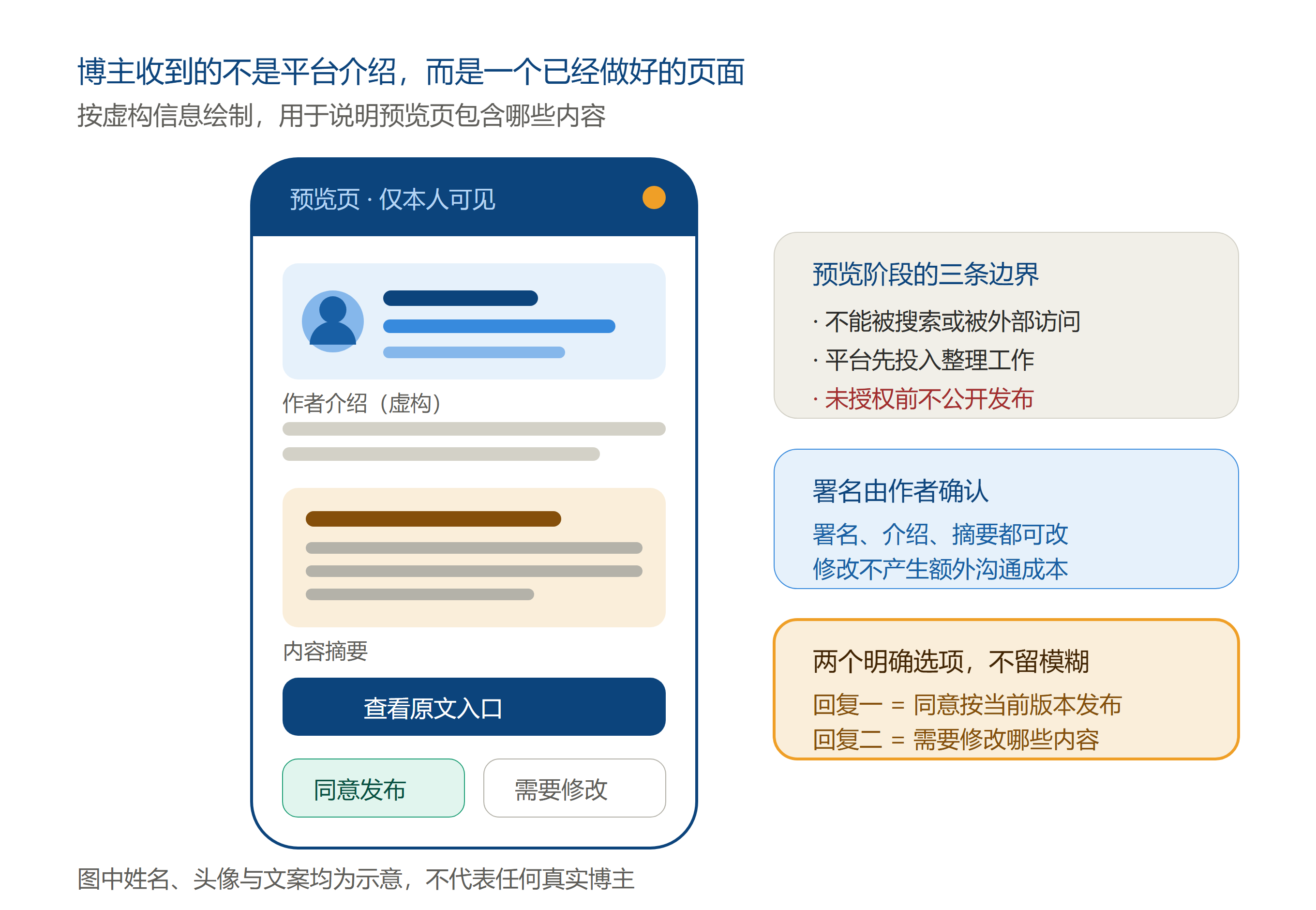 The preview page includes author bio, content summary, attribution, and original source entry. All info in the image is fictional for illustration and does not represent any real blogger.
Boundaries that must be clarified in this step: The preview page cannot be searched or accessed externally. No content is published publicly until the blogger explicitly authorizes it.
VI. Step 4: Close the first deal with explicit authorization
How we did it: We asked the blogger to confirm the specific work, attribution, and scope of display. Only after they explicitly replied agreeing to publish did we go live. Authorization applies only to the specified work, is non-exclusive, limited in scope, and revocable. We do not take rights to control their original platform account, handle rights protection on their behalf, or sublicense.
Why it worked: Bloggers knew exactly what they agreed to and how to modify or revoke it, creating a stronger sense of security. For the platform, each authorization has a clear record, reducing copyright and communication disputes.
Script for the authorization phase: "The preview is ready. Please check if the attribution and bio are accurate. Reply '1' to agree to publish the current version, or reply '2' if changes are needed. We won't publish without your confirmation."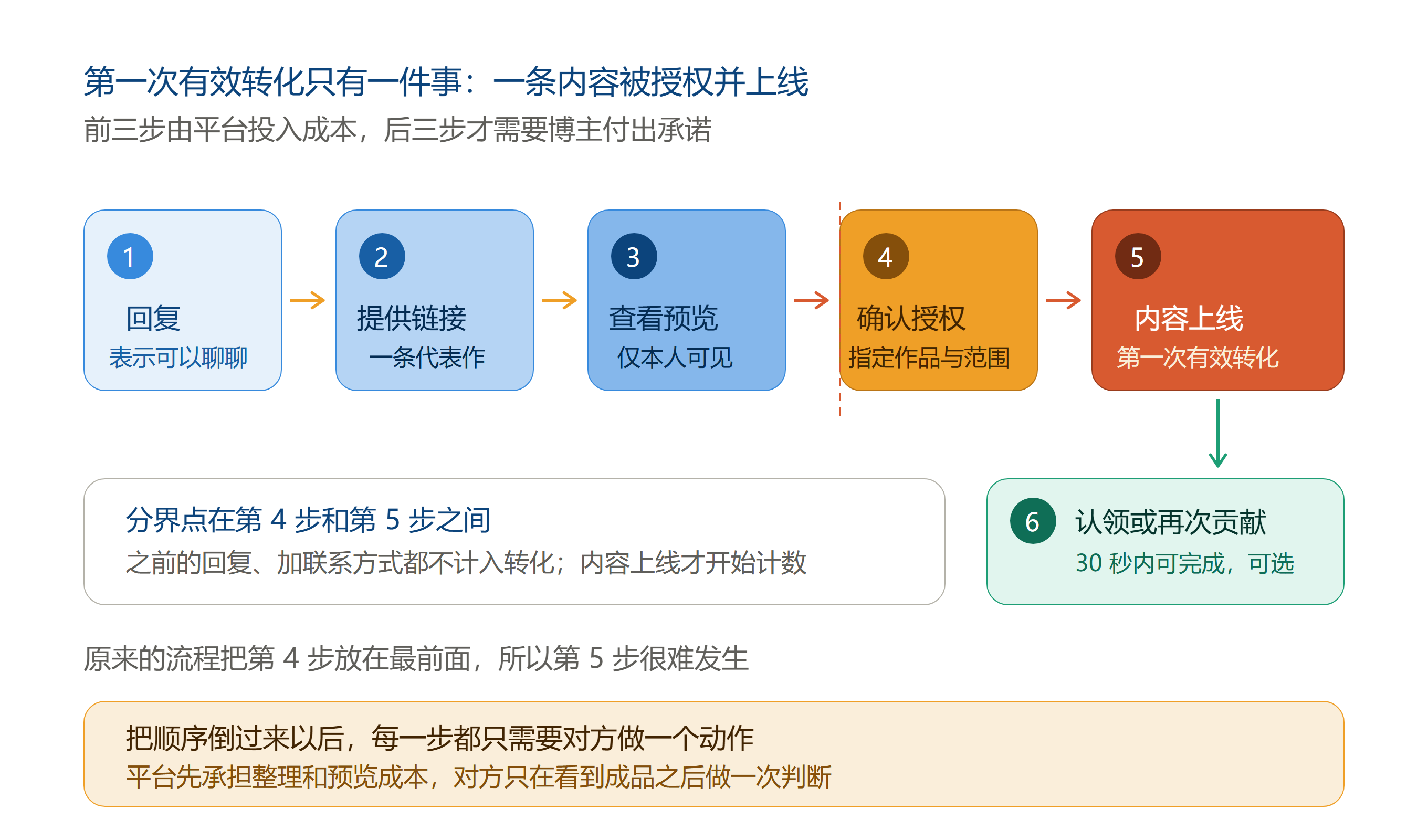 Full chain: Reply, Provide Link, View Preview, Confirm Authorization, Content Live, Claim or Contribute Again. The first three steps are platform investments; only the last three require commitment from the other party.
VII. Step 5: Invite them to claim their profile after publishing
How we did it: After the content went live, we handed the author homepage and shareable cards to the blogger, then invited them to voluntarily claim it. The claiming process only collects necessary info and aims to be done in under 30 seconds; not claiming temporarily doesn't affect the display of already authorized content.
Why it worked: The blogger had already seen the actual result of the content going live. Asking them to claim a homepage at this point feels much more natural than requiring registration before collaboration started—claiming shifted from a prerequisite barrier to an optional follow-up action.
VIII. Step 6: Report only real results
How we did it: Seven days after publication, we reported real page views, original link clicks, and bookmark data, then invited them to provide a second piece of content. If there was no traffic, we said so directly, while asking if the author page, content display, or workflow needed improvement.
Why it worked: Real data builds long-term trust and helps distinguish whether bloggers appreciate the content display or just expect short-term traffic. Lack of data isn't scary; inflating numbers and promising unfulfillable exposure is what hurts future collaborations.
Script for the 7-day feedback: "Here are the actual stats seven days after the content went live. If you think the display style works, we can include a second piece. You still only need to send a link."
IX. Step 7: Segment retention efforts
How we did it: We categorized bloggers into three types: one-time content partners, community members willing to chat, and core co-builders willing to contribute again. For those who don't want to continue after one post, we don't nag repeatedly; only those with clear communication needs enter niche small groups.
Why it worked: Not every blogger who authorizes a repost needs to become a long-term user. Segmentation reduces ineffective maintenance and avoids misjudging a one-off collaboration as a failure.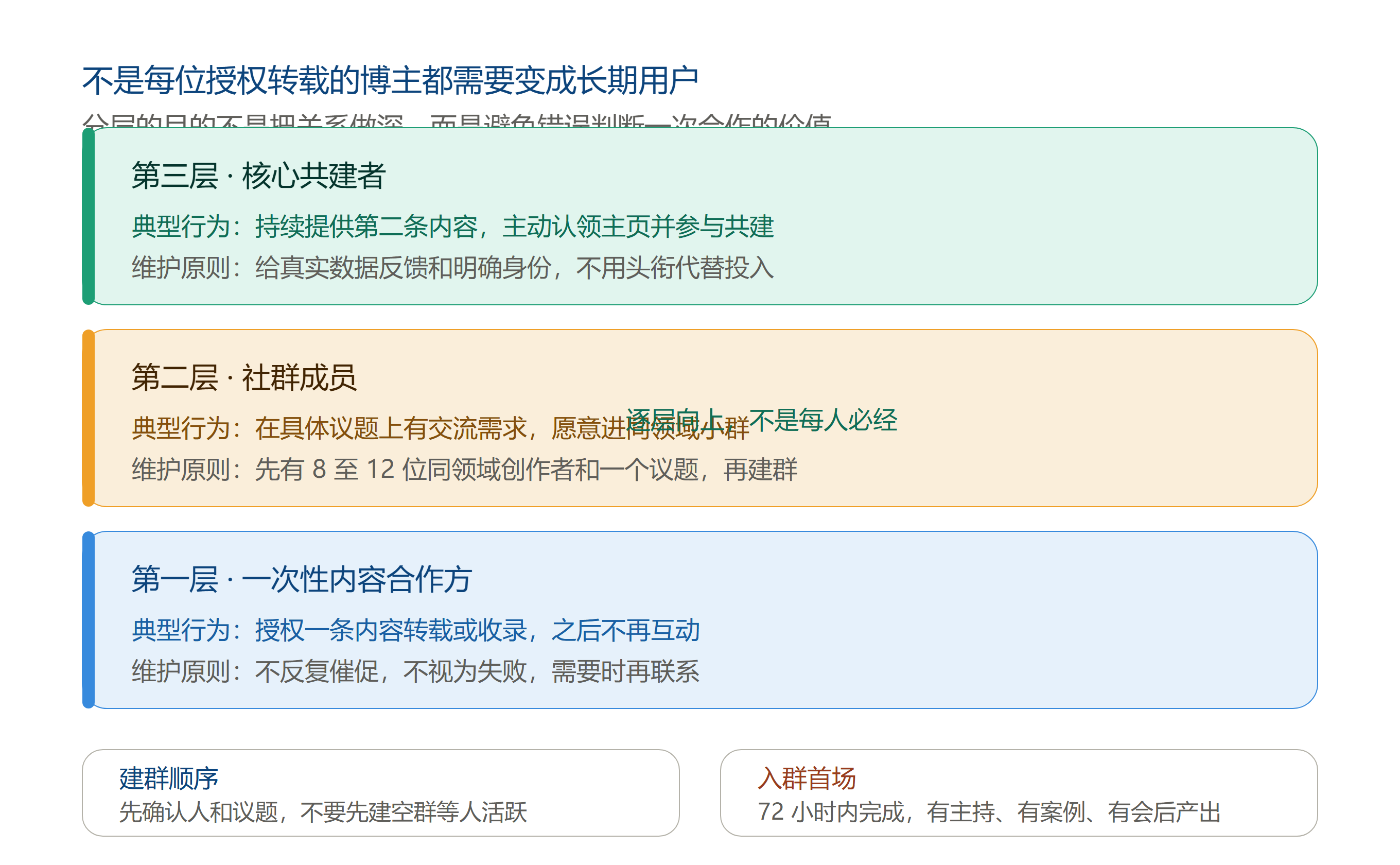 Three-tier relationship ladder: One-time content partners, Community members, Core co-builders. Each tier corresponds to different typical behaviors and maintenance methods.
How to run the community: First, confirm 8–12 creators in the same field and a specific topic, then create the group. Host the first discussion within 72 hours of joining, with a moderator, case studies, and post-meeting outputs. Don't build an empty group and wait for members to activate themselves.
X. Current results: Changes happened, but scaling is premature
After adjusting the process, we finally saw actual change. Several bloggers are now willing to let the platform repost or index their content, and some have proactively expressed interest in joining during communications.
This isn't scaled success yet, nor can we prove anything with ratios. But it at least shows the new method makes it easier for others to take the first step. In a stage where traffic and commercial partnerships are still lacking, getting that "first step" is already the scarcest resource.
XI. A 14-Day Checklist Readers Can Follow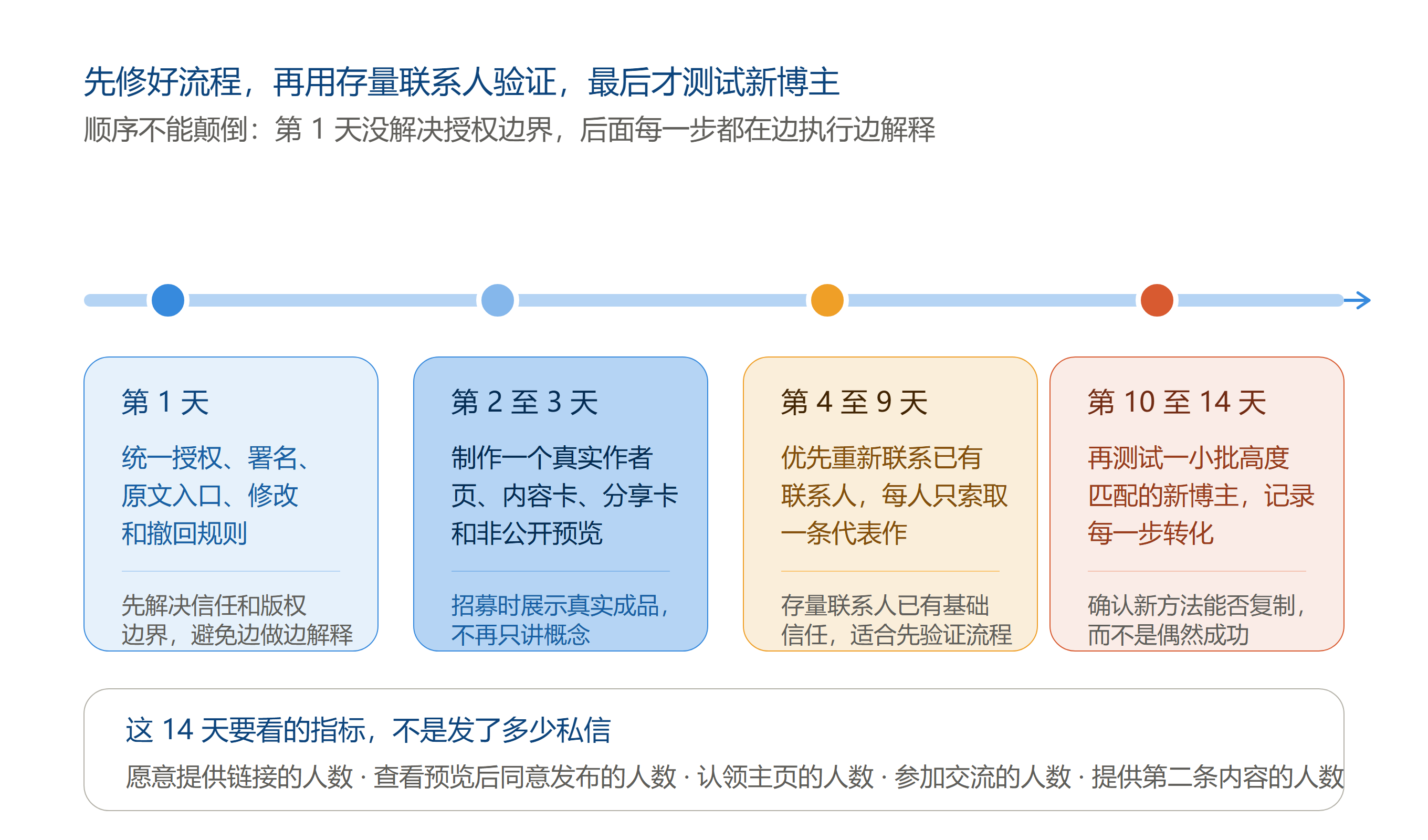 Work focus across four stages: Day 1 unify rules, Days 2–3 create real deliverables, Days 4–9 contact existing leads, Days 10–14 test new bloggers.
| Time | Work to Complete | Why Arrange It This Way |
|---|---|---|
| Day 1 | Unify rules for authorization, attribution, original source entry, modifications, and revocation | Solve trust and copyright boundaries first to avoid explaining while executing |
| Days 2–3 | Create one real author page, content card, share card, and private preview | Show real deliverables when recruiting, stop pitching concepts only |
| Days 4–9 | Prioritize re-contacting existing leads, asking each for only one representative work | Existing leads have baseline trust, suitable for validating the process first |
| Days 10–14 | Test a small batch of highly matched new bloggers, recording conversion at each step | Confirm if the new method is replicable, not just a fluke success |
Metrics to observe: Number of people willing to provide links, number of people agreeing to publish after viewing the preview, number of people claiming homepages, number of people joining discussions, and number of people providing a second piece of content. Don't just count how many DMs were sent or contacts added—those numbers look good but don't indicate any real conversion.
Final Thoughts
The key to recruiting bloggers isn't making the platform sound grander, but enabling them to complete the first real action at low cost and safely.
Before taking the next step, check these three things:
1. Is the first action light enough? Can they complete it in under a minute?
2. Can they see the result first before deciding whether to continue?
3. Are exit and revocation terms clear enough that they can stop anytime?
Where do you get stuck most often when inviting creators, clients, or partners? Feel free to share in the comments.
This article is a practical review of a blogger recruitment project. It involves no real blogger names, accounts, or contact info. Images are tool-generated and for illustrative purposes only.

