 Physix Frontier
Mom asks why my grades improved despite sleeping an hour less daily

My mom asked why my grades went up even though I slept an hour less every day
My mom asked why my grades went up even though I slept an hour less every day
Data World Workshop August 10, 2026
It turned out it wasn't "not studying enough," but "studying too slowly."
01 — I Mistook "Staying Up Late" for Effort, and "Inefficiency" for Talent
During freshman year, I was a standard "time grinder"—spending 12 hours a day in the library, staying up until 1 AM memorizing vocabulary words with a flashlight after lights-out.
My parents thought I was working hard; my roommates thought I was gifted.
But when final exam results came out, I ranked 38th in my major (lower-middle tier). Our major had only 42 people.
Even more painful was that my roommate in the lower bunk, who went to bed punctually at 11 PM every day, ranked 6th.
I started doubting: Were the textbooks too hard? Was my brain inadequate? Or was I actually not as hardworking as I thought?

02 — My Cousin's Words Made Me Think for a Long Time
One night before winter break, I studied until I broke down and complained to my cousin via video call: "I really tried my best, but I still can't learn it."
My cousin paused for a few seconds and asked me one thing: "You're not studying insufficiently; you're studying too slowly."
I froze.
She continued: "Show me that 200+ page 'Macroeconomics' textbook you have."
I flipped through a few pages—it was dense with charts, theorems, and models. I admitted I hadn't truly understood the logic behind those charts; I was just rote memorizing.
"Did you let a desktop AI that understands human language categorize the book's charts by scenario for you?" she asked.
I shook my head.

03 — The First Thing I Asked It to Do: Rearrange Notes by Exam Focus
In the first week of the new semester, I installed that tool.
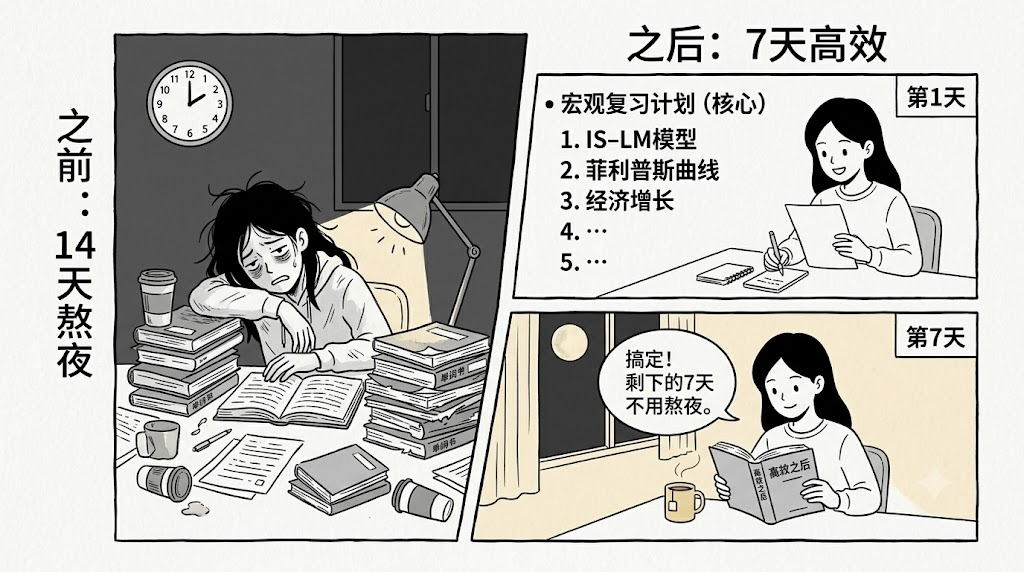
The first thing I said to it was: "This 'Macroeconomics' book has 200 pages, accounting for 60% of the final exam. Please rearrange it according to exam priorities, listing the 5 core modules most likely to appear, along with review priority and estimated time for each module."
In 5 minutes, it returned a rearranged note structure:
- Module 1: IS-LM Model (25% of score, recommended 8 hours)
- Module 2: Phillips Curve (20% of score, recommended 6 hours)
- Module 3: Economic Growth Theory (15% of score, recommended 5 hours)
- ……
I reviewed according to this list, finishing a plan originally meant for 14 days in just 7 days.
For the remaining 7 days, I didn't stay up late for the first time.
04 — Afterwards, I Used These Four Things to Replace "Staying Up Late" with "High Density"
From then on, I started using these four things to replace my previous "inefficient late nights":
- Let it categorize textbook charts by "usage scenario" (e.g., use IS-LM for analyzing central bank policies, use Phillips Curve for judging inflation)
- Snap photos of wrong answers and let it write explanations, provide similar problems, and highlight common pitfalls
- Let it act as my "Study Client"—sending me a daily plan at 8 AM and asking for completion reports at 10 PM
- Auto-generate final review checklists (directly output as PDF / Word)
The biggest impact on me was the "Study Client" aspect.
I used to waver between "what I want to do" and "what I did." Now, someone (not a person, but it) asks me every day: "What did you do between 8-10 AM today? Prove it to me."
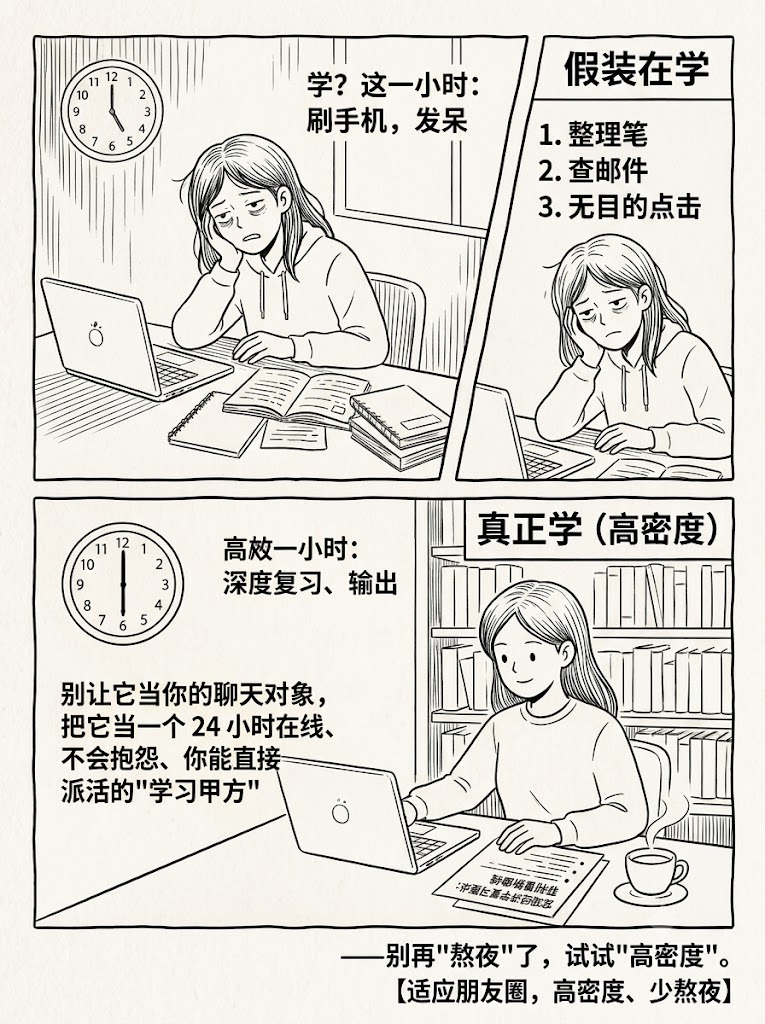
After sticking with it for two weeks, I realized—my perceived "12 hours in the library" actually amounted to only 4.5 hours of effective study time.
05 — On the Day Finals Came Out, I Decided to Study One Hour Less
On the day finals were released, I ranked 9th in my major.
Calling my parents: "Mom, I studied one hour less every day this semester, but my rank went from 38th to 9th."
Mom: "How did you do that?"
I smiled: "Because I replaced 'staying up late' with 'high density.'"
Mom didn't understand. But I knew—
I used to think "Studying" = "Duration." Actually, "Studying" = "Density per unit of time."
After handing off mechanical labor like "finding resources, organizing notes, copying wrong answers, formatting" to it, the 2 hours I freed up daily weren't just time; they were "the 2 hours previously spent on 'pretending to work hard.'"
| Dimension | Last Semester | This Semester | Change |
|---|---|---|---|
| Daily Study Duration | 12h | 10.5h | -1.5h |
| Effective Study Time | 4.5h | 7h | +2.5h |
| Avg. Bedtime | 1:00 AM | 11:30 PM | -1.5h |
| GPA | 3.2 | 3.65 | +0.45 |
| Major Rank | 38/42 | 9/42 | +29 |
06 — For Those of You Also Grinding Time
If you're also deceiving yourself with "staying up late"—
Before thinking "I'll study one more hour" next time, ask yourself first:
What will I do in this hour? Is it "learning" or "pretending to learn"?
When recommending it to friends later, I always say one thing: Don't let it be your chat companion; treat it as a "Study Client" that's online 24/7, never complains, and takes direct assignments.
🏭 Data World Workshop | Helping 10 million ordinary people use AI to get work done
