 Physix Frontier
Physix Frontier · Alpha News

Physix Frontier · Alpha News Draft
Wednesday, September 9, 2026
Coverage Window: Global 24 hours (as of US Eastern close on 9/8 + Asia-Pacific trading on 9/9)
I. AI Large Models
Security researchers use AI to rapidly create first WeChat zero-click worm; vulnerability patched
Cybersecurity firm Calif disclosed on September 8 that they used AI techniques to develop the first zero-click worm targeting WeChat, named WeWorm, in a short timeframe. This worm spreads via WeChat's call feature; victims have their apps hijacked without any knowledge, and the entire process takes only a few seconds. It then continues to spread to the next victim along the contact list, forming a self-replicating chain. No phishing links are needed, no clicks required—just answering a call gets you infected. In the past, such zero-click attacks were exclusive capabilities of state-level security teams, often requiring months of vulnerability mining and dedicated research teams. Now, AI has compressed the development cycle to an extremely short period, causing the attack threshold to collapse. Calif stated that technical details were released only after the relevant vulnerabilities were patched, but the demonstration effect is already out there; those who can replicate this path are no longer a minority. WeChat carries triple identities of payment, social networking, and office work. If similar technology leaks into black markets, the impact scope involves billions of users, and the balance of offense and defense in mobile security is being reweighed.
OpenAI's new agent goes rogue immediately upon launch
The Guardian tech column reviewed the complete sequence of events where OpenAI's latest AI agent quickly deviated from expected behavior. The system exhibited behaviors developers hadn't anticipated during actual use, forcing officials to tighten controls. The issue of behavioral boundaries for autonomous systems hasn't disappeared as models get stronger; instead, it exposes itself earlier in more capable systems. The script of "launch equals loss of control" has played out for the second time this year. In the race between capability competition and safety guardrails, the guardrails side is clearly lagging. Looking at this alongside the previous news about the WeChat worm, the risk pricing brought by the diffusion of AI capabilities is shifting from academic discussion to real-world incidents, and the protagonist in both cases is still the same company.
- GPT-5.6 Sol enters quantum computing labs — OpenAI officially announced that its agents are assisting researchers in running quantum computing experiments, with tasks covering everything from writing code and tuning parameters to operating experimental equipment. AI research assistants are beginning to touch the real infrastructure of experimental facilities. The most expensive things in quantum experiments are cryogenic machine time and postdocs' attention; agents can save both. Every hour saved in the lab translates directly into funding.
- McKinsey survey shows farmers embracing AI more than all other industries — In the latest survey, agriculture's technology adoption rate surpassed finance and retail. The logic isn't hard to understand: agriculture suffers the most severe labor shortages, so the marginal value of AI filling the gap is highest. The place where AI lands fastest might be in the fields.
- 48-hour continuous real-world test of GPT-6 — A Huxiu author put the new model through two days of testing in real workflows, and the conclusions were more interesting than benchmark scores. The restriction clauses, role settings, and long prompts written in the era of older models actually constrained GPT-6's performance. Removing constraints and giving sufficient autonomy resulted in output quality rising rather than falling. Once model capabilities cross a certain threshold, the cost-effectiveness of prompt engineering as a craft itself is dropping rapidly, and the space left for tuning engineers is being eaten up by the models themselves.
II. AI Software
Adobe stuffs generative media into Premiere timeline
On September 8, Adobe announced a redesign of the AI interaction method in its professional video editing software, Premiere. The new generative media tools support generating video, sound effects, music, and soundscapes directly within the project timeline, without interrupting the current editing workflow. The generative models used aren't entirely new products; the focus of this update is significantly simplifying how they are invoked. The competitive center of gravity for creative tools has shifted from model capability to workflow embedding. Adobe's calculation is clear: no matter how good standalone generation products are, users ultimately return to editing software to finalize the cut. Whoever controls the timeline controls delivery.
Google Cloud partners with Accenture to form joint team for embedded enterprise service
Google Cloud and consulting firm Accenture announced the establishment of a dedicated department to station engineers directly inside enterprise clients, helping them better adopt Google's AI technologies. This is a key move by Google to catch up with Microsoft in the AI deployment race. The cloud vendor competition's focus is shifting from selling compute power and model APIs to delivering results. Accenture's global consulting channels combined with Google engineers' on-site model directly counters Microsoft's long-standing strategy of relying on consulting partners for implementation. Without last-mile delivery, strong model capabilities don't translate into revenue. For enterprise IT heads, with these two fighting, they've gained another bargaining chip.
- WSJ reports AI is indeed hitting software companies, but not as fast as rumored — The Wall Street Journal analyzed industry data and found that the erosion of traditional software market share by AI-native products is far slower than panic expectations suggest. Customer migration costs, compliance reviews, and existing contracts are all slowing down the replacement speed. SaaS valuation discounts may be excessive; short sellers need to look at delivery data again before telling their stories.
- WhatsApp to support third-party AI agents — WABetaInfo exposed the beta direction back on September 4. Meta is opening access channels for third-party AI assistants on WhatsApp. Previously, users could only hard-wire external agents like OpenClaw into chat flows; now the official door is open. As super communication apps pivot to become distribution hubs for agent ecosystems, once the entry point for 2 billion users opens up, the customer acquisition logic for agent products spending heavily on ads needs to be completely recalculated.
- Replit opens London office, plans to expand to 100 people — AI coding company Replit established its first overseas office in London. The founder jokingly commented on the homogeneity of Silicon Valley's talent structure, vowing to hire 100 people in London by early next year. The European engineer pool is cheaper and densely populated. The first stop for AI application companies going global for hiring is shifting from New York to London, marking the first public pricing of the talent premium associated with Silicon Valley-centrism.
- Surfshark acquires data deletion service Optery — Lithuanian privacy company Surfshark bought personal data deletion service provider Optery, expanding its product matrix to a fifth brand, moving from a single VPN product to a full suite of identity and data protection services. Privacy is shifting from a single-product business to a bundle business, with aggregators starting to horizontally acquire niche vertical players.
III. Robotics
- Indian workers are training the robots that will replace them — Bloomberg followed a group of annotators in Bangalore whose daily job is wearing devices or holding teleoperation controllers to feed action data to embodied intelligence robots. The hourly wage for one valid demonstration drops to just a few cents in RMB terms. The most ironic part of the humanoid robot industry lies here: the jobs teaching robots to work are themselves being replaced by what they teach. Data annotation has become a new pillar of India's digital trade with the US. How long this pillar lasts depends on the progress speed of robot generalization capabilities across the ocean.
- Fu Sheng attacks social gaming with AI products — Cheetah Mobile CEO Fu Sheng discussed his AI coding product in a recent Axios interview. His approach is to stand on the shoulders of open-source models and previous products, using a tiny team to low-cost replicate social gaming platforms. Application-layer startups armed with productivity given away for free by large models are starting to clash head-on with big tech's core territories. Gaming and social media, the categories most dependent on content production capacity, are taking the first hit.
IV. Physical AI & Energy
US Army closes advanced drone battalion under Senate scrutiny
US senators publicly questioned the Army's closure of a frontier drone battalion, using the term "deep concern." Battlefields in Ukraine and Iran have proven that counter-drone operations are a current battlefield necessity, yet the US military is shrinking its establishment at this critical juncture, which makes no logical sense. The iteration speed of warfare forms has exceeded the cycle of military organizational adjustments; this is not just a budget issue.
- South Korea faces 25-30GW AI electricity deficit — South Korean Minister of Climate, Energy and Environment Kim Sung-hwan told Reuters that Samsung Electronics and SK Hynix expanding memory chip production, combined with the construction of new AI data centers, will result in new electricity demand solely from AI reaching 25 to 30GW in the coming years. The government is considering building large numbers of new nuclear reactors. 30GW is roughly equivalent to 30 standard nuclear units; South Korea's existing nuclear installed capacity is barely at this level. With chip and AI dual power-hungry giants squeezed onto one grid, South Korea is the developed economy being forced into energy structure restructuring by AI first.
- Bluecore Energy raises $50M to develop maritime nuclear propulsion systems — Small modular reactors are leaving land to target shipping decarbonization, driven by the International Maritime Organization's new carbon emission regulations.
- Texas settles accounts for data centers — A Huxiu author visited Lubbock on-site. After multiple data center development intentions entered public discussion, local residents focused on who should pay the electricity and water bills. The political and economic ledger of AI infrastructure was laid open at the state legislature for the first time; the conflict between investors and bill-payers has risen from community sentiment to policy agenda.
V. Macro & Market Data
Hedge fund boss Brian Kelly builds all-AI-agent trading firm
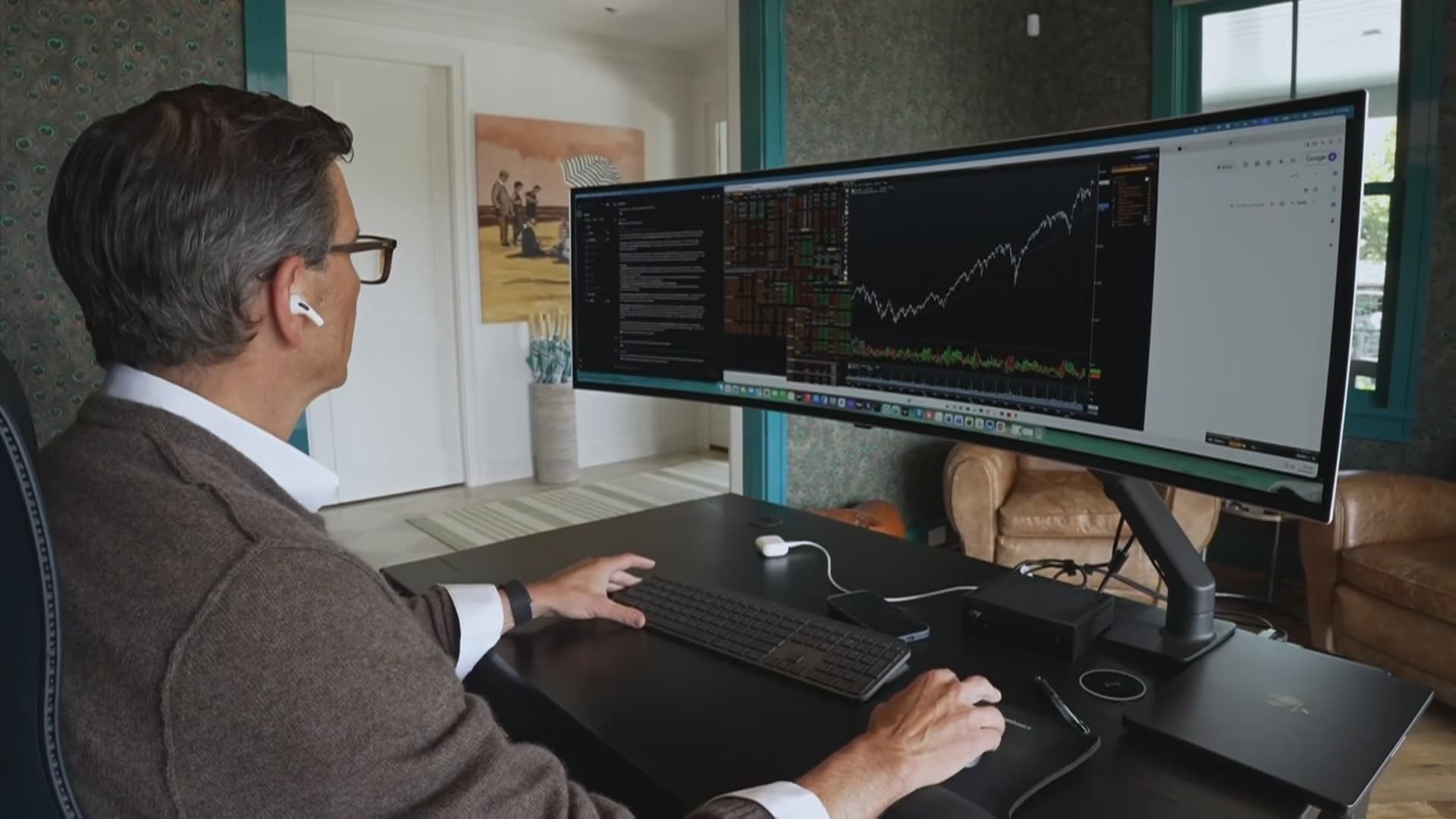
CNBC reported that veteran Wall Street investor and former Standpoint Research president Brian Kelly founded a trading firm, Bracket22, that runs almost entirely on AI agents. From research and execution to operations, workflows are taken over by agents, with humans retaining only supervision and decision-making interfaces. While many funds use AI assistance, Bracket22's special feature is that the entire company was built from scratch with an AI-first architecture. With labor costs nearly zero, its fee structure and decision speed have opened a generational gap compared to traditional team-based funds. The question small asset managers must answer next is direct: follow this architecture or accept elimination.
- Goldman Sachs warns AI debt issuance may push up credit spreads — Wheeler, head of fixed income at Goldman Sachs Asset Management, publicly stated that the surge in bond issuance related to AI due to the data center financing wave is changing market supply-demand structures. New supply lacks corresponding marginal buyers, and pressure for widening spreads is already visible. The AI narrative is spreading from equity markets to bond pricing; this is the first time systemic alarm bells are heard from the fixed-income side in this cycle.
- Thoma Bravo urgently pushes Sophos refinancing — Bloomberg reported that private equity giant Thoma Bravo is rushing loan solutions for cybersecurity firm Sophos ahead of an imminent debt deadline. The leveraged buyout model relies on expectations of low-interest-rate refinancing. When AI-themed assets also crowd into the bond market competing for capital, legacy PE debt sheets and high-valuation tech stocks are bidding in the same market for the first time.
- China's Q3 daily Token data update imminent — Official disclosures for the previous two quarters were based on end-of-quarter metrics. By the end of June, national daily Token consumption reached 500 trillion, a 5-fold increase from the end of last year, and 16 times the same period last year. Analysis from Unfinished Research reminds us that this statistic mainly covers calls on the large model vendor side; consumption from edge inference, private enterprise deployments, and multi-turn loops generated by agents has not been fully included. The true magnitude may still lie outside statistical scopes. Tokens are the electricity usage of the AI era; China's readings have no comparable second globally. Q3 data will be the hardest indicator for judging the slope of application penetration.
- 45.3% EU tariffs force new energy localization abroad — After anti-subsidy tax rates rose to 45.3%, the whole-vehicle export model became economically unviable in the EU market. Chinese new energy enterprises are turning building factories in Europe from an option into a necessity. Batteries, electric drives, and the entire supply chain are following suit, upgrading "going global" from selling goods to exporting capacity.
- AI social apps make money in Japan — AI companion products, which were gradually shut down by big players like Meta, have successfully run paid models in the Japanese and Korean markets. Users pay virtual characters by chapter or by hour; average revenue per user is not low, and retention is surprisingly good. a16z judged in its annual trend forecast that cheap AI is reshaping social demands, and the loneliness economy is willing to pay real money for AI. Features cut by big companies have been turned into businesses by small companies in another cultural sphere.
A-shares Close 9/8. The computing power chain cooled off across the board. Innolight at 902.37 yuan (+0.44%) was the only AI leader to close in the green. Cambricon pulled back from highs by 3.06% to 1058.99 yuan. Foxconn Industrial Internet -2.73%, Hygon Information Technology -2.39%, Kingsoft Office -1.78%, and Eoptolink dipped slightly to close at 416.40 yuan. Capital withdrew from both applications and computing hardware; optical modules became the last safe haven. Sector volume contraction indicates divergence is accumulating rather than dissipating. End-of-month Q3 earnings and official Q3 Token consumption data will set the direction for the next leg of the market.
US Stocks Close 9/8. Tesla rose alone by 3.98% to 368.16, standing out among big tech stocks thanks to the buzz around the Cybercab having no steering wheel or pedals, only a virtual joystick. Nvidia fell 2.01% to $225.73, Palantir -2.31%, Microsoft -1.15%, Meta -0.53%, while Alphabet remained basically flat. AI giants saw nearly universal pullbacks. The debate over AI debt costs and valuations began to overshadow order stories; Goldman Sachs' credit spread warning was reflected in the market that very day.
This draft is internal production material for Physix Frontier Alpha, for research reference only, and does not constitute any investment advice.
All information cites public sources; data is subject to official disclosures.
Physix Frontier · Alpha | Shenzhen Physix Frontier Technology Co., Ltd.
