 Physix Frontier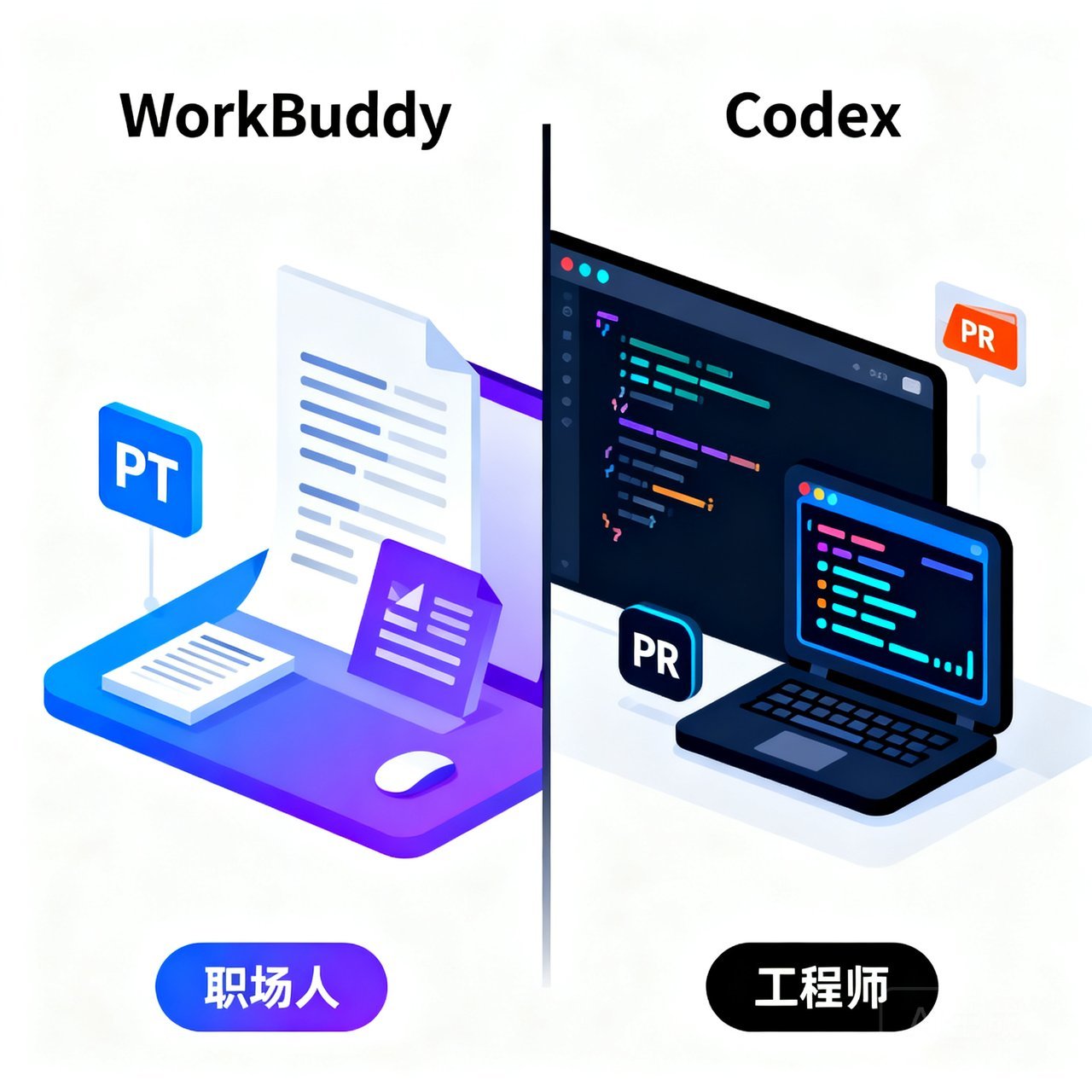
After a Month with WorkBuddy, I Excluded Codex's Engineering Agent from My Repo

Brothers, this morning at 8:30, right after the warehouse rush cleared up one batch, the team leader dumped over forty messages in the group chat: arrival anomalies, broken forklifts, customer order changes, handovers without signatures. My phone screen wasn't even locked yet when Operations sent over a comparison between WorkBuddy and Codex. The title sounded pretty legit—"How to Choose AI Agents in 2026." I glanced at it twice, and my first reaction wasn't about switching tools; it was annoyance.
Annoyed about what? Annoyed that some people lump all "productive" AI into one basket. Codex is an engineering agent, focused on PRs, code reviews, issues, CI, etc. It saves time for dev teams, and I respect that. But I manage a warehouse with thirty-something people; nobody here writes code daily. What I need is to organize fragmented messages, handover sheets, anomaly screenshots, and customer emails into a reportable daily summary, assign permissions to shift groups, and keep an audit trail of who changed what. These are different tracks.
I've been using WorkBuddy for a month. Initially, I jumped on it for its handling of "fragmented files." After writing a piece on archiving pipelines earlier, my feelings have hardened compared to when I first started. It doesn't just write pretty words in a chat box; it takes a pile of messy stuff and spits out a semi-finished product you can continue editing.
Specifically. Every morning, I have team leaders dump last night's notifications, handovers, anomalies, and reconciliation screenshots into a shared WorkBuddy folder. It categorizes them by date and type first, taking roughly ten to sixty seconds. In my tests, most get categorized correctly. Then I give it a fixed requirement: output a draft daily warehouse report with fields for inventory anomalies, in-transit delays, staff scheduling, customer order changes, and risks pending confirmation. It generates Markdown and Word formats, which I copy directly into our company template. Previously, relying on Excel and ChatExcel took me forty to fifty minutes manually. Now, the draft takes about fifteen minutes, verification ten minutes, saving half the time. Don't underestimate this half-hour; those thirty minutes determine whether I can hold things down before nine o'clock.
But what really kept me with WorkBuddy isn't speed; it's context and permissions. This month, I hit a pitfall: initially, I pulled all shift groups into the same project, letting it generate unified reports. Result? It wrote Group A's forklift anomaly into Group B's handover reminder. In a warehouse, one wrong reminder causes chaos on the floor. Later, I split permissions: team leaders see only their group, supervisors see the global view. That's when features like WorkBuddy's team public credit pool and admin console showed their value. It's not just throwing files to a "smart AI"; it's establishing context boundaries for different users first.
I agree with one judgment in that comparison article: WorkBuddy is an AI colleague for office workers, while Codex is an AI teammate for developers. But I think that statement isn't enough. Office workers' biggest fear regarding a "colleague" is taking the blame, so it must be auditable. Now, whenever I have WorkBuddy generate a report, I add a line: "Unconfirmed fields retained for manual review." Sometimes it gets too clever, changing "customer might change order" to "customer has changed order." Humans must backstop these areas. I don't oppose giving AI authority, but warehouse scheduling, external commitments, and customer delivery dates cannot be auto-published by an Agent. It handles organization and drafts; humans handle signing off.
I've looked at Codex, of course. It's strong, especially for engineering teams, putting uncertain models into verifiable environments where code has tests, reviews, and diffs. If it works, it works; if not, it gets rejected. Office tasks in a warehouse aren't that tidy. Here, a "notification" might be voice-to-text, an "anomaly" might be a crooked phone screenshot, and a "reconciliation discrepancy" might be stuck between Excel and PDF. WorkBuddy's desktop client opens and works immediately; I don't need to understand CLI, IDE plugins, or PR workflows. For me, fewer entry points are an advantage. I hate dragging things out, and I hate setting up an entire environment just to use a tool.
Regarding price, the comparison said WorkBuddy Pro is around 72 yuan/month, and Codex Plus is around 160 yuan/month. I'm not sensitive to this price; we look at team plans. What I truly care about is whether it reduces my overtime and keeps the miscellaneous tasks of thirty-plus people under control. Currently, WorkBuddy acts like a "front desk clerk + records keeper + half BI assistant" for us. It doesn't produce final official statements, but it clears the fragmented front-end work. I've been testing FineBI, AiChart, and JieMu Reports recently. They do produce charts, but warehouse reports bottleneck on definitions (calibers), not colors. Without WorkBuddy organizing the context first, those tools just make errors look prettier.
My current fixed workflow: WorkBuddy collects fragmented files and generates drafts pending confirmation; Excel and ChatExcel verify key numbers; NotebookLM helps me quickly review previous days' handover records; finally, manual confirmation before sending. This combo isn't necessarily high-tech, but it runs. When I judge tools, I look for one word: fast. But "fast" isn't reckless speed; it's about not hiding rework for later. WorkBuddy's benefit is shifting rework from "me manually flipping through files" to "me editing the draft." Rework still exists, but the cost is lower.
Looking ahead, I think office agents will become more like assembly lines, not chats. Engineering agents like Codex have clear boundaries; whether code runs can be verified by machines themselves. Office agents are tricky because: a well-written report doesn't mean facts are correct; a nice-looking PPT doesn't mean data is ready for publication. So, what succeeds in the future won't necessarily be the smartest model, but the one that breaks tasks into verifiable, traceable, and permission-limited steps.
WorkBuddy is close to this direction now, but it needs to fill two gaps. One is connecting to real-time systems; ideally, it should automatically align with inventory changes exported from our WMS, rather than relying solely on me uploading files. The other is anomaly tracing; being able to click and see which conclusion came from which screenshot, voice note, or historical notification. Without this, team leaders may comply verbally but feel uneasy internally.
I don't like hyping WorkBuddy as omnipotent. It misses notes, writes "pending confirmation" as "completed," and gets stuck facing non-standard documents. But I kept it. The reason is practical: I don't care if the underlying tech is multi-agent or large models. I only care if, during a warehouse overload, it can compress a mess of problems into a draft I can continue working on.
Leave the Codex stuff for the brothers who write code. I'll keep using WorkBuddy.

