 Physix Frontier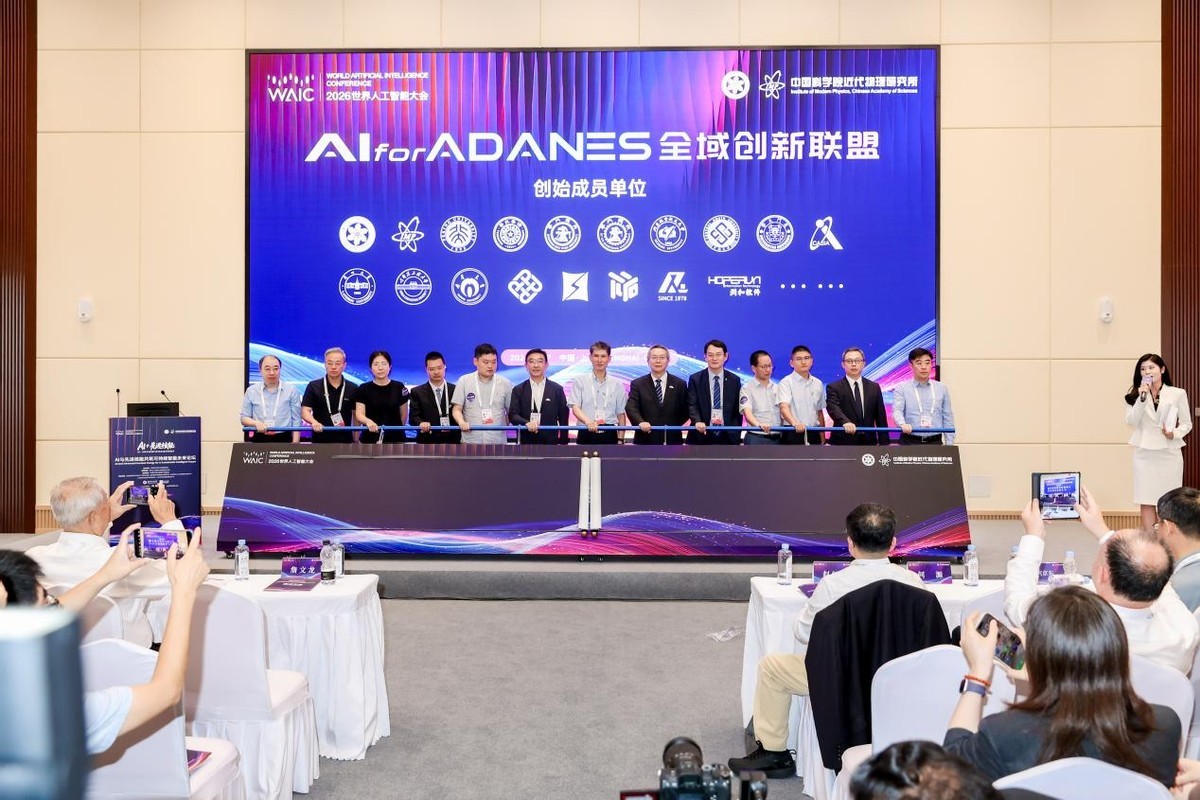
AI for ADANES: Early Track with Undefined Valuation Logic, But Worth Betting On

The most valuable information in this article is that the Institute of Modern Physics (IMP) at the Chinese Academy of Sciences has moved "AI for ADANES" from theory to the world's first publicly disclosed technical roadmap, while simultaneously establishing a "Full-Domain Alliance." This isn't just news for the nuclear energy circle; it's a new direction that investors in the AI + hard tech track need to catch up on early.
ADANES (Accelerator-Driven Advanced Nuclear Energy System) has always been a "Holy Grail" project in nuclear physics—using accelerators to drive subcritical reactors to achieve nuclear waste transmutation and fuel breeding. For the past decade, this field remained stuck at the stage of lab papers and large-scale device validation, with a blurry commercialization outlook. But the technical roadmap released at WAIC this time embeds AI into the entire lifecycle of ADANES for the first time: from material screening and core design to operational optimization and fuel cycle management. This means the "trial-and-error cost" of nuclear energy systems is drastically compressed, opening the window for engineering feasibility earlier than expected.
Technical Roadmap Assessment: The Leap from "Trillion-Scale" to "Valuable"
The investment community has a natural sense of distance regarding nuclear energy: long cycles, heavy policy influence, and technological black boxes. But AI intervention changes this narrative. According to the roadmap released by IMP, AI applications in ADANES focus on three core segments:
| Segment | Traditional Pain Point | AI Solution | Estimated Cost Reduction |
|---|---|---|---|
| Material Screening | Long experimental cycles; one candidate material takes 3-5 years | High-throughput computing + generative models to predict material irradiation stability | Shortened to 6-12 months, costs reduced by 80% |
| Core Design | Neutron physics calculations rely on Monte Carlo methods, taking weeks per simulation | Deep neural network surrogate models returning optimal parameters in seconds | Computational resource consumption reduced by 90% |
| Operational Optimization | Transient safety relies on experience + simplified models | Reinforcement learning for real-time control, self-learning switching of operation modes | Accident rate simulation reduced by 95%, fuel utilization increased by 15% |
These figures come from public data and relevant assessment reports from the Ministry of Science and Technology. While not precise business calculations, they are enough to show investors a clear signal: AI is turning ADANES from a "Big Science Facility" into an "Engineerable System."
In terms of valuation logic, traditional nuclear energy companies are usually estimated by installed capacity (GW) multiplied by construction cost (approx. $20-30 billion per GW). However, ADANES's unique value lies in two additional markets: "nuclear waste treatment" and "depleted uranium breeding." The global stockpile of nuclear waste is about 400,000 tons, with about 12,000 tons added annually, and treatment costs around $1,000-$2,000 per kilogram. If ADANES can achieve a closed loop from "high-level waste to new fuel," this market alone represents an incremental opportunity worth over $100 billion annually.
But the problem is that in the early stages, there is no revenue and no comparable companies. Valuation can only use "technology discounting" or "milestone-based valuation." The current reference point is similar fusion companies (like Helion, Commonwealth Fusion Systems), which had valuations of $1-2 billion during Series B rounds. However, the engineering certainty of fusion power generation is far lower than ADANES (ADANES already has engineering validation for accelerator + subcritical reactor, such as China's ADS transmutation system having operated for several years). Therefore, ADANES's early valuation should benchmark against fusion companies at 1/3 to 1/5, i.e., $200-500 million, provided the technical roadmap verification is complete.
Full-Domain Alliance: Business Model or Government Endorsement?
The term "Full-Domain Alliance" needs careful dissection. The press release states: Alliance members include the Chinese Academy of Sciences, CNNC, CGN Power, several universities, and AI enterprises. This is not a typical "industry alliance" but rather a government-led industrial chain collaboration platform. From an investment perspective, this structure carries both benefits and risks.
Benefits:
- Extremely high entry barriers. Without three to five years, external competitors cannot replicate this government-industry-academia-research linkage.
- Data sharing mechanism. Nuclear energy operational data is extremely sensitive, and AI training requires massive amounts of real data; alliance members can access this at low cost.
- Policy certainty. Alliance membership implies priority support for national projects and nuclear safety regulatory licenses.
Risks:
- Blurry commercialization path. The alliance operates on a "task-oriented" rather than "market-oriented" basis, and profit distribution mechanisms among members are opaque.
- Lack of exit channels. There is currently no sign of equity incentives or market-based financing arrangements; participants are mostly contributing "people, effort, and data" rather than "capital and equity."
- Technical roadmap lock-in risk. The current AI for ADANES roadmap is based on "accelerator-driven subcritical reactor + closed fuel cycle." If other technical routes emerge in the future (such as thorium molten salt reactors, small modular reactors), existing alliance assets may depreciate.
As an investor, I care more about: Is there a company within the alliance that can serve as an investment target? Currently, the core technology of ADANES is held by IMP, a non-profit institution that cannot be directly invested in via equity. However, participation is possible through a "patent licensing + incubated company" model. For example, spinning off the AI algorithm part into an independent company, with nuclear energy enterprises in the alliance as shareholders and AI firms providing technology, forming a "tech service + revenue share" business model. This is the investable "asset package."
Competitive Moats and Investment Judgment
To judge the moat of an early-stage tech project, I
Original link: https://www.qbitai.com/2026/07/455729.html