 Physix Frontier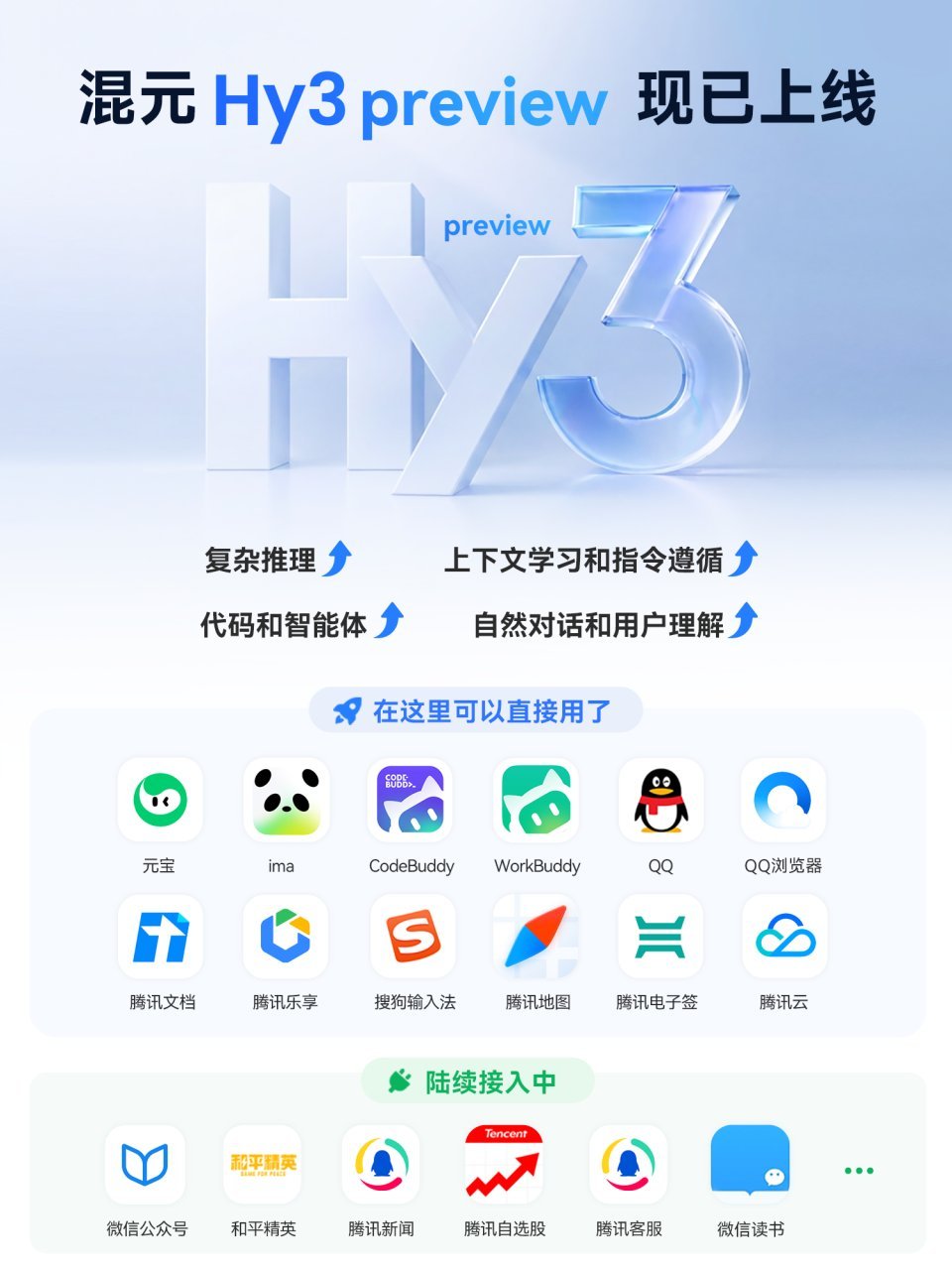
Engineering Signal Behind Extended Free Access: Hy3's Inference Efficiency May Not Yet Clear the '7nm' Hurdle

The most valuable information in this article is: Tencent Hunyuan large model Hy3's free access extension for WorkBuddy and CodeBuddy users until August 5th. On the surface, it looks like a marketing renewal, but from a chip design engineer's perspective, it feels more like an "extension of stress testing" for inference workloads.
I. Why Are WorkBuddy and CodeBuddy the Targets?
WorkBuddy and CodeBuddy are Tencent's internal office and code assistance tools, with highly structured usage scenarios. WorkBuddy involves document summarization and process Q&A, while CodeBuddy involves code completion and review. These two scenarios differ in latency sensitivity but share one commonality: Input/output lengths are relatively controllable.
By comparison, general-purpose conversational models facing consumers have large prompt length fluctuations, and long-context scenarios severely impact VRAM and computational throughput. Internal tool scenarios have more concentrated Token distributions, making it easier to collect workload characteristics and provide data support for subsequent quantized deployment or model pruning.
Key Data Points:
- Free access extended from July 5th (originally two weeks) to August 5th, totaling approximately 30 days of free compute cycle
- Targeted at two specific entry points, not open to all
This indicates Tencent is deliberately controlling inference costs while gathering more granular feedback through targeted users.
II. Hy3 Model Scale and Inference Cost Estimation
According to public information, Hy3 is a significant iteration of the Tencent Hunyuan large model, with estimated parameter sizes between 200B-300B. Deploying a model of this magnitude on mainstream GPU clusters (like H100 or A100) results in considerable energy consumption and cost per inference.
Taking a 200B parameter model as an example, using FP16 precision, a single H100 (80GB HBM) does not have enough VRAM to hold the complete model, requiring tensor parallelism or pipeline parallelism. Common deployment scheme comparisons:
| Scheme | VRAM Requirement | Inference Throughput (First Token Latency) | Cost per 1000 tokens (Est.) |
|---|---|---|---|
| Single Card 8×H100 (FP16) | ~400GB | First token ~300ms | 0.01-0.02 CNY (incl. electricity) |
| Quantized to INT8 | ~200GB | First token ~150ms | 0.005-0.01 CNY |
| Distilled to 70B Sub-model | ~140GB | First token ~80ms | 0.002-0.005 CNY |
Hy3 clearly hasn't switched to the distilled version yet, otherwise they wouldn't use "free access" to test user stickiness. A more reasonable speculation is: Tencent is using this round of free traffic to verify whether the quality loss after INT8 quantization or sparsification deployment is acceptable.
III. Viewing the Extension Through the "Power Wall"
I worked on 5G basebands at Unisoc and deeply understand the impact of the power wall on system design. The power wall for large model inference manifests at two levels:
- Chip Level: A single H100 has a TDP of up to 700W. An 8-card cluster equals 5600W. Adding memory and cooling, one inference node easily exceeds 6kW. Running 24 hours a day, with electricity at 0.6 CNY/kWh, daily electricity cost per node is approx. 86 CNY. Maintaining 10 nodes for 30 days costs 25,800 CNY. This doesn't even account for GPU depreciation.
- System Level: Long-tail requests (like long code generation) can lead to uneven GPU utilization. Actual power might be below peak, but power supply and cooling designs must reserve for peak loads. Extending free access means Tencent is willing to bear this extra electricity cost in exchange for real workload data.
For engineers, this is the most practical motivation: Without real long-tail traffic, you cannot optimize the scheduling strategies of the inference engine. For instance, code completion requests usually involve short prompts + short generations, while WorkBuddy's document summaries might involve long prompts + medium generations. Both occupy VRAM bandwidth in completely different patterns.
Image (Must insert):
IV. Comparing Free Access Strategies of Other LLM Providers
| Provider | Free Access Target | Duration | Main Purpose |
|---|---|---|---|
| Tencent Hy3 | WorkBuddy/CodeBuddy | Extended to Aug 5 | Collect workload features, optimize inference deployment |
| Baidu ERNIE Bot | Some office scenarios | 7 days | User acquisition |
| Alibaba Tongyi Qianwen | Internal developers | 14 days | Test model capability boundaries |
| ByteDance Doubao | General conversation | 30 days | Capture user mindshare |
It's obvious that Tencent's approach is more "pragmatic": Targeting only internal tools, with employees as the user group. This means shorter feedback loops, lower data anonymization costs, and engineers getting direct access to real request logs.
V. Final Revealed Viewpoint
The extension of Hy3's free access is essentially Tencent "catching up" on inference efficiency. 202
Original Link: https://www.ithome.com/0/978/865.htm