 Physix Frontier
My Mom Asked Why My Grades Improved Even Though I Slept Less
My Mom Asked Why My Grades Improved Even Though I Slept Less
My Mom Asked Why My Grades Improved Even Though I Slept Less
MathWorld Workshop August 10, 2026
It turns out it wasn't "not studying enough," but "studying too slowly."
01 — I Mistook "Staying Up Late" for Effort and "Inefficiency" for Talent
In freshman year, I was a standard "time grinder"—spending 12 hours a day in the library, staying up until 1 AM memorizing vocabulary with a flashlight after lights-out.
My parents thought I was working hard; my roommates thought I was gifted.
But when finals grades came out, I ranked 38th in my major (lower-middle). Our major had only 42 students.
More heartbreaking was that my roommate who slept punctually at 11 PM ranked 6th.
I began to doubt: Were the textbooks too hard? Was my brain inadequate? Or was I not as hardworking as I thought?

02 — My Cousin's Words Made Me Think for a Long Time
One night before winter break, I studied until I broke down and complained to my cousin via video call: "I really tried my best, but I still can't learn it."
My cousin paused for a few seconds and asked: "You're not studying too little; you're studying too slowly."
I froze.
She continued: "Show me that 200+ page 'Macroeconomics' textbook."
I flipped through a few pages—it was dense with charts, theorems, and models. I admitted I hadn't truly understood the logic behind those charts; I had just rote-memorized them.
"Did you ask a desktop AI that understands human language to categorize the book's charts by scenario?" she asked.
I shook my head.

03 — The First Thing I Asked It To Do: Reorganize Notes by Exam Priorities
In the first week of the new semester, I installed that tool.
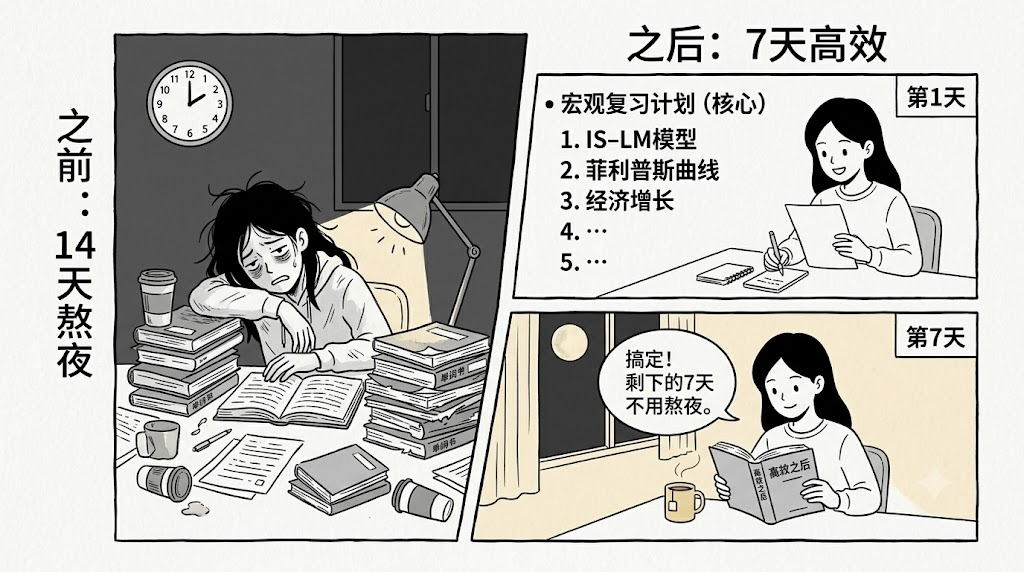
My first command was: "This 'Macroeconomics' book has 200 pages and accounts for 60% of the final exam. Please reorganize it by exam priorities, listing the 5 most likely core modules, along with review priority and estimated time for each."
In 5 minutes, it returned a reorganized note structure:
- Module 1: IS-LM Model (25% weight, suggested 8 hours)
- Module 2: Phillips Curve (20% weight, suggested 6 hours)
- Module 3: Economic Growth Theory (15% weight, suggested 5 hours)
- ...
Following this list, I completed my original 14-day review plan in just 7 days.
For the remaining 7 days, I didn't stay up late for the first time.
04 — Then I Used These Four Things to Replace "Staying Up Late" with "High Density"
Since then, I started using these four methods to replace my previous "inefficient late nights":
- Asked it to categorize textbook charts by "usage scenario" (e.g., use IS-LM for analyzing central bank policy, Phillips Curve for judging inflation)
- Took photos of wrong answers to it, asking for explanations, similar problems, and reminders of common pitfalls
- Let it act as my "study client"—sending me a daily plan at 8 AM and requiring a completion report at 10 PM
- Auto-generated final review checklists (directly exported to PDF / Word)
The biggest impact on me was the "Study Client" role.
I used to waver between "what I want to do" and "what I actually did." Now, someone (not a person, but it) asks me every day: "What did you do between 8 and 10 AM? Prove it to me."
After sticking with it for two weeks, I discovered—my perceived "12 hours in the library" actually contained only 4.5 hours of effective study time.
05 — On Finals Day, I Decided to Study One Hour Less
On the day finals grades were released, I ranked 9th in my major.
Calling my parents: "Mom, this semester I studied one hour less every day, but my rank went from 38th to 9th."
Mom: "How did you do that?"
I smiled: "Because I replaced 'staying up late' with 'high density'."
Mom didn't understand. But I knew—
I used to think "Studying" = "Duration." Actually, "Studying" = "Density per unit of time."
When I handed off mechanical tasks like "finding resources, organizing notes, copying wrong answers, formatting" to it, I freed up not just 2 hours a day, but the "2 hours previously spent on 'pretending to work hard'."