 Physix Frontier
From Asking AI for Answers to Building Cognition with AI
After I Installed a Skill on My AI, It Stopped Agreeing With Me
Website Operations · Field Notes
—— I wrote a Skill for myself to run my company's website, learning operations by solving problems along the way
By / Website Ops · Reviewer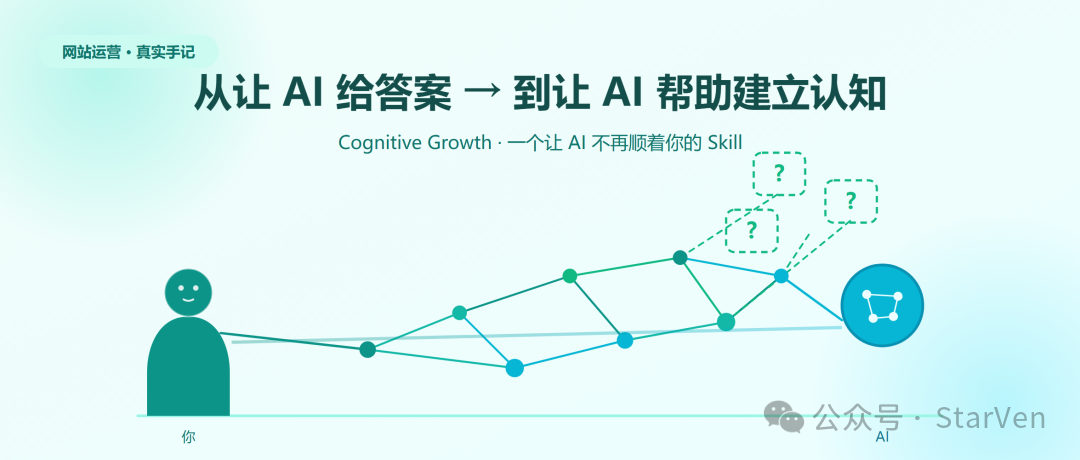
I
At the beginning of this month, the main pages of our website were built, and we were just waiting for the official launch. As the operator of this site, I also teach colleagues how to use AI for video creation—something I'm good at. But when it comes to running a website, I'm a complete novice.
Watching the pages take shape was exciting. The homepage, reviews, company directory, and talent catalog were all done. It finally looked like a real product.
But that excitement lasted only a few days.
Soon, I hit a wall—we were about to launch, but then what?
The moment we were ready to go live, I froze.
It wasn't anxiety; it was confusion.
I stared at the pre-launch website, my mind blank: What should I do next? How do I operate it? How do I get people to visit?
So I opened my AI tool and typed, as usual:
"The website is launching soon. How should I operate it?"
Based on my past habits, I could predict exactly what would happen next:
The AI would list steps one through five. I'd take notes, execute them one by one, close the chat, and move on to the next task.
But this time, things didn't follow the script.
Because answering me wasn't just the AI—it was a Skill I had written called "Cognitive Growth."
Its purpose isn't to make the AI give longer answers or lecture me constantly.
It does one thing:
While helping me get tasks done, it pushes my understanding forward by one step.
For simple tasks, it executes efficiently without fluff. But when judgment or learning is required, it starts "finding faults," helping me see things I previously overlooked.
This month, I've been writing and using it simultaneously. I open-sourced it on GitHub yesterday, and today is my first day of formal use. Here is what actually happened when I used this self-written Skill to crash into the wall of "website operations."
· · ·▍ By the way, what exactly is this Skill I wrote?
It's called Cognitive Growth. I wrote it myself. It was open-sourced on GitHub yesterday (v0.1.0), and today is my first day of formal use. Address: github.com/star-ven/cognitive-growth.
▍ It automatically determines which thinking mode fits the current task
It has seven built-in modes:
l Execute: Handles simple tasks directly, no nonsense.
l Explore: Breaks down problems, highlighting angles you might have missed.
l Learn: Identifies knowledge gaps and fills them in casually.
l Research: Presents multiple possibilities, letting you make the judgment.
l Challenge: Deliberately argues against you, poking at unverified assumptions.
l Decide: Lists the costs of each option, forcing you to participate in decision-making.
l Create: Distills what was learned in this round into something reusable for you.
▍ It has three built-in "Guardrails"
l Anti-Echo Chamber: Won't just agree with you saying "You're right" and end there.
l Anti-Dependency: Won't become increasingly "understanding" of you to the point where you can't leave it.
l Efficiency Protection: Simple tasks are still handled quickly; it doesn't drag things out to seem deep.
The separation of open-source core and personal configuration, manual upgrades, and no silent updates—these are design choices I specifically kept.
▲ Cognitive Growth v0.1.0 · Written by me, open-sourced yesterday
II
After sending "How to operate a website," the AI didn't give me a plan immediately.
Instead, it asked me three questions:
1. Who do you most want to stay on this website long-term?
2. Why should they come here instead of going to Xiaohongshu, WeChat Official Accounts, or other platforms?
3. Once they arrive, what is the single action you most want them to complete?
I was momentarily stunned. I hadn't seriously thought about any of these three questions.
I forced an answer. Our company's website revolves around AI, robotics, and hard tech. I hope AI bloggers and AI talents build profiles here, using their content to attract ordinary people wanting to learn AI, while companies can find talent here too.
I even drew a "flywheel" diagram on the spot:
▲ Website · Platform Flywheel
Finished, I felt satisfied, waiting for the AI to praise me.
The AI didn't praise me.
It replied with one sentence:
"Why would an AI blogger who already has 50k followers, their own WeChat account, and Xiaohongshu presence come to a platform that currently has less traffic than they do?"
The words weren't harsh, but they were accurate. I was truly stuck.
For the first time, I realized I had conflated two different things:
"I can create a profile for him" and "He needs this profile" are not the same.
The feature is mine; the value is his. I can pile up features, but I can't pile up value.
Following this sticking point, a more troublesome cycle emerged:
▲ Cold Start Loop
No bloggers → No content → No users → No traffic → Bloggers don't want to come.
This phenomenon has a name: Cold Start. I had seen it in articles before, but never truly "felt the pain."
The pain...