 Physix Frontier
Children with Ordinary Academic Credentials Should Use AI to Master Real Skills
[AI Taking Jobs · Parent Edition] Children with Ordinary Academic Credentials Should Use AI to Master Real Skills
Degrees determine where a child starts; real skills determine how fast they can go.
Let's speak plainly first: The vast majority of children do not attend 985 or 211 universities.
Undergraduate, associate degree, or vocational school—all paths eventually lead to the same exam hall: job hunting. And in this hall, the first question interviewers ask is never "Which school did you graduate from?" but "What can you do?"
So today, we won't talk about prestigious schools or anxiety. We'll discuss one thing: How can children with ordinary credentials make up for the "skills" gap? The answer might surprise you—using AI well is the most cost-effective path for children with average academic backgrounds.
Why? Let's start with a story from 26 years ago, because the choices parents face today are exactly the same as back then.
I. Twenty-Six Years Ago, Two Types of Parents Made Different Choices
In 2000, China had only 16.9 million internet users (CNNIC data). Out of over 1.2 billion people, barely 1% had touched the internet. A single computer cost over 10,000 yuan, equivalent to an ordinary family's annual income. At that time, most parents' attitude was: "That thing has nothing to do with us; just let the child study hard."
But a small group of parents made different choices: They tightened their belts to sign their kids up for computer classes to learn typing and internet usage, or even learned to browse the web themselves first. Wealthier families bought a computer despite the cost; less affluent ones took their kids to internet cafes on weekends. They were mocked by neighbors as "wasting money" and criticized by elders for "not doing proper business."
Twenty-six years later, the children of these two types of parents may sit in the same classroom—undergraduate, associate, or vocational. Their degrees look similar, but the differences have widened: Children from families that embraced the internet early often have more options—better internship opportunities, broader horizons, and stronger information-gathering abilities. Families that "waited and saw" ended up with children who, despite having degrees, often fell behind due to information and cognitive gaps.
Degrees determine where a child starts, but the ability to use tools effectively is determining how fast they can go.
Today, the same script is playing out. Only this time, it's not "Should we learn computers?" but "Should we teach our children to use AI?"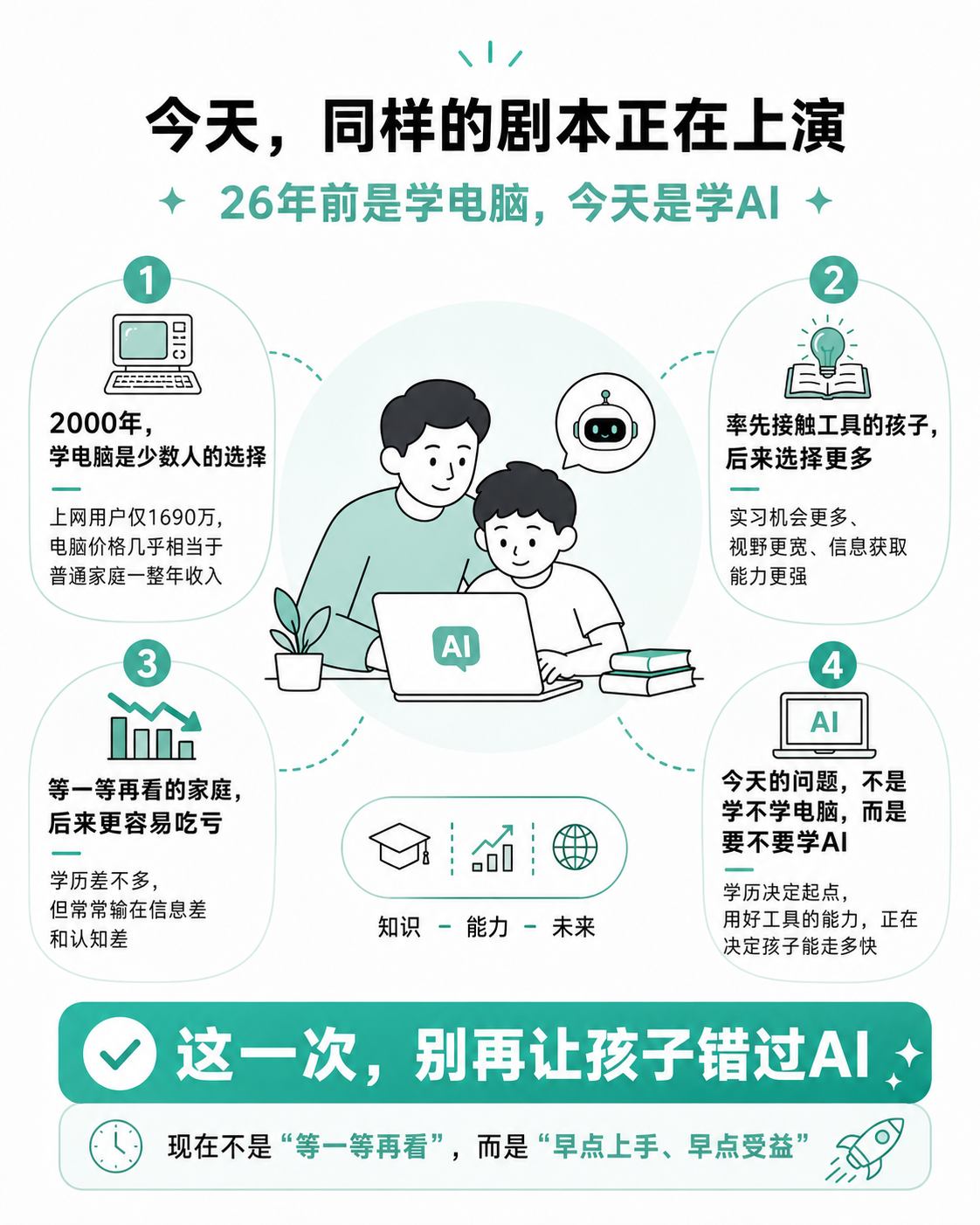
II. Two Families, Two Paths
I've encountered two families born in the 1970s with nearly identical starting points but completely different trajectories (details have been typicalized for privacy, but such families exist around you).
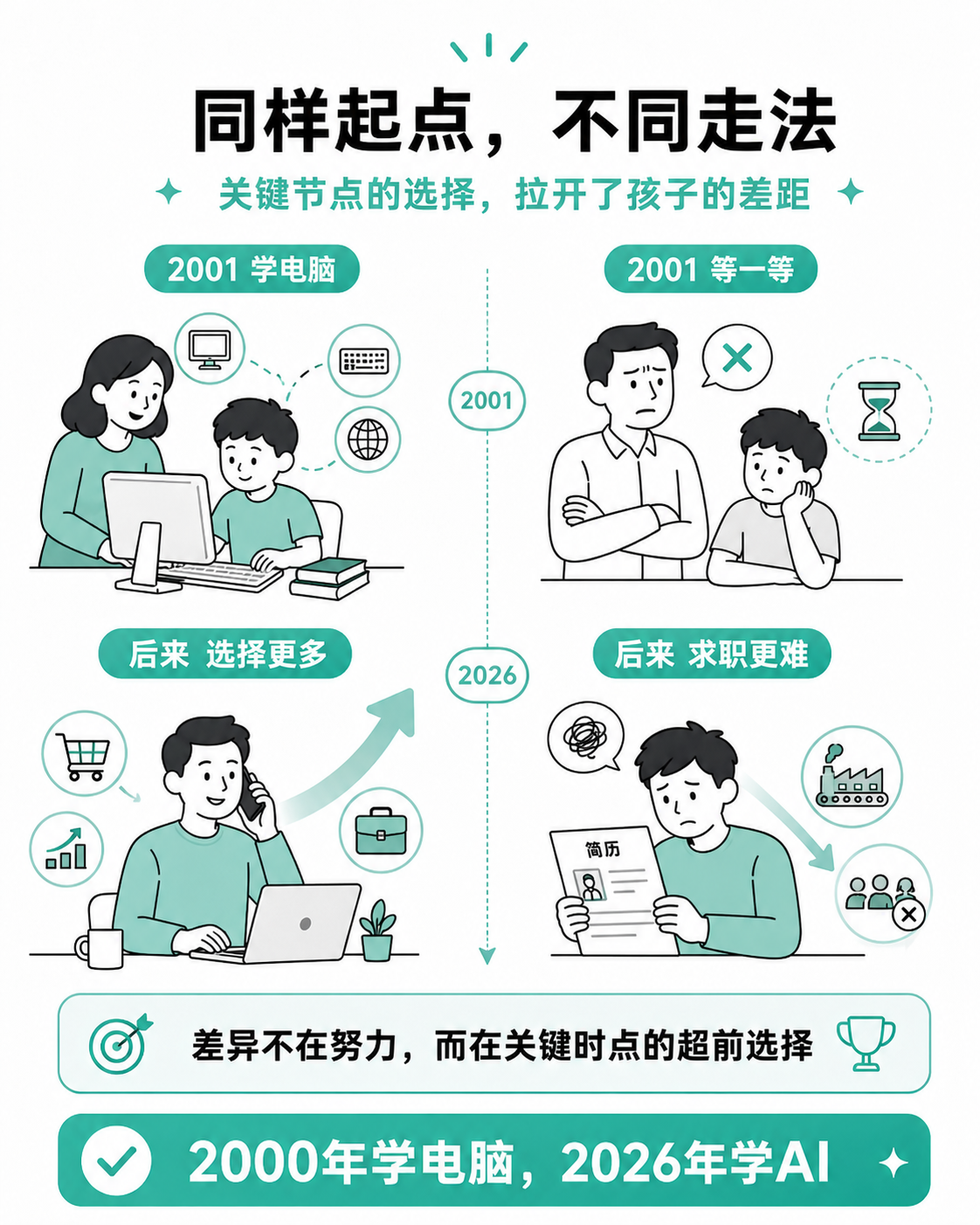
The mother in the first family gritted her teeth in 2001 and paid hundreds of yuan to send her son to a computer class to learn typing and internet usage. Relatives called it "a waste of money; useless for the child." Later, the son chose e-commerce as his major, graduating right as the e-commerce boom hit. Today, he holds a management position in an e-commerce company.
The father in the second family refused colleagues' invitations to join computer classes, saying, "No use learning it." Later, when training courses were everywhere, he said, "Schools will teach it." He remained a warehouse manager in traditional manufacturing. His son is currently a junior in an associate degree program studying electromechanical integration. Before graduating, he's already anxious—many seniors from the same major went straight to assembly lines after graduation, sending dozens of resumes with few interviews.
The difference between these two families isn't effort, but making a "forward-looking" choice at critical junctures. The choice in 2000 was "Learn Computers"; the choice in 2026 is "Learn AI."
III. An Honest Word Specifically for Parents of Associate Degree and Vocational School Students
You might think: "AI is for tech people. My child is in vocational school or getting an associate degree; why learn this?"
Quite the opposite.
In the AI era, repetitive and procedural jobs change first—and these are precisely the main employment directions for many associate and vocational graduates: clerks, customer service, data entry, basic design, production line inspection, warehouse management. Children in these roles actually need to learn to collaborate with AI first.
Both attending associate degree programs—the one who uses AI can perform data analysis, automate reports, and batch-process files; the one who doesn't is still manually matching data in Excel, working overtime until 10 PM.
Both attending vocational school—the one who uses AI can create design drafts, write copy, and manage orders with AI; the one who doesn't is still waiting for step-by-step instruction from mentors, while peers have already been promoted to team leaders.
AI won't level the playing field regarding degrees, but it will widen the gap between those who "can use tools" and those who "cannot." For children with ordinary credentials, this gap is more fatal than the degree gap—but also easier to bridge.
IV. Your Child Is Already Using AI, But Maybe Not Correctly
A July 2026 survey by China Youth Daily (1,032 valid responses) showed that 98.55% of surveyed college students have used AI tools for learning, with assisting homework completion being the core scenario.
In other words, your child is likely already using AI—whether in undergraduate, associate, or vocational programs. The issue isn't "whether to use it," but "whether they are using it correctly."
A June 2026 survey by Huashang Daily involving over a thousand parents highlighted parental dilemma: 52.93% allow occasional AI use for study assistance, but the biggest concern is "children becoming overly dependent on AI and losing independent thinking skills." One parent wrote a poignant comment: "Before, I feared my child's grades were bad; now I fear they don't even get the chance to fail—AI does it for them, so they don't even make mistakes anymore."
This is the real problem: It's not that AI is too strong, but that no one teaches "how to use AI correctly."
Phoenix News July 2026