 Physix Frontier
Does the Li i6 Need Four Lidar Units—Is One on the Roof Not Enough?

Official Li i6 model promotional image; the four-lidar setup refers to the new Mahe package configuration reported by Autohome.
The 2026 Li i6 will begin arriving in showrooms today, with an official launch on October 28. What raises more questions than the larger screen and increased range is the four lidar units it plans to carry.
Autohome reported on October 9, citing official Li information, that the new car's Mahe package includes four lidar units: one main lidar on the roof, one blind-spot lidar on each side of the body, and one blind-spot lidar at the rear. The four are not all crammed onto the roof, nor do they all face forward.
The three added positions shift the ranging focus to the area around the vehicle body. The Li L9 Livis already uses one Hesai ATL-P main lidar plus three FTX blind-spot lidars, with near-range data also used for doors, reversing, and parking. The main lidar and blind-spot lidars are different products, each with its own job.
The Roof Looks Ahead, the Sides Look Close
Lidar emits laser light and measures distance based on the reflected signal. Repeated measurements form a point cloud—a set of points with spatial positions—and the vehicle's software then combines these points with information from other sensors to identify surrounding objects.
A main lidar mounted on the roof must first balance observation distance and detail for the road ahead. But the sides of the body, the rear, and low objects close to the vehicle require observation from different directions. Comparing only how far a single lidar can see makes it hard to answer whether there is an obstacle beside the door.
Hesai's May 18 announcement laid out the L9 Livis configuration clearly. The forward main lidar is one ATL-P, and the other three are FTX—two looking at the vehicle sides and one looking behind. The main lidar and blind-spot lidars use different products.

Hesai's May 18, 2026 announcement confirms the L9 Livis carries four Hesai lidars; this supply disclosure corresponds to the L9, not the new i6.
The FTX product specifications also explain this division of labor. Hesai's official website currently lists two field-of-view versions. The 180° horizontal field-of-view version has a 140° vertical field of view and a stated detection range of 20 meters under 10% reflectivity test conditions.
Field of view can be understood as the angular range a lidar observes at one time. This FTX version covers half a circle horizontally and is also very wide vertically, with a design focus on large-area near-range observation. Looking at 20 meters together with 180° is more useful than emphasizing a single distance number alone.
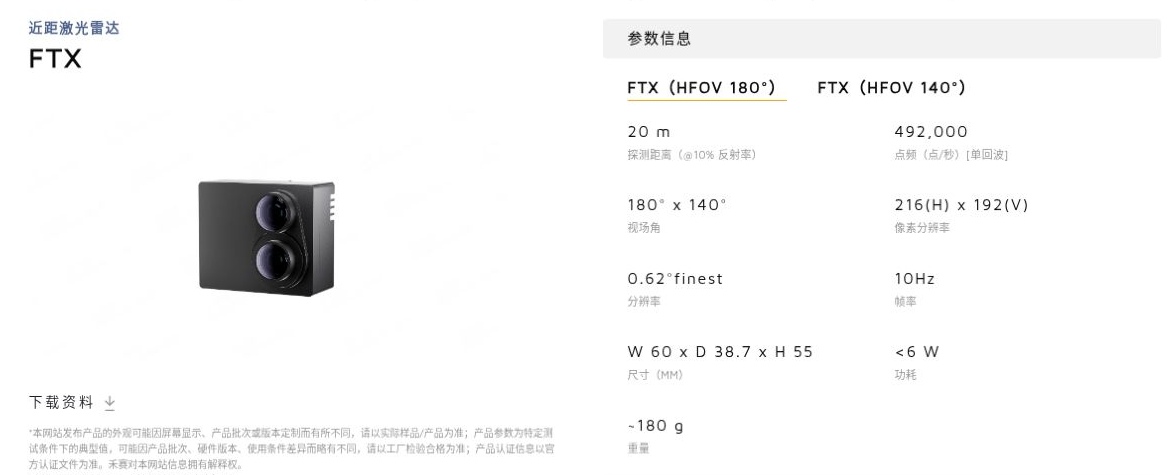
Hesai FTX official website; the image shows the 180° version, where 20 meters corresponds to 10% reflectivity test conditions and does not represent custom specifications for the new i6.
The forward observation handled by the roof main lidar is still retained, while the three blind-spot positions add side and rear information. The value of the four units depends on where each is mounted, what area it covers, and how the software uses that data.
How Are the Three Extra Lidar Units Used?
In the L9 example, Hesai listed uses more specific than the number of lidars. The side FTX units provide side obstacle information for the electric doors; when the vehicle reverses and parks, the FTX units work with UWB high-precision near-field radar to identify suspended obstacles and support the corresponding automatic emergency braking function. UWB here refers to another type of near-field ranging radar.
These functions need to know how close an obstacle is to the vehicle and at what height it sits. The near-range targets mentioned in Hesai's announcement include bollards, pets, and curbstones. Near-range data therefore has its own uses, and it is also needed when the vehicle is moving slowly or parked with a door opening.
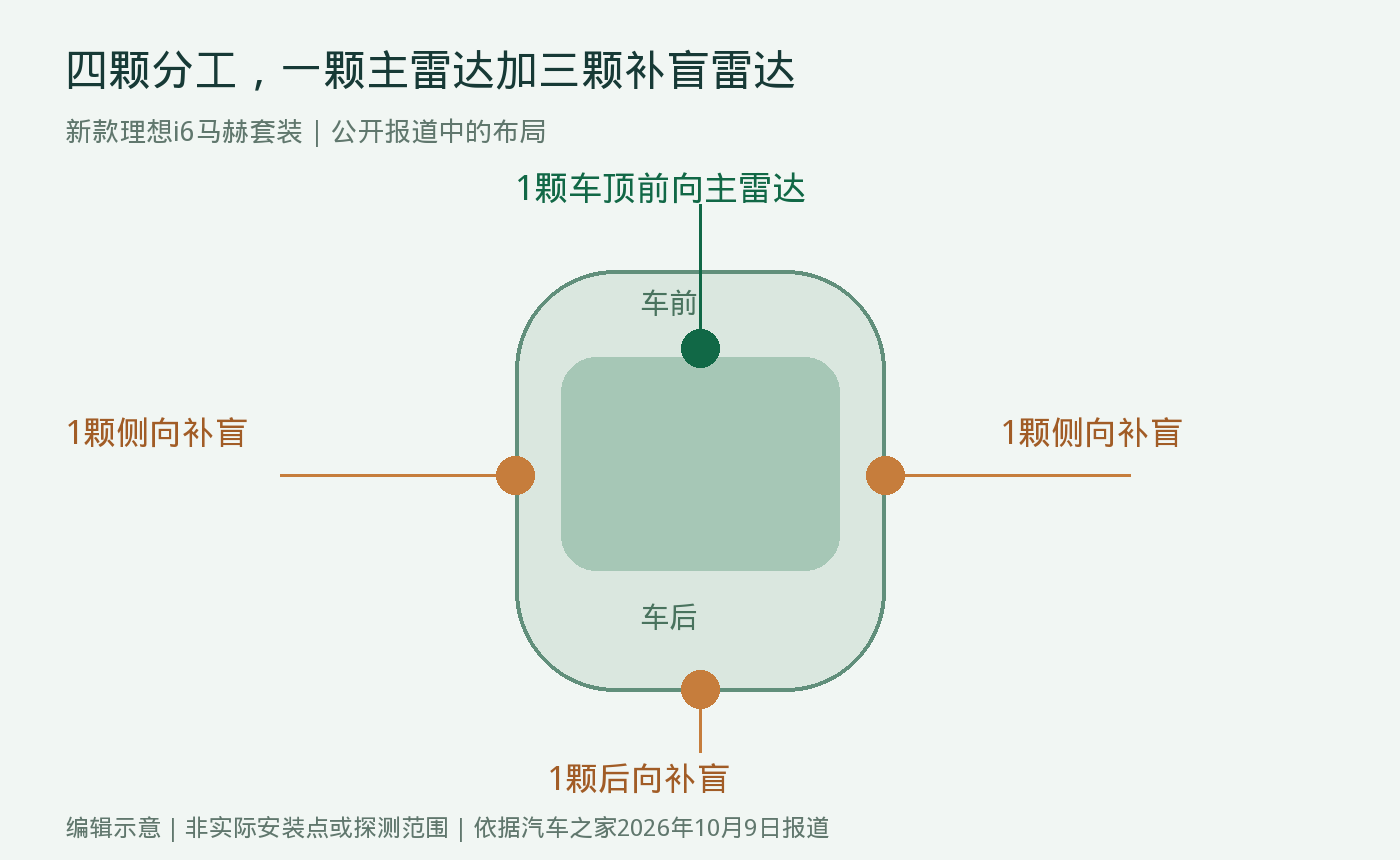
Editor's illustration based on the i6 Mahe package layout. It only indicates the division of labor among the four lidars and does not represent actual mounting points, detection ranges, or coverage areas.
The above functions come from public disclosures about the L9. Information about the new i6's four lidars currently appears in launch previews from media such as Autohome; Li's official website has confirmed the showroom arrival and launch dates, but the lidar models, suppliers, and final configuration list have yet to be fully announced. The L9's door and parking functions and which functions the i6 ultimately enables are two separate matters that need to be confirmed independently.
Lidar provides ranging data, while recognition, decision-making, and braking still need to be completed by the vehicle system. What the addition of three lidars alone already makes clear is that the directions of observation have increased; the specific functions still depend on how the model uses this information.
What Kind of Supply Opportunity Does This Add for Hesai?
The disclosed cooperation between Hesai and Li is the supply of lidar products. The L9 Livis expanded the purchase from one main lidar to one main lidar plus three blind-spot lidars. It added two application directions for the supplier—vehicle side and rear—and also brought a near-range product like the FTX into a mass-production model.
Hesai's latest quarterly results announced on August 18 also mentioned that Li will extend the multi-lidar configuration from the flagship L9 and L8 to the L6, with some models carrying up to four Hesai lidars. Multi-lidar applications are no longer limited to flagship models, but the supply attribution for the new i6 still needs separate confirmation.
The incremental business here also cannot be calculated by simply multiplying four lidars by four. The L9 uses one ATL-P and three FTX units, with different product tasks and specifications. The two sides have not disclosed the purchase unit price for this combination, and existing disclosures are insufficient to calculate how much revenue or profit each vehicle adds for Hesai.
How many lidars a vehicle carries must also be considered together with the actual number of delivered vehicles using this configuration and the prices of different products. The new i6 is still in the launch preview stage, with no delivery volume available for calculation. The combination already disclosed for the L9 Livis gives Hesai three additional near-range blind-spot lidar supply positions beyond the main lidar.