 Physix Frontier
Hesai's Two Sets of Books: Lidar Profitable, New Business Loss-Making
Hesai Technology Series ⑤
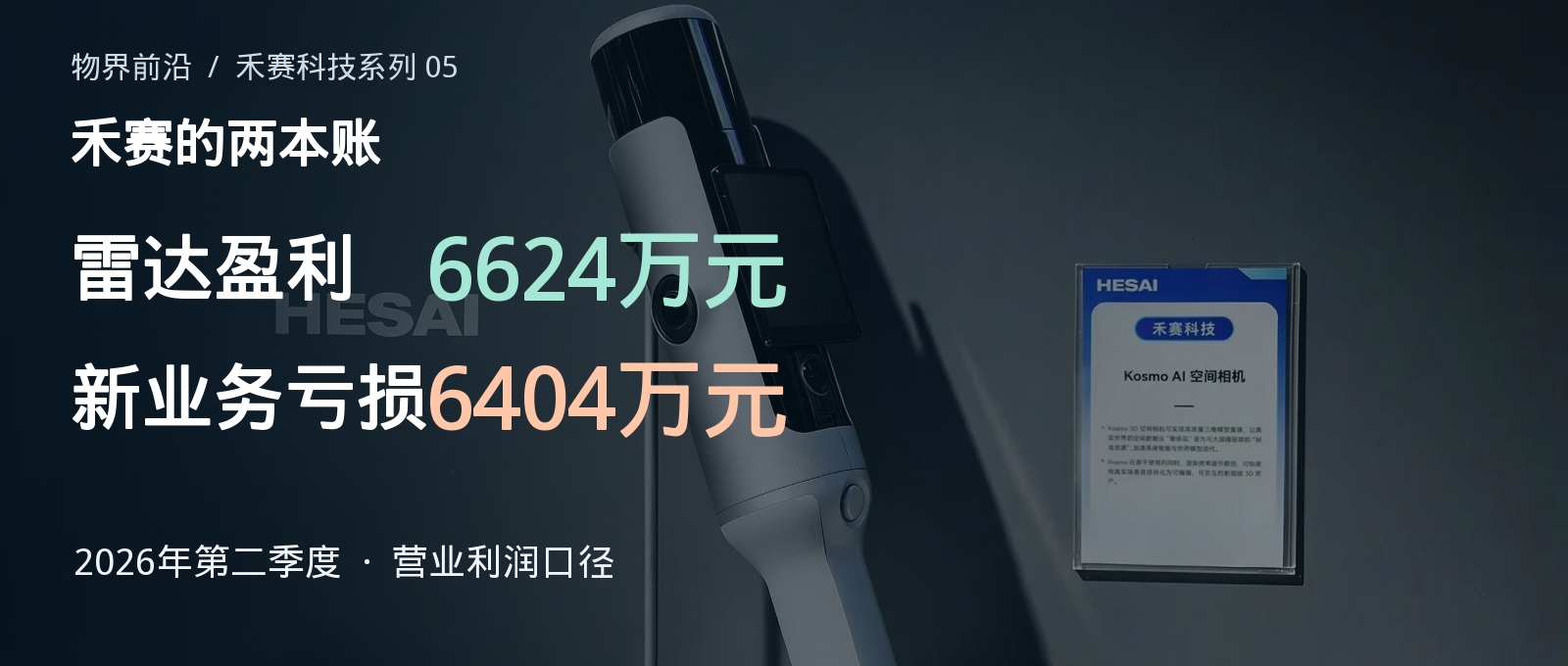
The cover background image is a real photo of the Kosmo exhibit from Hesai's official website announcement on July 18; the profit and loss figures are the Q2 operating profit of the group's two segments.
In the second quarter of 2026, Hesai's lidar business earned 66.24 million yuan in operating profit, while the new business lost 64.04 million yuan. Combined, the group's operating profit was only about 2.2 million yuan. Lidar is still making money, but investment in power modules and Kosmo has clearly changed the profit the company retains.
At the end of September, Sharpa's new robot equipped with Hesai power modules made its debut, and two art venues reconstructed by Kosmo have also been connected to Amap. Products are moving toward customers, yet the income statement still records losses from the startup phase. Only by connecting revenue, R&D, and pricing terms can we see where this batch of new businesses has actually gotten to.
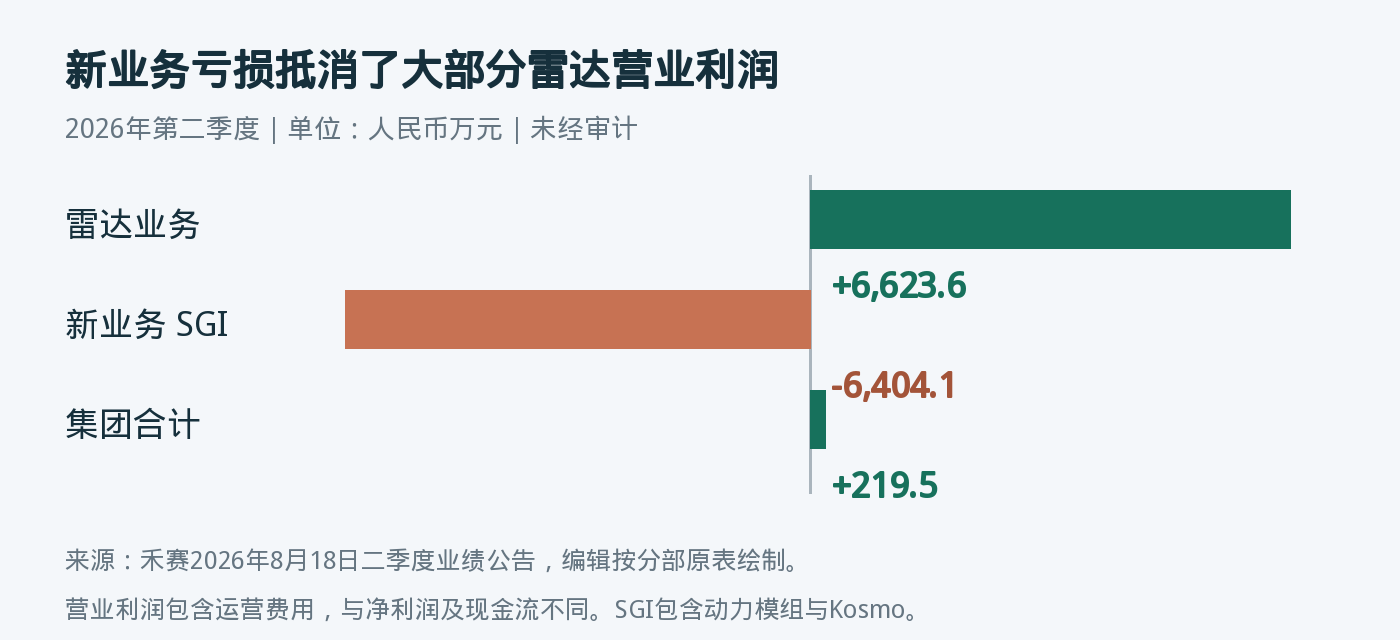
Drawn based on Hesai's unaudited Q2 2026 results dated August 18, 2026. Units are ten thousand yuan, all on an operating profit basis; the chart uses original amounts converted, while the text is rounded.
Lidar profitability and group profitability are two different things
Hesai divides its business into two parts: lidar, and strategic growth initiatives, abbreviated as SGI. The latter currently includes robot power modules and the spatial intelligence platform Kosmo. Lidar sold to cars and robots still belongs to the lidar business; not all robot-related revenue can be counted as new business.
In Q2, lidar revenue was 816 million yuan, operating profit was 66.24 million yuan, and the operating margin was about 8.1%. This has already deducted the segment's operating costs and operating expenses. New business revenue was 44.94 million yuan, while operating costs and operating expenses totaled 109 million yuan, meaning revenue still could not cover the quarter's spending.
Extending to the first half of the year, the lidar business had an operating profit of 108 million yuan, the new business had an operating loss of 115 million yuan, and the group had an operating loss of about 6.37 million yuan. The impact of the new business on profit is no longer just a line in the financial report saying "increased investment."
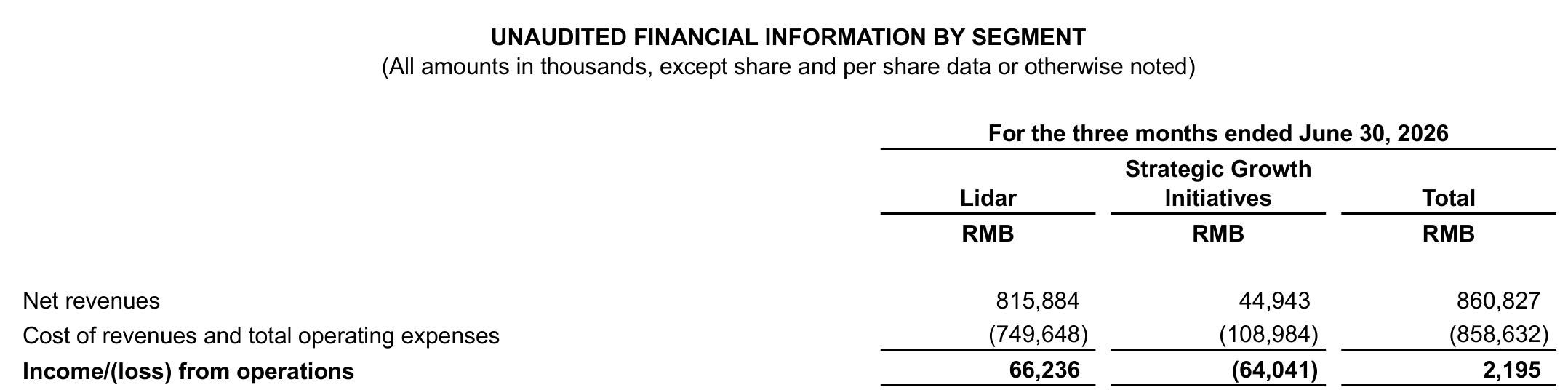
A partial view of the original table in Hesai's unaudited Q2 2026 results announcement, with amounts in thousands of RMB. Lidar is the lidar business, and Strategic Growth Initiatives is the new business.
The group still had 70.55 million yuan in net profit in Q2, because after operating profit there are also items such as interest income, investment gains and losses, and foreign exchange gains and losses. Net profit shows how much the company ultimately earned, while segment operating profit lays out the profit and loss of each type of business separately. The loss here also does not equal cash outflow, and cannot be directly treated as cash "burned" by the new business.
The first to generate revenue is power modules
Power modules are the components that make a robot's fingers, arms, and joints move according to commands. Hesai has already supplied Sharpa, and began recognizing revenue from this business in Q2; the company says that as of the end of June, cumulative deliveries exceeded 10,000 units. This is the number of components, not 10,000 robots.
On September 28, Sharpa launched the D01 robot and W02 dexterous hand at the IROS conference in Pittsburgh, USA. Hesai's September 30 announcement said both products use its power modules. The new products expand the range of things the components can be installed in, but the launch itself did not provide new delivery or revenue figures.
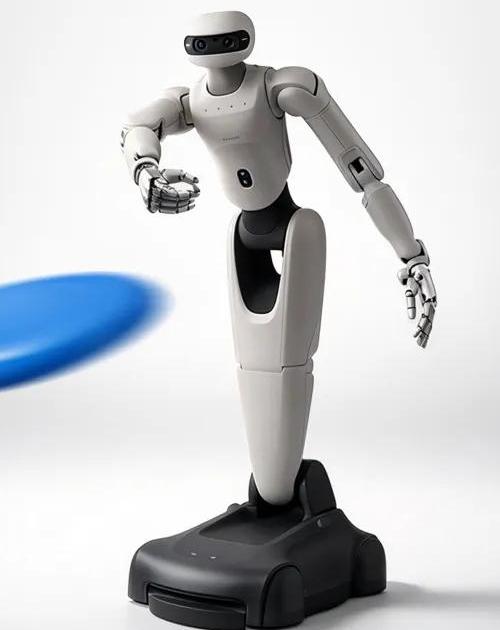
A partial promotional image of the Sharpa D01 product published on Hesai's official website on September 30, 2026, showing the application target of the power modules.
What Sharpa buys is not only components. The framework agreement amended on July 31 also includes procurement of supporting materials, manufacturing and assembly, testing, packaging and delivery, and related support services. Hesai acts both as a component supplier and takes on corresponding manufacturing work, with revenue paid by Sharpa according to specific contracts.
This is also a related-party transaction. Hesai's three co-founders collectively indirectly hold a majority voting interest in Sharpa. Historical transaction amounts under the framework agreement from March 25 to the end of June were about 42 million yuan, including lidar, power modules, and related services, and cannot all be counted as power module revenue, nor can they be directly treated as amounts already collected. The new business already has customers paying, but demand from this type of customer still needs to be understood separately from demand from non-related customers.
The markup has increased, but R&D still has to be borne
This business is charged on a cost-plus basis. The amended agreement raised the cost-plus range for power modules from 40%–50% to 70%–80%, and manufacturing and support services were also changed to 70%–80%. The company explains that as the share of self-developed key components increased, the R&D burden also rose; Q2 R&D expenses for power modules increased by about 29.9% compared with Q1.
A 70% cost markup does not equal a 70% gross margin. Suppose the contract pricing cost is 100 yuan; after a 70% markup, the charge is 170 yuan, and the 70 yuan difference is about 41.2% of the charge, with R&D and other expenses still to be borne. This is only an example to explain the pricing method, and the contract cost scope may not equal the financial report's operating cost, so it cannot be used to calculate the actual gross margin of power modules.
There is still a stretch of R&D and operating expenses between being able to sell products above cost and the entire business already being profitable. In the first half of the year, the new business's operating costs and operating expenses included in the income statement totaled 159 million yuan, with revenue of 44.94 million yuan; these expenses were not further broken down into the respective amounts for power modules and Kosmo. What can currently be determined is that the two combined have not yet covered spending.
The amended agreement also raised the annual cap for related-party transactions in 2026 from 100 million yuan to 300 million yuan, which was approved by independent shareholders on August 28. The cap reserves room for subsequent transactions, while specific sales still require separate contracts, and actual revenue also depends on delivery and recognition; 300 million yuan is not realized revenue.
Kosmo's revenue lags one step behind power modules
Kosmo uses spatial cameras to capture real environments, then reconstructs editable, browsable three-dimensional spaces through algorithms and a cloud platform. Hesai disclosed how it makes money