 Physix Frontier
XPeng YOYO Has Arrived: What Else Does It Want to Earn Besides Selling Cars?
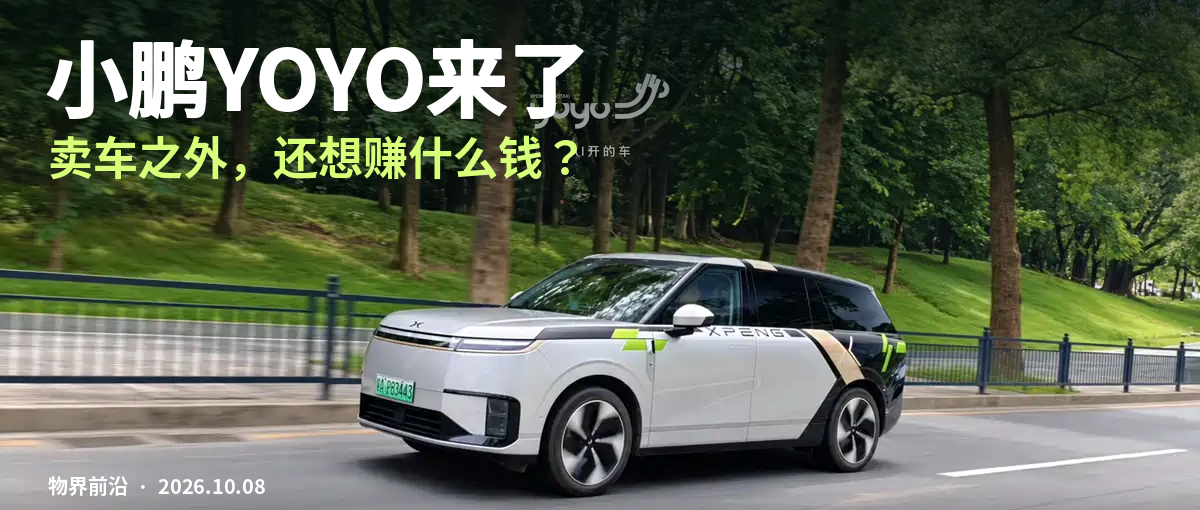
The cover background image comes from a vehicle image on XPeng's official website, reposted by Autohome on October 8.
On October 8, XPeng's autonomous driving taxi got an official name: XPeng Youyou, with the English name XPENG YOYO. The official website and the "XPeng YOYO Autonomous Driving" ride-hailing mini-program also went online today.
Previously, XPeng had already conducted more than 2,200 internal employee test rides. Business head Yuan Tingting said that day that starting today, non-employee users can also place orders with an invitation code. This Robotaxi we are seeing, that is, the autonomous driving taxi, is beginning to open its doors to more people.
XPeng now has its own brand and its own ride-hailing entry point. However, it has already made clear the future division of labor: offline operations will be handed to partners, while it will earn revenue by selling hardware, selling services, and taking commission shares. The official website launched today still calls it an "open Robotaxi technology platform."
This is interesting. What passengers see is a car they can call over, but what XPeng wants to sell to partners is a set of vehicles and an autonomous driving system that can be used to run a mobility business. Only by understanding this division of labor can one clearly see whose money YOYO intends to earn.
How to ride this car now
YOYO still requires an invitation code. After checking the mini-program on October 8, Gasgoo found that users can already select points on the map and enter a destination, but actually calling a car still requires an invitation code to unlock. The service is limited to designated areas in Guangzhou, and other cities such as Beijing and Shanghai have not yet opened.
Moving from internal employee testing to external user experience, the vehicles are beginning to face more people's usage habits. For invited passengers, autonomous driving finally has an entry point where they can place orders themselves. What they care about will also be very direct: where will the car pick me up, how do I get in, and how was the ride.
Currently, this vehicle is built based on the XPeng GX. According to XPeng's introduction, before getting in, passengers can adjust the air conditioning and choose a fragrance in the mini-program, and the interior also has seat massage and an entertainment screen. When the car is sold to a car owner, these are configurations; when it is used to pick up and drop off passengers, they become part of each trip. XPeng has also brought the comfort of this flagship model into the taxi riding experience.
Those more than 2,200 orders refer to the cumulative internal employee test orders previously conducted. They can tell us how many orders the testing has run, but they still cannot calculate how many passengers each vehicle carries per day or how much revenue it can generate. The step forward today is that the group of people experiencing it has expanded.
The car is made by XPeng, but who handles operations?
He Xiaopeng already broke down this business at the Robotaxi all-hands meeting in July. According to a report published by the company on July 14, XPeng plans to sell hardware, sell services, and then take commission shares, while handing offline operations to partners around the world. By the August 24 earnings call, he also proposed plans to cooperate with domestic and international mobility platforms in 2027 to expand the business scale.
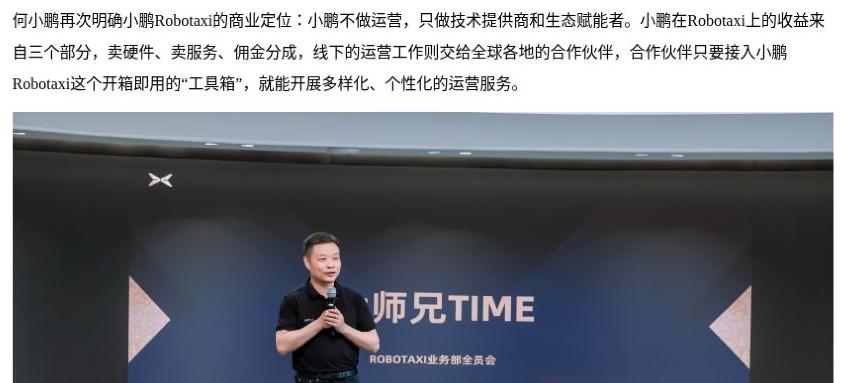
XPeng official website, July 14, 2026. The original text clearly disclosed the revenue arrangement involving hardware, services, and commission sharing, with offline operations handed to partners.
Today's official website is also introducing the product to these partners. The vehicle platform, Turing AI chip, second-generation VLA model, and intelligent manufacturing are placed into the same solution. VLA can be simply understood as a model that lets AI make driving actions based on the road environment it sees. XPeng's idea is that after partners connect to this system, they can then build their own mobility services according to the local market and usage scenarios.
From this perspective, YOYO's mini-program and partner operations are not contradictory. Guangzhou first has an entry point that allows invited users to place orders and ride, validating the entire service. In the future, who will operate the fleet elsewhere will need to be arranged separately with local partners. On today's official page, there are both cabin features for passengers to see and technology introductions for partners to see.
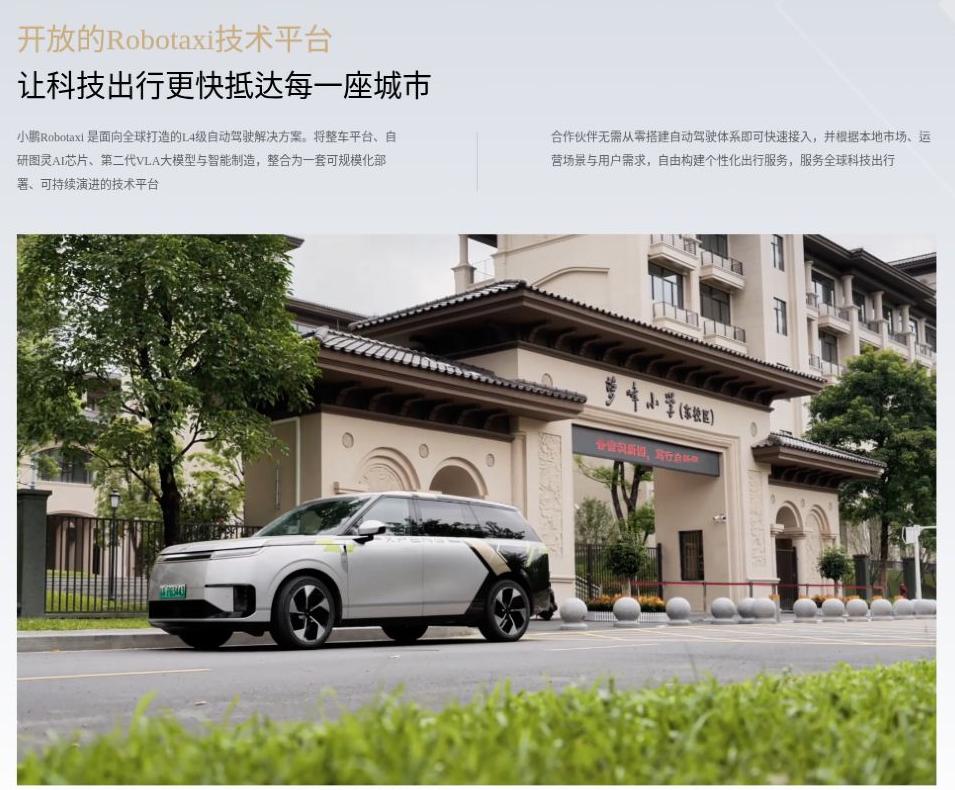
Captured from XPeng's Robotaxi official website on October 8, 2026. The new page still centers on the positioning of an open technology platform and partner access; the image is a company display.
Once the car is sold, XPeng can obtain hardware sales revenue; as the car continues to carry passengers, service fees and commission sharing may also bring follow-up revenue. This is the profit approach it has disclosed. As for how service fees are calculated, what the revenue-sharing ratio is, and who bears which costs, XPeng has not yet announced specific contract terms, and these arrangements cannot currently be treated as money already earned.
For this business to continue, XPeng must make two types of people willing to use it. Passengers must be willing to place orders and ride, and operating partners must be willing to use it to run their business. What the latter buys also includes an autonomous driving system, and whether it can be used locally will directly affect whether they are willing to cooperate.
First get the service running in Guangzhou
XPeng's progress this year already has several clear milestones. On May 18, the first mass-produced Robotaxi vehicle rolled off the line; in July, the company announced full-process internal testing covering online ordering, vehicle pickup, and trip completion; in August, it obtained a remote testing permit in Guangzhou.
This permit allows vehicles to conduct road testing without safety officers in the vehicle on designated level one, two, and three test roads, with the specific scope written in XPeng's September 1 investor announcement. A permit on test roads and passenger-facing driverless operations should be viewed separately. The target time for driverless passenger operations proposed by He Xiaopeng at the August earnings call is still 2027.
XPeng also wants to bring Guangzhou's experience to other cities. According to the company's technology introduction, Robotaxi does not rely on lidar and high-precision maps, and reuses the model, data, and software capabilities of mass-produced passenger vehicles. A high-precision map is a map that records road details in fine detail. Reducing reliance on it is a technical path through which XPeng hopes to improve cross-city deployment efficiency.
This also explains why the official website repeatedly mentions changing cities. If XPeng wants to provide the system to global partners, it must consider how it will be used in another city. The company believes this route is conducive to rapid deployment, but how much time and cost can be saved in each city has not yet been disclosed through actual test results.
For now, YOYO is first expanding the experience range in Guangzhou, letting more passengers test this service through their own trips. The timeline given on the official website