 Physix Frontier
MiniMax Flash Goes After the Front End
MiniMax Flash Goes After the Front End
Motion works attract attention, but commercial value still depends on continuous payment October 3, 2026
Pixel wizards, cocktail animations, interactive web pages—MiniMax's new model is using a batch of visible works to compete for developer attention.
M3.1-Flash-Preview, launched just before National Day, has recently become a new object of media comparison with Claude Opus 5.5. The completeness of some front-end cases is surprising, and it has also sparked new discussion about how much complex work Flash models can handle.
For investors, the question worth asking is: can these works lead to daily use and convert into continuous payment?
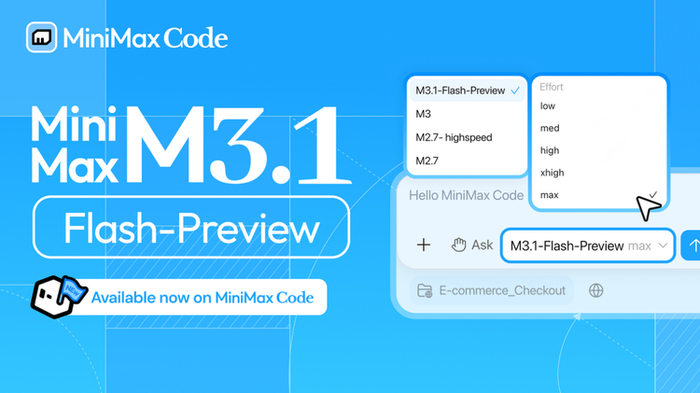
M3.1-Flash-Preview release image Source: report published by Sina Finance
01.
Front-End Works Challenge Flagships
Look at the Effect First, Then the Use Case
Zhidongxi's hands-on test covered motion effects, cocktail instruction, and pixel wizards. M3.1-Flash can fill in design details, but there were also issues with unreasonable container proportions. The look of a single set of works is close, but that still cannot lead to the conclusion that overall capability is on par.

Pixel wizard in a front-end case Source: Zhidongxi, republished by Tech Corner
The commercial appeal of front-end capability is very direct. Marketing teams need campaign pages, designers need interactive prototypes; if the model can reduce repeated revisions from draft to demo, it has a chance to enter high-frequency work.
The official case also showed an interactive model of the Temple of Heaven made from a reference photo. For such tasks, the model needs to translate the spatial relationships it sees into code and check the visuals during execution. If visual understanding and code modification can connect, front-end tools have a better chance of handling customers' own materials rather than relying only on fixed templates.
Whether it can be used in formal projects also depends on whether the page works properly on mobile, whether buttons are effective, and whether it can still be maintained after the customer changes requirements. Visual completeness is the entry point; stable delivery determines usage frequency.
02.
Financial Tasks Are Closer to Business
Research Tools Still Need Manual Verification
A hands-on test published by Sina Finance gave MiniMax's annual report and interim report to the model and asked it to build a local performance verification tool. The tester said the model completed document ingestion, queries with source page numbers, and attempted to explain changes in different loss measures.

The potential value of such tools is to let researchers locate numbers faster, verify definitions, and produce visual materials. Whether it can be adopted by institutions depends on whether source data can be traced, whether formulas are correct, and whether the same process can handle more companies' financial reports.
A successful case provides direction, but there is still a gap before it becomes a reliable research product. The time saved on searching must be offset by the time spent on manual review and correcting errors. Financial tasks especially need to distinguish between organizing materials and final judgment.
03.
Beyond Output Speed
The Cost of Qualified Tasks Is More Critical
Work from Creator Alliance, reviewed and approved.