 Physix Frontier
100 Robots Enter Stores to Sell Pots
100 Robots Enter Stores to Sell Pots
What I Care About More Is the Math Behind 2.23 Million Yuan
I am willing to applaud robots entering stores, but I will not conclude that the business model has been proven just because of three days of sales figures. Rather than whether it can sell pots, what I care about more is: after the novelty wears off, will the boss still be willing to keep paying?
01 First, let's be clear about this deployment
Starting September 28, 100 AgiBot Lingxi X2 units successively entered 100 ASD stores nationwide. Wearing chef hats and aprons, they got a new name: Aibao. Wenhui Bao disclosed that cumulative sales during the three-day soft opening were about 2.23 million yuan, with average sales performance across the hundred stores growing 39%.[1]
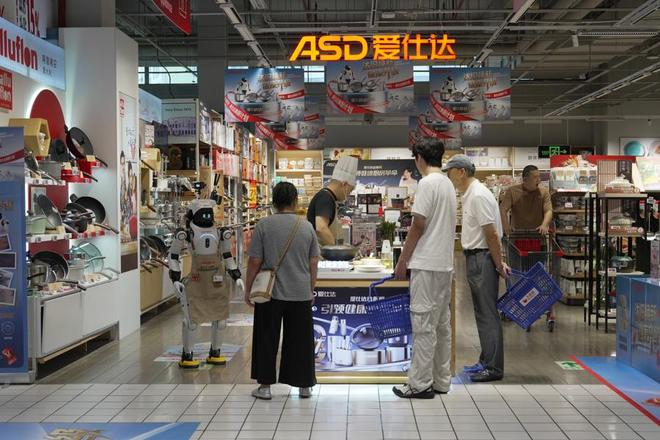
Robots and human staff receiving customers at an ASD store. Source: Wenhui Bao / Sina.
Their work has clear boundaries: greeting, asking about needs, explaining products, recommending cookware, and leading the way; when it comes to checkout and other steps, it is handed back to human staff. So-called robot pot-selling is actually a human-machine collaborative shopping guide process, and the 2.23 million yuan cannot be understood as sales completed independently by robots.[2]
What I find valuable is that it has started recommending products based on the customer's household size, cooking habits, and budget. This requires AI to apply product knowledge to specific needs, and whether the recommendations are reliable finally has a test in the form of transactions and after-sales service.
02 Sales look impressive, but profit still needs separate calculation
2.23 million yuan is sales, not profit; the 39% average growth also cannot be directly treated as the robot's net contribution. Current public information does not provide control stores, the statistical base period, or complete costs, and National Day foot traffic, promotions, and the novelty effect could all affect the results.
If I were a store owner, I would keep three sets of data: changes in conversion rates at comparable stores, incremental gross profit after deducting returns and discounts, and monthly deployment and maintenance costs. The last item also needs to include leasing or depreciation, product knowledge updates, troubleshooting, and the time staff spend taking over service.
I would extend the observation period and compare holidays with ordinary weekdays. How much gross profit the extra pots sold bring, minus these additional costs, is what comes closest to the robot's economic value. Comparing only sales figures makes it easy to mistake excitement for profitability.
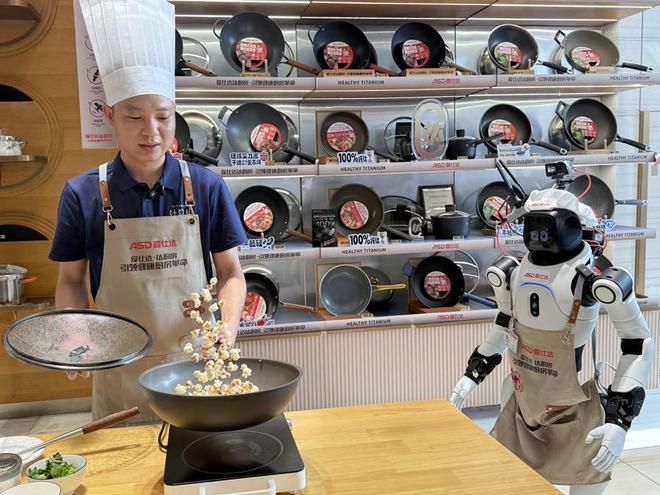
A human chef demonstrates cooking while a robot participates in explanation and interaction. Source: Wenhui Bao / Sina.
I would also ask a question that is easy to overlook: could these tasks be done with a screen plus a voice assistant? If the added benefit brought by humanoid form and mobility cannot outweigh the higher hardware and maintenance costs, stores may not necessarily need to buy robots.
The technical challenges are also very concrete: can it hear clearly amid mall noise, can it avoid obstacles in narrow aisles between shelves, can it answer correctly after discount changes. The project went from single-store testing to a hundred stores, going through more than half a year of refinement. This reminds me that beyond model capability, store knowledge and on-site adaptation also take time.[1]
03 What I look forward to is the next renewal
This attempt is more interesting when placed in the context of the industry. According to IDC, global humanoid robot shipments in the first half of 2026 were nearly 25,000 units, up 432.1% year-over-year; scientific research and education, performance and display, and government data collection centers together accounted for 69%, down from 83.8% for the full year of 2025. This is a change in application structure and cannot be simplified into "69% of robots only know how to perform."[3]
The cooperation between ASD and AgiBot also extends to procurement, contract manufacturing, and the supply chain. The stores serve as a testing ground and may also help both sides find new business entry points, but how many orders the framework cooperation can generate still depends on actual delivery.[4]

On July 6, 2026, ASD and AgiBot signed a strategic cooperation agreement. Source: Cailian Press.
Financially, the distinctions must be even clearer. ASD disclosed on September 6 that the embodied intelligence cooperation project had generated only 137,200 yuan in sales revenue at that time. That predates this round of hundred-store deployment and belongs to robot business revenue; the 2.23 million yuan, by contrast, is store sales from selling pots and cannot be used to prove a surge in robot business revenue.[5]
My feeling about this deployment is expectation, and I also want to ask more about what comes next. The AI industry is already very good at demonstrating capabilities; what it needs to prove next is: can delivery be replicated, can maintenance be afforded, and will customers be willing to renew after using it. The value of a hundred stores lies in leaving behind reviewable data so that the next deployment involves less trial and error.
If half a year later there are still stores proactively increasing investment, that would convince me more than the sales figures from the debut.
What do you think a robot shopping guide should do best first: attract foot traffic, recommend products, or reduce repetitive work for staff?
Materials and image sources (click to open)
[1] Wenhui Bao | Hundred-store soft opening and on-site operation (October 2)
[2] AgiBot official | 100 X2 units enter 100 stores (September 28)
Work from Creator Alliance, reviewed and approved.