 Physix Frontier
After Hesai's Sales Doubled, Who Is Contributing the Growth?
Hesai Technology Series ②
October 7, 2026

Official image of the Hesai-Li Auto partnership announcement, November 11, 2025.
Hesai sold 1.62 million lidar units in 2025. In the first half of 2026, shipments doubled year over year, yet group revenue grew only 25.1%. What investors really need to break down is where the new orders come from and how much money more lidar units can bring in.
As of the October 7 verification, the latest quarterly results are still the second-quarter report disclosed on August 18. Only by separating automotive and robotics demand, and putting shipments and revenue together, does the outline of growth become clear.
Robots Contributed Nearly 30% of New Shipments
In 2025, Hesai shipped 1,620,400 units, including 1,381,100 for assisted driving and 239,300 for robotics. Assisted driving accounted for 85.2% of the total and also contributed about 82.7% of the full-year increase in shipments, with automotive being the main support for scale.
In the first half of 2026, assisted driving shipments rose from 449,700 units in the same period last year to 839,300 units, while robotics rose from 98,300 units to 260,700 units.
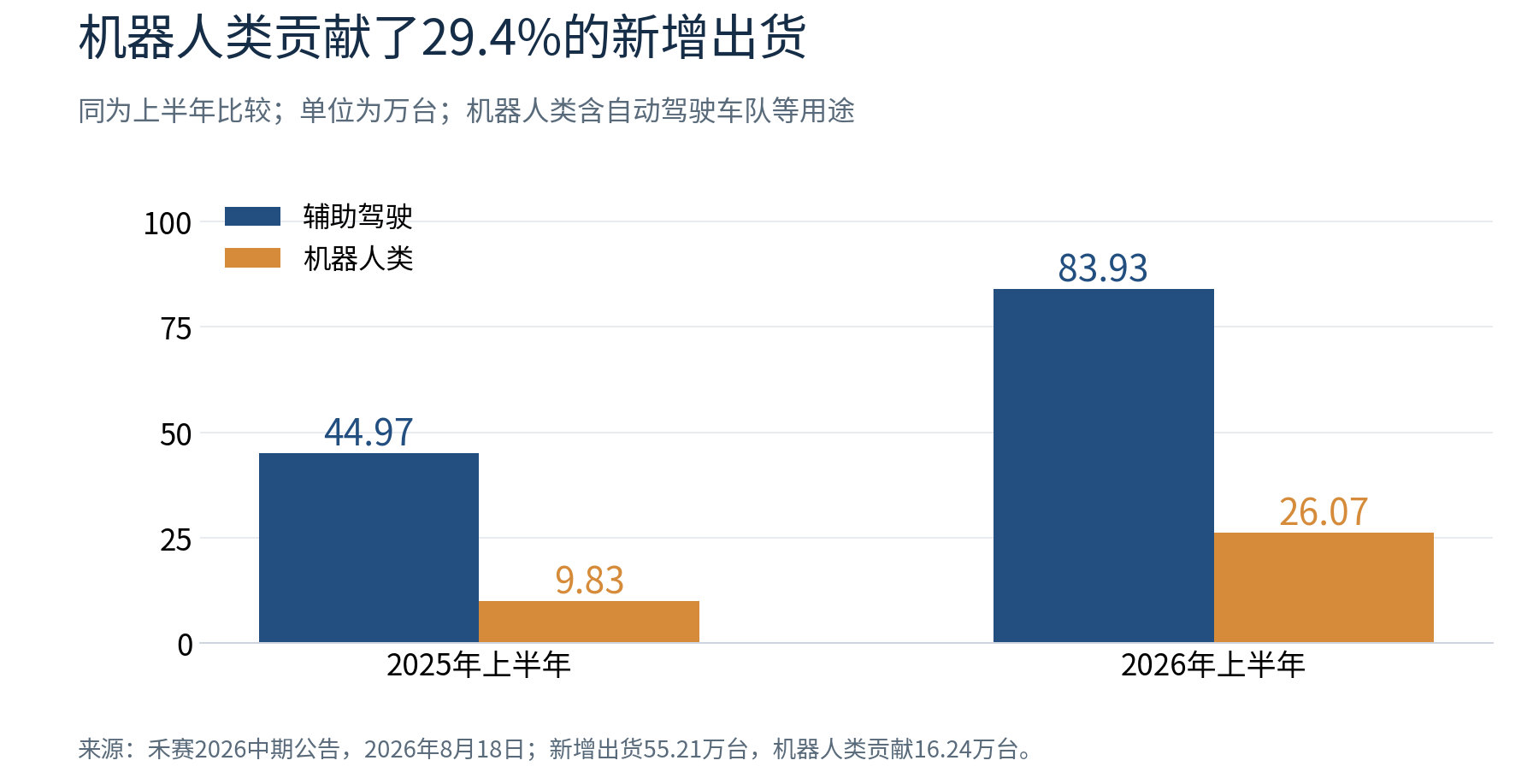
Figure 1: Robotics' share of shipments rose from 17.9% to 23.7%; incremental contribution is calculated based on year-over-year differences under the same scope.
Of the 552,100 new units added in the half-year, assisted driving contributed 389,700 units and robotics contributed 162,400 units, accounting for 29.4% of new shipments. Robotics' share of total shipments also rose from 17.9% in the same period last year to 23.7%. The two ratios have different denominators: the former measures who is driving growth, while the latter measures the current business structure.
This category includes Robotaxi, autonomous freight, lawn mowers, delivery, and industrial robots. The 260,000 units cannot all be explained as humanoid robot procurement, let alone converted into 260,000 robots.
More Shipments Have Not Yet Brought Equivalent Revenue Growth
In the same period, group revenue rose from 1.232 billion yuan to 1.541 billion yuan, and gross profit rose from 520 million yuan to 611 million yuan. Shipments grew 100.8%, revenue grew 25.1%, and gross profit grew 17.6%.
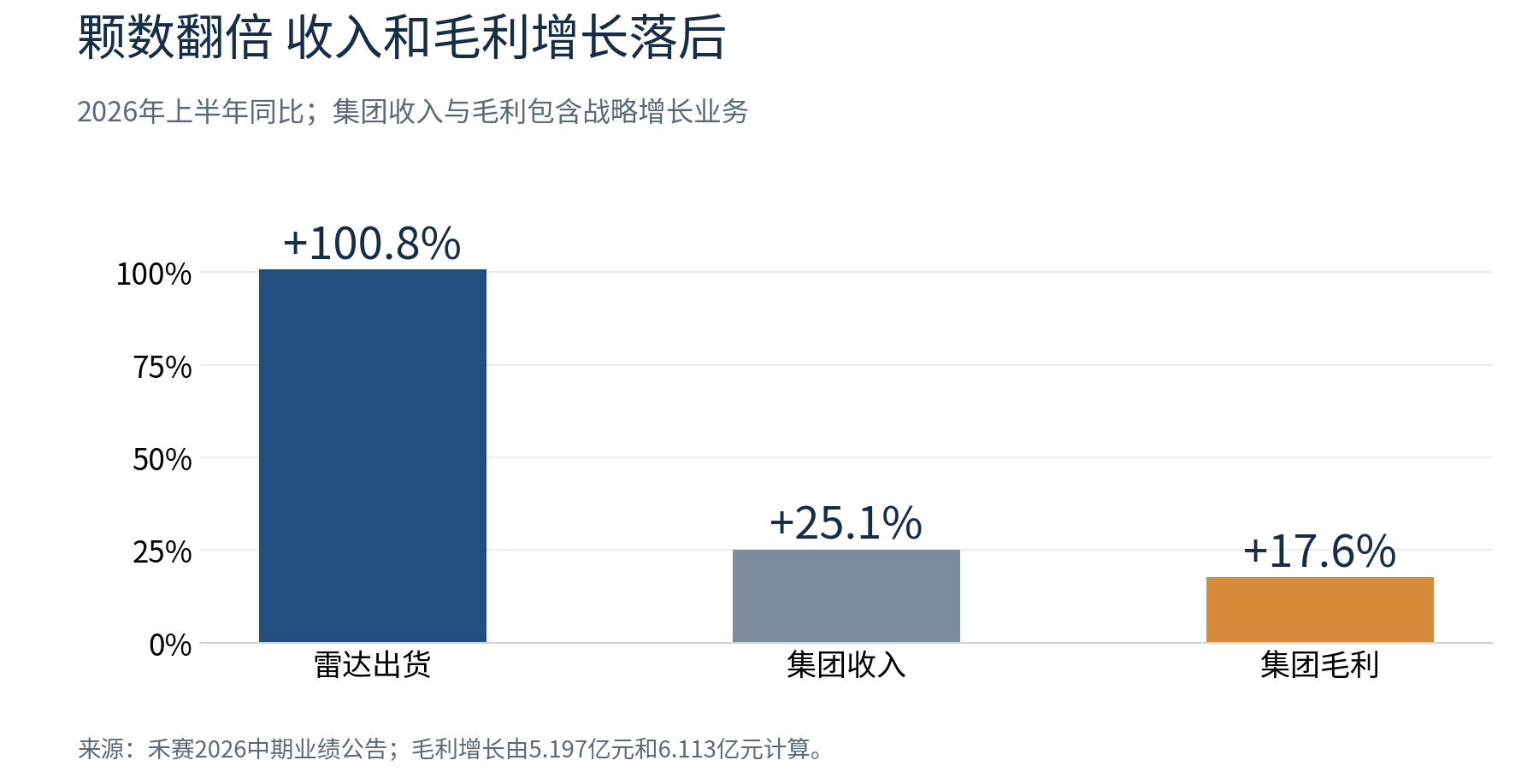
Figure 2: Year-over-year growth rates of shipments, group revenue, and gross profit. Group financial indicators cannot be treated as per-unit lidar indicators.
The company explained the change in product revenue as delivery growth, partly offset by a decline in average selling price. Gross margin fell from 42.2% to 39.7%, which the company attributed to a higher revenue contribution from relatively lower-margin products.
These figures prove that demand is scaling, and also show that the revenue and gross profit brought by each unit shipped are under pressure. Group revenue also includes new businesses, and the product mix is changing, so group revenue divided by lidar units cannot be written as an accurate average lidar price, let alone attributed to price cuts on the same product.
The new segment table provides another important piece of information. In the first half, the lidar business had revenue of 1.496 billion yuan and operating profit of 108 million yuan, implying an operating margin of about 7.2%; strategic growth business revenue was 44.94 million yuan, with an operating loss of 115 million yuan, leaving the group with an operating loss of about 6.37 million yuan.
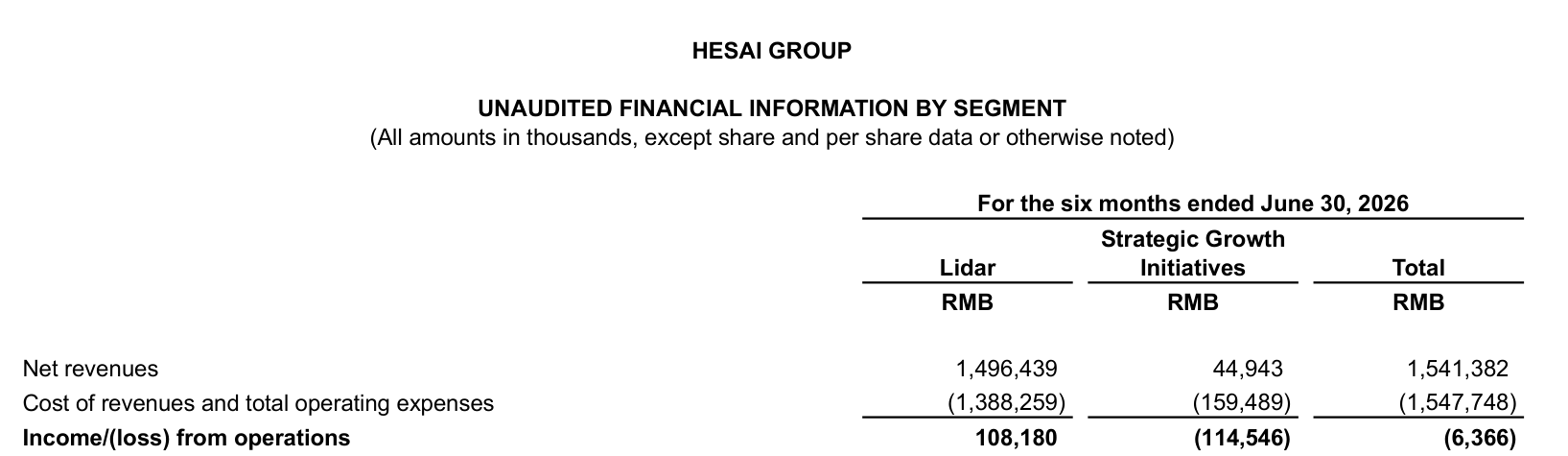
Hesai's unaudited segment disclosure for the first half of 2026, published on August 18; unit is thousands of RMB.
The core lidar business is already operating profitably, but the report combines automotive lidar and robotics lidar in the same segment and does not separately list revenue and gross profit for the two. Therefore, a higher share of robotics shipments cannot yet be directly used to infer higher profit contribution. Strategic growth businesses such as joint modules and Kosmo also cannot be mixed into the explanation of robotics lidar sales.
Customers Are More Diversified, but Five Still Account for More Than Half of Revenue
In the 2025 annual report, the revenue share of the top five customers fell from 67.5% in 2023 and 59.9% in 2024 to 55.8%. The anonymous customer with the highest revenue share in 2025 was 17.1%, estimated at about 518 million yuan based on full-year revenue; the other two accounted for 14.7% and 10.0%, respectively. This is revenue weight, not shipment weight.
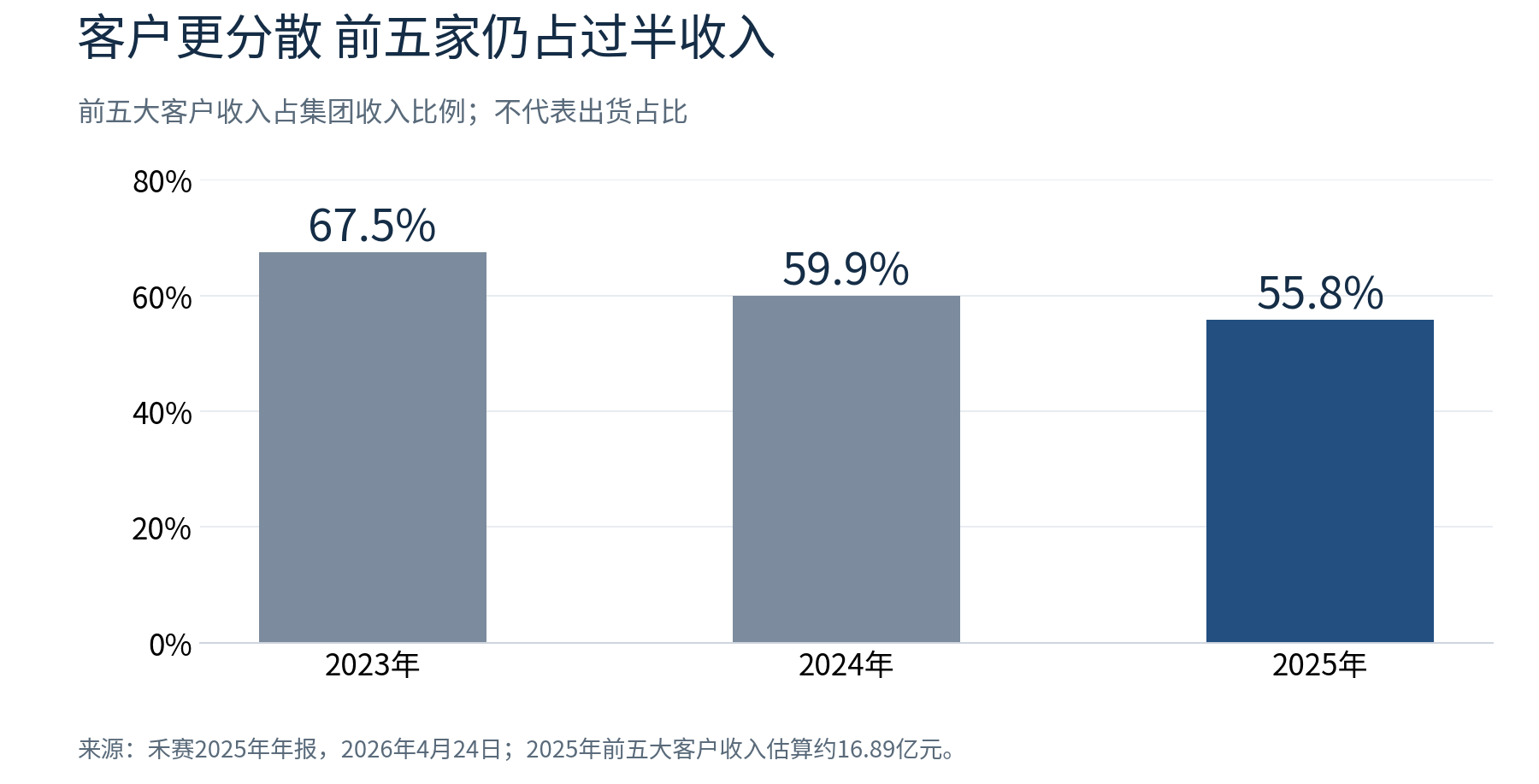
Figure 3: Customer revenue concentration has continued to decline. No inference is made about the identity of anonymous customers.
Diversification reduces the impact of a single customer on operations, but the top five still contributed about 1.689 billion yuan in revenue. Customer turnover, price pressure, and procurement share adjustments are still worth tracking. The annual report does not fully match anonymous customers with automakers, so these amounts cannot be assigned to Li Auto or Xiaomi based on partnership lists.
Demand is also geographically concentrated. In 2025, revenue from mainland China was 2.355 billion yuan, accounting for 77.8%; North America was 452 million yuan, and Europe was 140 million yuan. This is the financial report's geographic revenue scope and cannot be directly regarded as the final location where lidar is used, but it shows that a global partnership list does not mean revenue is already evenly distributed.
Li Auto provided a specific procurement mechanism. Hesai said in November 2025 that it was selected as the exclusive lidar supplier for the next-generation assisted driving platform; in the second quarter it also disclosed that multi-lidar configurations expanded from the L9 and L8 to the 250,000-yuan-class L6, supporting up to four units.
The volume of such orders depends on the sales of the equipped models, the standard or optional ratio, the number of units per vehicle, and the supply share. One more lidar can increase procurement volume, but how much revenue it adds also depends on the prices of the main lidar and blind-spot lidar. New design wins for Volkswagen China joint-venture models and GAC Toyota bZ7, as well as the Great Wall project expected to enter mass production at year-end, should continue to be checked against mass production