 Physix Frontier
Lenovo Rises Over 4%: Where Does the AI Business Start Making Money?
October 5, 2026
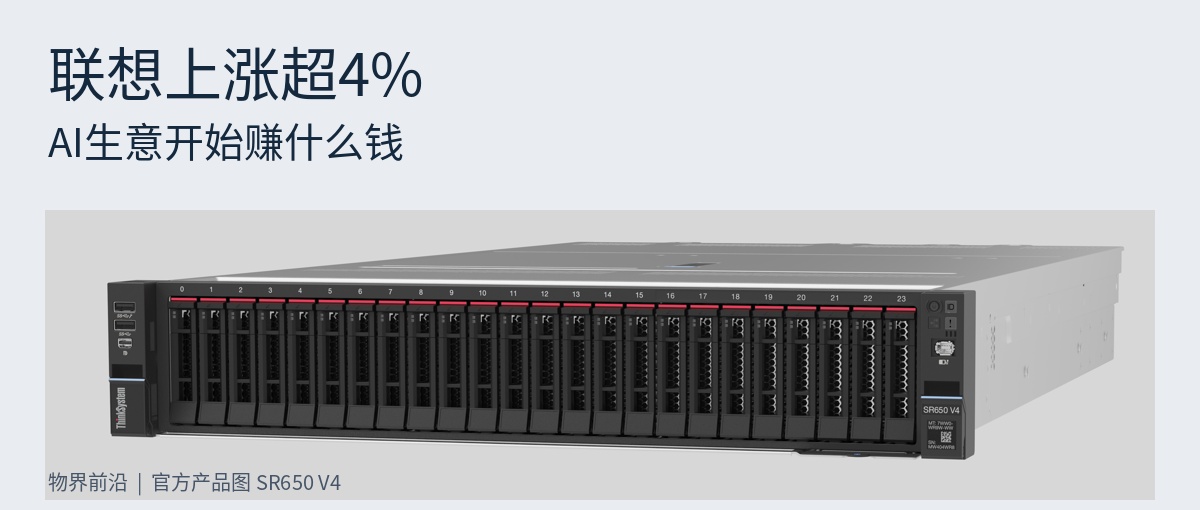
The cover image is Lenovo's official SR650 V4 product photo, used to show the server form factor; it is not the model procured by Akamai.
At midday on October 5, Lenovo Group rose more than 4%, while the Hang Seng Index edged down 0.08% over the same period. The move is eye-catching, but to understand this round of change at Lenovo, there is a more concrete entry point than the price gain.
On September 24, cloud service provider Akamai announced that Anthropic committed to purchasing about $11.6 billion in cloud services over seven years. In the supply agreement it subsequently disclosed, Lenovo's name appeared. More notably, this cloud service partnership supports CPU workloads, rather than the large-scale GPU training clusters commonly seen in announcements.
This gives Lenovo's AI business another traceable transaction chain. The question is: how do model companies' compute expenditures, passing through cloud service providers, actually turn into Lenovo's revenue and profit?
Who Does the $11.6 Billion Belong To?
First, break down the contractual relationships. Anthropic is the developer of Claude, and it is purchasing dedicated cloud computing capacity and supporting services from Akamai. The $11.6 billion is the combined payment commitment in the two parties' project plan, subject to delivery, service availability requirements, and termination clauses. It is neither an $11.6 billion order signed by Lenovo, nor revenue already realized in the current period.
Akamai's 8-K filing publicly disclosed with the U.S. Securities and Exchange Commission shows that on September 23, Akamai signed a master product and services agreement, along with an initial statement of work, with an Irish entity of Lenovo. Lenovo will provide hardware, software, and related services to Akamai and some affiliates. The master agreement has an initial term of three years, and the initial statement of work has a term of seven years.

Akamai 8-K, disclosed September 24, 2026. The supply scope includes hardware, software, and services; a seven-year term does not mean seven years of revenue is locked in.
This disclosure does not give the amount of Lenovo's contract, the number of devices, or the annual delivery pace, nor does it state that a particular server model was selected. Therefore, what can be confirmed is that Lenovo has entered this procurement chain; at this point, it is still impossible to calculate how much revenue it can capture, let alone directly apply a profit margin to estimate net profit.
The agreement also allows Akamai to terminate for convenience after meeting conditions such as notice and termination fees. "Long-term cooperation" has commercial significance, but the contract term itself cannot substitute for procurement amount and execution.
Why CPUs Also Appear in AI Procurement
A CPU can be understood as the processor in a server that handles general-purpose tasks; GPUs excel at massive parallel computation and are often used for model training and inference. When AI applications run, they still need general-purpose computing, storage, networking, and software services to work together. Which hardware a specific task is placed on depends on the workload.
Akamai's official announcement explicitly states that it supports Anthropic's accelerating growth in CPU workloads. This shows that model companies' infrastructure needs will propagate to server procurement beyond GPUs. However, the announcement does not disclose the specific task composition, so it cannot be further claimed which type of model computation these CPUs are performing, nor can the model of the equipment Lenovo supplies be guessed.
For Lenovo, the significance of this cooperation lies in the customer relationship. It provides products and services to a cloud service provider that takes on model companies' needs, participating in the construction of underlying infrastructure. Lenovo does not need to own its own large model first to potentially gain business from procurement driven by growing model usage. The contract disclosure proves that this path exists; it has not yet proven the project's profit level.
Akamai expects that the total capital expenditure corresponding to this $11.6 billion cooperation will be about $5.5 billion, of which about $1.7 billion will be added in 2026 for advance procurement of key supply chain components such as memory. At the same time, it said the cooperation will not affect its 2026 revenue guidance.
There is a time lag between procurement preparation and cloud service revenue. But this $1.7 billion also cannot be counted as Lenovo revenue. The same 8-K disclosure states that Akamai separately authorized manufacturer Jabil to procure about $1.7 billion in memory components. The attribution of funds and the division of labor among suppliers both need to be checked along their respective contracts.
How Much Money Has Lenovo Already Made?
Beyond the new contract, Lenovo already has a set of actual operating results. In the first quarter of fiscal year 2026/27 announced on August 13, covering the three months ended June 30, the Infrastructure Solutions Group (ISG), which mainly operates servers and other infrastructure, had quarterly revenue of about $8.5 billion, up 98% year over year; segment operating profit was $777 million, with an operating margin of 9.1%.
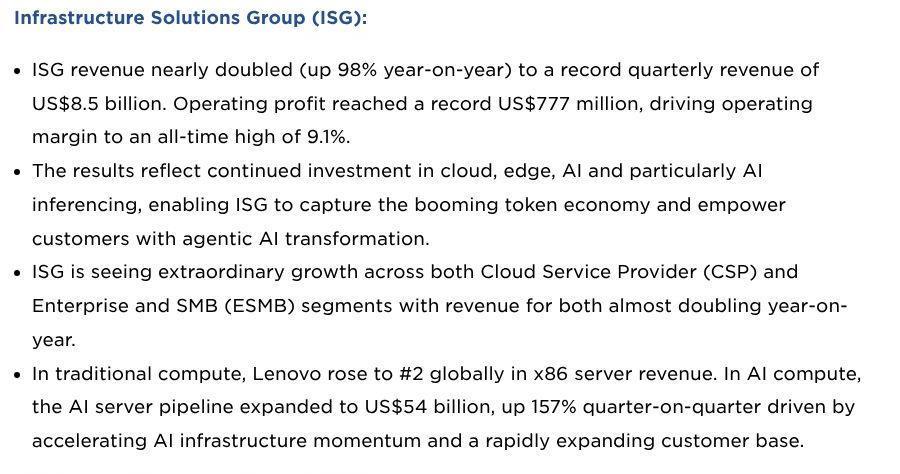
Lenovo official website, August 13, 2026. ISG quarterly revenue grew 98%, with a segment operating margin of 9.1%; the screenshot also retains the AI server pipeline metric.
$8.5 billion in sales corresponding to $777 million in segment operating profit shows that this business has already contributed considerable profit. Here, "operating margin" cannot be written as the group's net margin, nor can the entire ISG be regarded as AI servers. Lenovo disclosed that revenue from both cloud service provider customers and enterprise and SMB customers nearly doubled in the quarter.
There is also a difference that is especially easy to miss. The group's adjusted net profit attributable to shareholders for the quarter was $1.075 billion, up 176% year over year; under Hong Kong Financial Reporting Standards, the attributable result was a loss of $609 million. The adjusted metric excludes items such as fair value changes in derivative financial liabilities related to warrants and notional interest on convertible bonds. The two figures answer different questions; one cannot use only the former to say Lenovo's "net profit surged," nor conflate segment operating improvement with the group's book loss.
Lenovo also disclosed that its AI server pipeline reached $54 billion, up 157% quarter over quarter. The English word "pipeline" refers to business opportunities or project reserves; the term alone cannot be treated as all orders already signed, non-cancelable, and about to be delivered. It differs in evidentiary strength from revenue already recognized in the quarter.
Putting these materials together, the changes visible are quite concrete. Lenovo's infrastructure business has already expanded revenue and improved profitability; Akamai's disclosure provides another example of procurement driven by model demand.