 Physix Frontier
After SpaceX Rose 7.35%, How 26 Satellites Turn Into Revenue
October 3, 2026

According to IBD's October 2 closing report, SpaceX (SPCX) rose 7.35% to $158.96. The stock price has drawn attention again, but the fact truly worth unpacking this week happened on September 28.
Starship's 14th flight entered Earth orbit for the first time and deployed 26 V3 Starlink satellites. In its mission summary, SpaceX said it had established contact with all satellites; these satellites still need to complete on-orbit checks and orbit raising before they begin serving customers.
The order of these steps determines how to understand this breakthrough. The rocket delivered the cargo to its destination, but whether the communications network can increase revenue still depends on whether the cargo can operate normally, to whom the capacity can be sold, and whether the next delivery cost can be lowered.
If I could ask only one question, I would be more concerned with how these 26 satellites change Starlink's business equation. That is closer to currently verifiable value than the label of "aerospace plus AI."
First, Look at the Capacity Delivered
The design specification given on Starlink's latest V3 technology page is that each satellite has 1 Tbps of downlink capacity, about 10 times that of V2. Downlink means transmitting data to ground users; 1 Tbps equals 1,000 gigabits per second.
Adding up these design specifications, 26 satellites correspond to about 26 Tbps of downlink capacity. This is an arithmetic total of nominal capacity and cannot be treated as capacity already in service, let alone understood as meaning every user can enjoy such network speeds.
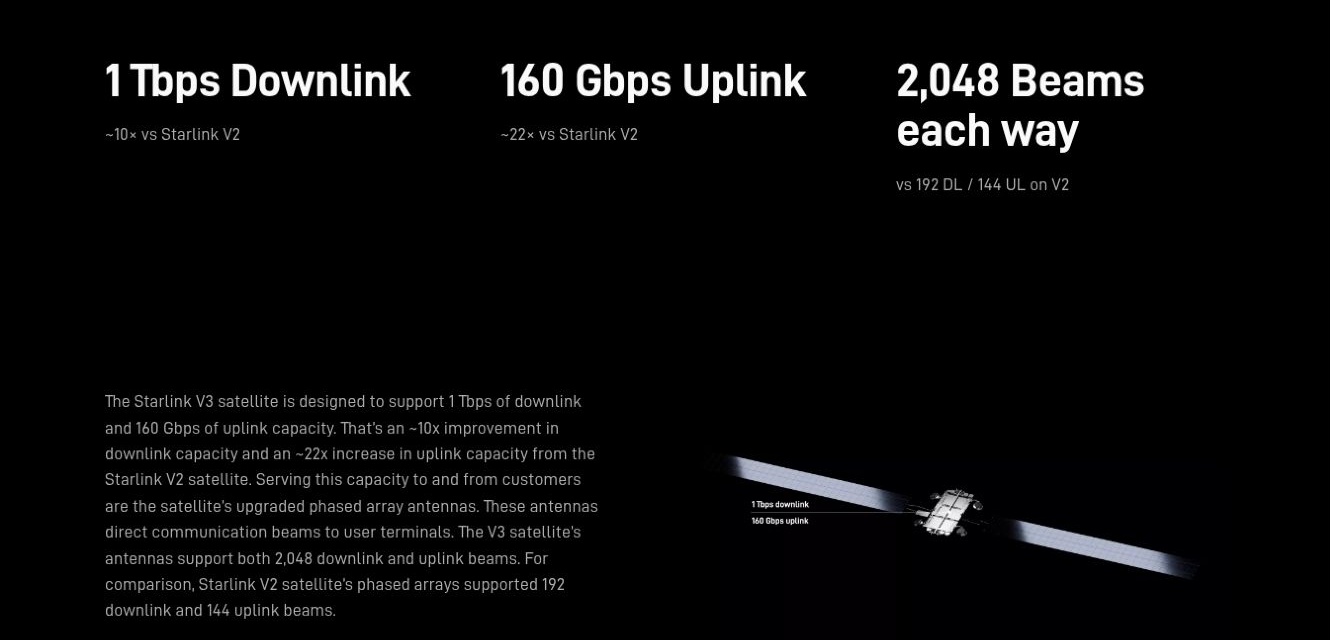
Starlink's official V3 page: single-satellite downlink design capacity of 1 Tbps, about 10 times that of V2. The page does not indicate a publication date; verified on October 3, 2026.
For Starlink, one more satellite and one more unit of sellable capacity do not have the same economic meaning. Satellite counts are easier to tally, but what truly affects revenue is how much usable bandwidth can be added in places with paying demand during congested periods.
V3's change is not just about making the parameters larger. The company disclosed that the satellite's downlink communication beams increased from 192 on V2 to 2,048. Beams can be understood as communication channels separately pointed at ground terminals, with supporting chips responsible for allocating and adjusting data.
Therefore, a more specific business inference is: if the added capacity can be allocated to areas where demand is concentrated, Starlink has an opportunity to accommodate more paying users or improve peak-hour experience. If the capacity mainly lands in areas with insufficient demand, higher specifications may not translate into revenue at the same pace.
Money Must Pass Through Two Gates
The first is starting service. A successful deployment proves Starship can send this batch of satellites into orbit; the on-orbit checks and orbit-raising process explicitly described by SpaceX also shows that there is still work to be done between releasing the payload and putting it into operation.
The second is transport cost. At the end of this mission, both the booster and the upper stage ended with ocean splashdowns. It verified orbital insertion and payload deployment, but did not yet demonstrate that the same set of hardware can be recovered and perform another mission.
This will directly affect the capital expenditure of expanding the network. With single-use operation, every delivery must account for new hardware; only with reuse can hardware spending potentially be spread across multiple missions, but inspection, maintenance, refurbishment, and turnaround time still cost money.

SpaceX's 14th flight summary, mission date September 28, 2026: contact established with 26 satellites, still requiring checks and orbit raising; an engine issue shortened the mission.
The official summary also retained failure details. One vacuum engine on Starship's upper stage shut down early, and the remaining five extended their operating time to compensate; the team then confirmed it could perform the orbital insertion burn, and out of caution shortened the on-orbit stay.
This shows the ability to compensate after a failure, and also reminds us that first delivery and stable transport are different stages. Investors need to wait for the next mission, and the one after that, before judging whether this is repeatable delivery capability or still experimental capability requiring a longer period of debugging.
Putting these two gates together makes Starship's financial significance for Starlink clear: greater effective capacity may increase revenue; lower deployment cost per unit of capacity may improve returns. Both sides must be delivered for satellite count growth to carry more weight.
AI's Timeline Has Another Page
SpaceX is indeed advancing an orbital AI compute project. Its official Starmind page introduces the AI1 satellite, envisioning solar power, on-orbit computation, and then transmitting results back to Earth via laser links and Starlink.
But this batch of 26 payloads consists of V3 communications satellites. Downlink bandwidth describes data transmission capability, while AI compute describes data processing capability; the two cannot substitute for each other.
A more specific piece of timing information than "compute platform" is that SpaceX says it is building the Gigasat factory in Bastrop, with plans to begin rapid production and deployment of thousands of AI satellites as early as late 2027. Both the timing and the quantity here are company plans.
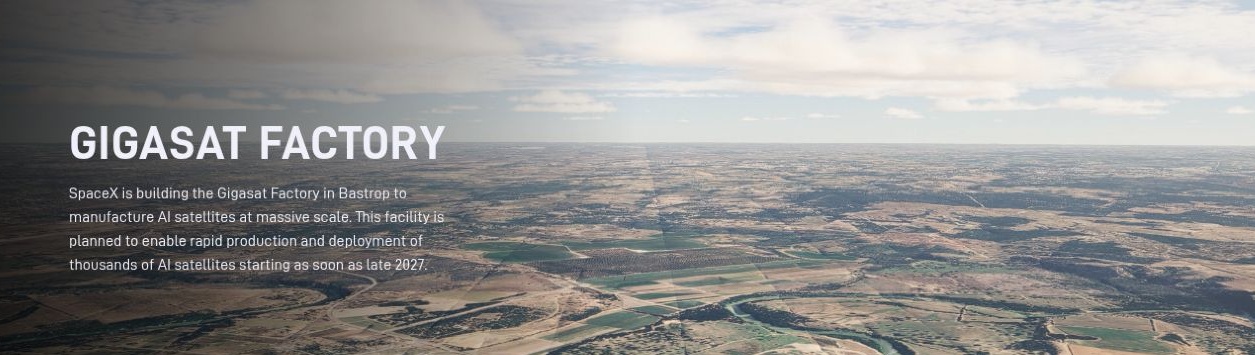
SpaceX's official Starmind page: the AI satellite factory is planned to support large-scale production and deployment as early as late 2027. The image is a display from the official website and cannot prove that the planned capacity has been built.
There is also a real technical connection between V3 and AI satellites. On the V3 page, Starlink mentions that technological innovation in the new solar arrays will help power Starmind. But shared technology only indicates that engineering experience may be reusable; it does not yet prove that orbital compute has generated revenue or has a cost advantage.
My judgment is that Starship's orbital insertion adds one more piece of evidence for large-payload transport, and the first business result it can test is still Starlink expansion. To further argue the value of orbital AI, actual deployment, sustained compute operation, and cost disclosure are still needed.