 Physix Frontier
XPeng Deliveries Rise 15% Quarter over Quarter: How Much Gross Profit Can Each Car Leave?
XPeng Deliveries Rise 15% Quarter over Quarter
How Much Gross Profit Can Each Car Leave?
Wujie Aniu | Wujie Frontier | October 2, 2026

XPeng delivered 118,390 vehicles in the third quarter, up 15% quarter over quarter. But stretching the timeline out by a year, the same set of numbers corresponds to a year-over-year increase of only about 2%.
On October 2, reports related to Hong Kong stock announcements disclosed that XPeng delivered 41,256 vehicles in September, up 5% quarter over quarter, with L03 monthly deliveries exceeding 10,000 units. The company's investor relations website had already published this data on October 1.
There is now evidence of a sales recovery. The more important question to ask next is how much gross profit these additional deliveries can leave for XPeng. In the latest second-quarter financial report, the group gross margin was 20.7%, while the vehicle gross margin was 12.1%. Between these two numbers lies the key to understanding this delivery announcement.
For 15% Growth, Look at the Base First
XPeng delivered 103,295 vehicles in the second quarter of 2026 and 15,095 more in the third quarter. Calculated on the raw numbers, that is a 14.61% quarter-over-quarter increase, rounded to 15% in the announcement.
But in the third quarter of 2025, the company had already delivered 116,007 vehicles. This year's third quarter was 2,383 vehicles more than the same period last year, a 2.05% year-over-year increase. September alone was similar: last year's same month was 41,581 vehicles, while this year was 325 fewer, down about 0.78% year over year.
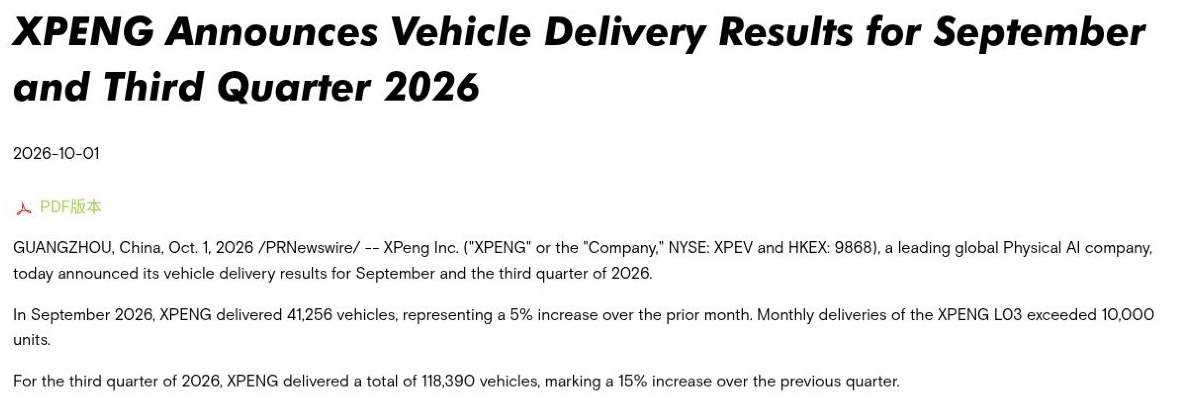
XPeng's official delivery announcement, October 1, 2026. The 15% refers to quarter-over-quarter growth and cannot be treated as year-over-year growth.
This shows that third-quarter growth was first and foremost a recovery relative to the second quarter. Using "15% quarter-over-quarter growth" to judge the operating trend is fine, but using it to infer that XPeng has re-entered rapid expansion goes beyond the evidence.
Look next at the guidance the company gave on August 24: third-quarter deliveries were expected to be 115,000 to 121,000 vehicles, with a midpoint of 118,000. Final deliveries were 390 vehicles above the midpoint, falling within the original range. For investors, this is delivery in line with expectations, not yet enough to prove that demand has made an unexpected leap.
20.7% Cannot Be Directly Multiplied onto Each Vehicle
Sales tell us the cars were sold; gross margin answers how much remains after subtracting the corresponding cost of sales from vehicle revenue. Only the remaining gross profit has a chance to cover R&D, marketing, and other expenses.
XPeng's unaudited second-quarter results released on August 24 separately listed a group gross margin of 20.7% and a vehicle gross margin of 12.1%. The latter fell 2.2 percentage points from 14.3% in the same period last year and was flat versus this year's first quarter. The company attributed the year-over-year decline to product transitions.
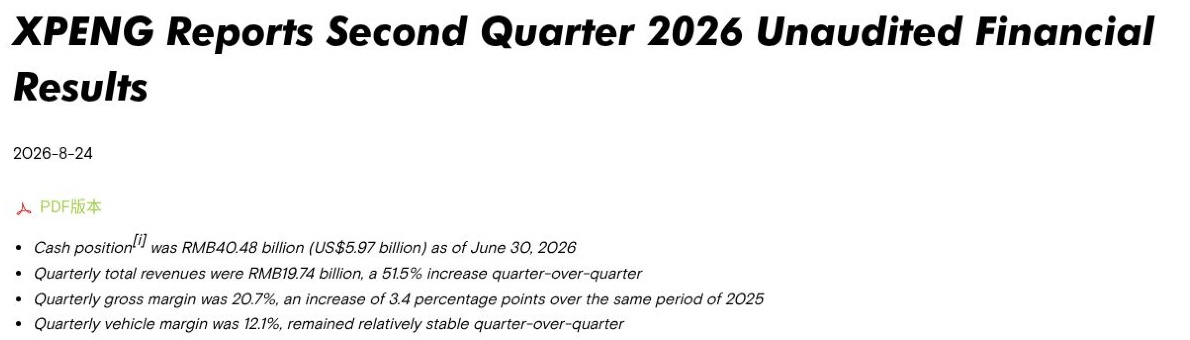
XPeng's unaudited second-quarter 2026 financial report, released August 24. Group gross margin and vehicle gross margin are two different measures.
The group also has a "services and others" business, including technology R&D services, parts and accessories sales, and so on. Not all gross profit can be attributed to vehicle deliveries. In the second quarter, this business had a gross margin of 75.1%; the company explained that factors such as technology R&D services reaching specific milestones drove revenue growth.
Technology services contributing gross profit is a commercial advance for XPeng. But the timing of milestone revenue recognition is not the same as monthly delivery volumes. To judge whether new cars are becoming more profitable as they sell, one must look separately at vehicle revenue, vehicle gross margin, and model mix.
A bounded calculation can be made. Assuming both per-vehicle recognized revenue and vehicle gross margin remain at second-quarter levels, delivering about 14.6% more vehicles in the third quarter would correspond to an approximately 14.6% increase in vehicle gross profit. This is arithmetic under same-basis assumptions and cannot be treated as a third-quarter earnings forecast.
If discounts on new cars lower per-vehicle revenue, or if early-stage mass-production costs rise, gross profit growth could be lower than sales growth. Conversely, if model mix improves and manufacturing costs fall, the same delivery volume can leave more gross profit. The announcement currently does not provide enough financial data to judge these two paths.
After L03 Tops 10,000, Watch How New Cars Make Money
L03 monthly deliveries exceeded 10,000 units, equivalent to at least about 24.2% of total September deliveries. These are actual deliveries, enough to show its importance to sales; but the company did not disclose L03's per-vehicle gross profit in this announcement, so one cannot directly infer from monthly sales topping 10,000 that it improved profitability.
The G9L launched on September 17 provides another entry point for observing model mix. Materials published on the official website on September 18 show that its official limited-time price starts at 231,800 yuan, offering both battery-electric and extended-range versions.

XPeng official website, September 18, 2026. The G9L's 231,800 yuan is a limited-time starting price and cannot replace the actual average transaction price across the full lineup.
A higher share of higher-priced models may increase per-vehicle revenue. But larger cars and richer configurations also increase costs. How much the price rises and how much cost rises along with it is what determines whether gross profit can improve. The launch of new models is an opportunity; model gross margin and sustained deliveries are the verification.
This also explains why intelligent driving updates and charging networks cannot be directly written up as profit growth. XPeng began rolling out XOS 6.3.0 on September 22; as of September 30, its self-operated charging network covered more than 430 cities and had over 4,000 charging stations.
Software experience and charging convenience may help consumers place orders and reduce reliance on discounts to make sales; system R&D and charging station construction and operations also require investment. To prove these investments are worthwhile, one still needs to see whether transaction prices can hold steady and whether incremental gross profit can cover ongoing spending. Version numbers and station counts alone cannot complete that calculation.
In the Next Financial Report, Watch Three Things
First, third-quarter vehicle gross margin