 Physix Frontier
Accenture Jumps 15.8% at US Close: How Are AI Service Providers Capturing Demand?
October 2, 2026

At around 4 a.m. Beijing time on October 2, US stocks opened the fourth quarter with modest gains. The Nasdaq Composite rose only about 0.04%, but AI-related companies diverged sharply. Nvidia gained about 1.1%, Micron rose about 3%, Applied Materials climbed about 3.5%, and Accenture surged about 15.8%.
Accenture provides consulting, technology implementation, and outsourcing services. As AI becomes increasingly capable of writing code and processing documents, there were concerns that such companies would win fewer projects and collect lower service fees. Yet that night, it clearly outperformed several major chip companies.
The more important question is: how exactly did it capture AI demand? In the same earnings report, revenue exceeded the original guidance, but management acknowledged that prices declined across multiple businesses. Clients are willing to buy more services, but they are also demanding that service providers share the benefits. Who can turn new work into profit is the question left by this unusual move.
First, Separate the Close from Intraday Trading
This round of statistics corresponds to the regular trading session on October 1, US Eastern Time, with the close at 4 a.m. Beijing time on October 2, excluding after-hours trading. Below are several representative companies relevant to this article, with gains rounded based on closing reports.
Company | Industry Position | Approx. Closing Gain |
Nvidia NVDA | Computing Chips | +1.1% |
Micron MU | Memory Chips | +3.0% |
Applied Materials AMAT | Chip Manufacturing Equipment | +3.5% |
Accenture ACN | Technology Implementation & Services | +15.8% |
Data source: AP closing report on October 1. A Reuters report on Accenture the same day mentioned a 22% intraday gain; that figure cannot be directly treated as the closing gain.
There were also common market factors that night. US Treasury yields spiked intraday and then pulled back, helping stocks recover losses. Therefore, a one-day gain cannot be entirely attributed to AI business, let alone used to judge that the entire industry chain has entered a new growth cycle.
Revenue Exceeds the Upper End of Guidance: Where Did the Money Come From?
Accenture released its fiscal 2026 fourth-quarter results on October 1, covering the period ended August 31. Quarterly revenue was $18.68 billion, above the previous guidance range of $17.75 billion to $18.4 billion, exceeding the upper end by $280 million. Revenue grew 6% year over year in US dollars and 7% in local currency.
New bookings were $22.17 billion, up 4% year over year in US dollars. Here, new bookings refer to the company-disclosed bookings, representing the scale of contracts signed, not money already earned in the quarter. Projects still need to be implemented, and revenue still needs to be recognized based on progress toward fulfillment.
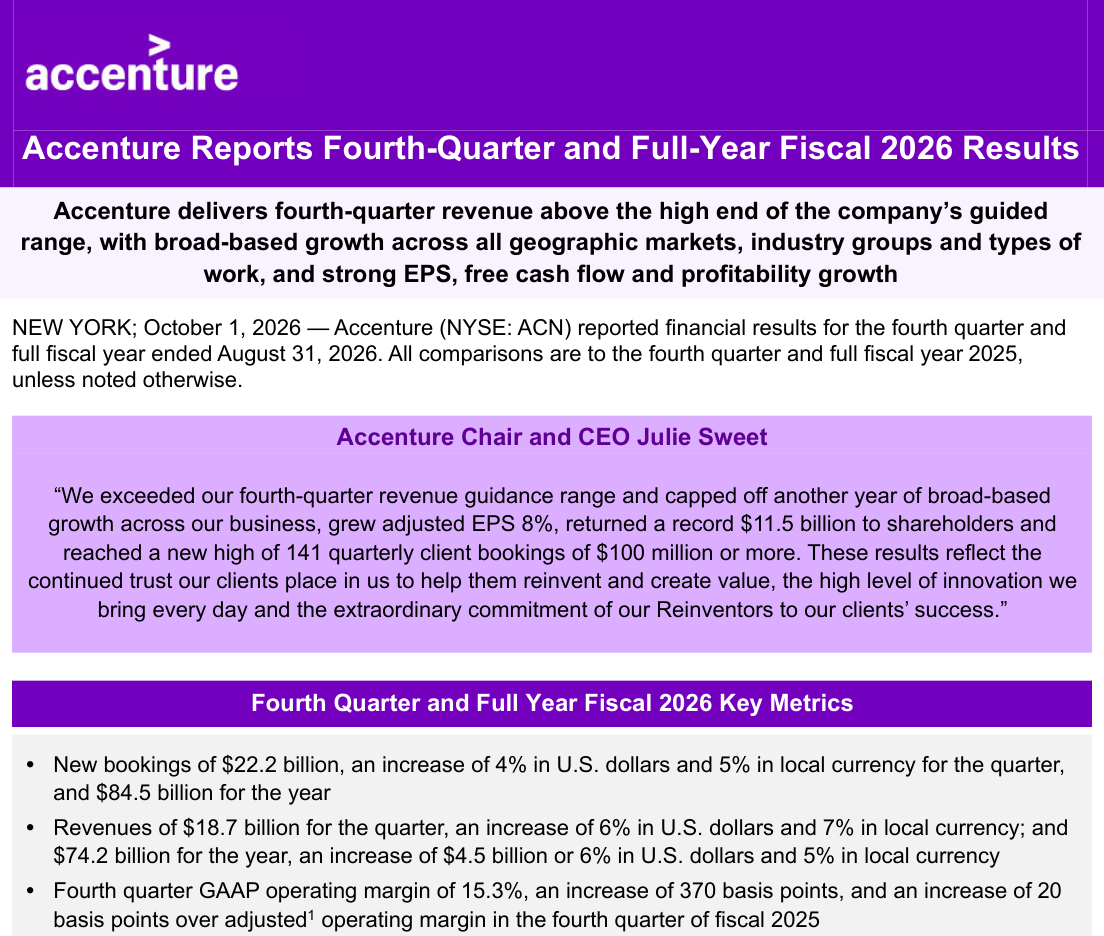
Figure 1: Accenture's official earnings announcement on October 1. Revenue exceeded original guidance, but bookings and recognized revenue are two different measures.
Management disclosed on the earnings call that full-year bookings related to eight emerging AI and data partners were more than triple those of the previous fiscal year, and revenue was more than double. This measure covers business related to specific partners and cannot be extrapolated to mean company-wide revenue doubled; the company also did not provide an absolute figure in that statement.
This information suggests that the stage at which enterprises pay now includes integrating AI into existing systems. A model can complete testing tasks, but getting it into an enterprise's daily workflows still involves data preparation, permission management, legacy system interfaces, performance evaluation, and error handling. The stronger the model, the more reason enterprises have to try it, and the more they need these steps done thoroughly.
For service providers, new revenue opportunities emerge from this. Client procurement may shift from developing a piece of code to integrating models, transforming processes, and ongoing operations. The tasks have changed, but existing client relationships, industry knowledge, and delivery experience may still have value. This is an explanation based on business mechanisms; the financial report is not yet sufficient to quantify the contribution of each type of work.
Efficiency Improves, and Clients Also Demand Price Cuts
One fact easily obscured by the rally is that CEO Julie Sweet said on the earnings call that prices declined across multiple businesses in the fourth quarter, and competition remained intense.
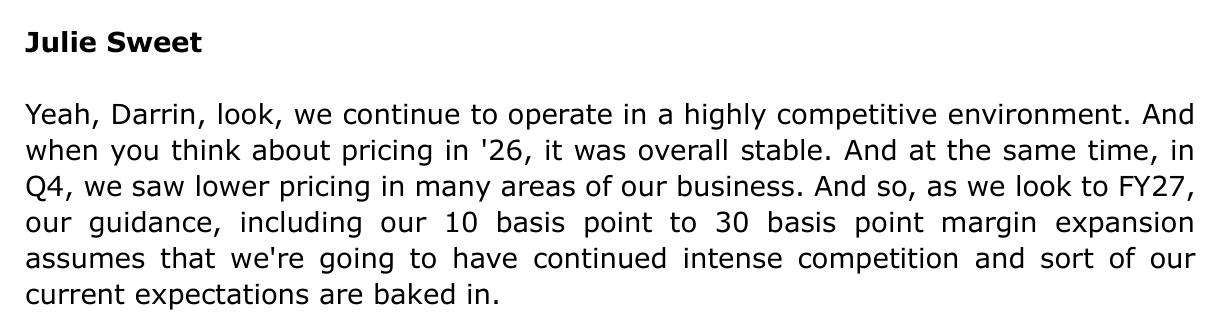
Figure 2: Accenture's official earnings call transcript, October 1, page 15. Sweet explicitly discussed price declines across multiple businesses in the fourth quarter and continued competition.
Assume that after