 Physix Frontier
Micron Q4 Gross Margin 87%: Why HBM Profitability Is Still Catching Up
Wujie Aniu · Wujie Frontier | October 1, 2026

Image source: Micron FY2026 Q4 earnings presentation, page 8, September 30, 2026.
The most noteworthy thing in Micron's earnings report is a somewhat counterintuitive explanation.
The fiscal 2026 fourth-quarter results released on September 30 show company revenue of $54.23 billion, up 379% year-over-year; net income under US GAAP of $37.7 billion, with adjusted gross margin reaching 87%. But the gross margin for the cloud memory business stalled at 83%. Micron said the gains from price increases were partially offset by a higher HBM mix.
HBM is the high-speed memory that sits alongside AI accelerators, and it is one of the most fiercely contested products in the memory industry's technology race. Why would selling more of it actually drag down this division's gross margin?
This matters for how we understand Micron's high profits. Technical advantages are certainly important, but the power of ordinary memory chip price increases should not be underestimated.
Selling More, and Also Selling at Higher Prices
Let's break down the revenue growth first.
DRAM can be understood as the memory that temporarily holds data while a device is working. In the fourth quarter, Micron's revenue for this business grew 27% quarter-over-quarter, with storage capacity shipments growing in the mid-single-digit percentage range and average selling prices rising in the high teens.
NAND is used to store data that must persist after power is cut, and solid-state drives use it. Revenue for this business grew 42% quarter-over-quarter, with capacity shipments up about 10% and average selling prices up about 30%.
Both sets of numbers point to the same thing. In the revenue growth, the contribution from price increases is very prominent. Shipments here are measured by storage capacity, not by chip count; average selling prices are also affected by product mix and should not be understood as every single chip getting a uniform price increase.
The quarterly basis also deserves attention. Micron's fiscal quarter ended September 3 and spanned 14 weeks, one week more than the usual 13. The quarter-over-quarter growth rate includes the effect of a longer statistical period and cannot be entirely attributed to demand and pricing.
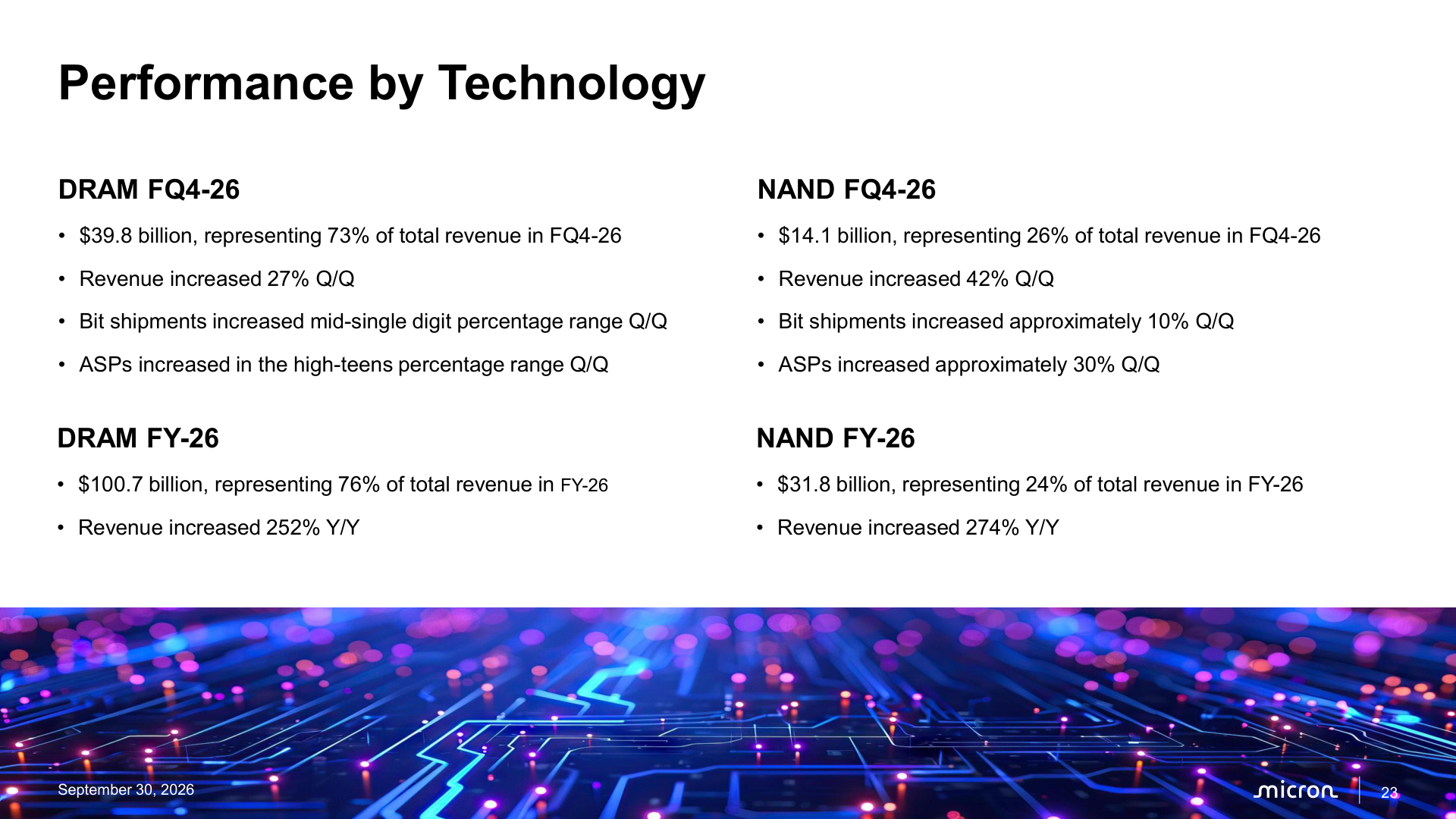
Micron's September 30 earnings report, page 23. NAND average selling prices rose about 30% quarter-over-quarter, with capacity shipments up about 10%.
The impact of pricing on profit is more direct than on revenue. For chips already produced by the factory, if selling prices rise faster than the corresponding costs, the extra sales revenue can retain more gross profit.
The company mainly attributed the overall gross margin improvement this quarter to higher selling prices and good execution. This supports a judgment that Micron's current earnings strength comes both from product capability and from pricing power during supply tightness.
HBM Is Important, but a High Price Does Not Equal a High Gross Margin
HBM stacks multiple layers of memory chips, uses a large number of vertical connections to transmit data, and operates close to the processor. For general readers, it can be understood as a wider, shorter data channel that lets expensive AI chips wait less for data.
The performance value is clear. But manufacturing is also more complex, requiring chip stacking, connection, and packaging steps. A high selling price can only retain a higher proportion of profit depending on costs, and on what happens in the market after prices are negotiated.
Micron disclosed that the cloud memory division's gross margin this quarter was 83%, flat quarter-over-quarter, with the positive effect of price increases offset by a higher HBM mix. The core data center division's gross margin reached 90%, benefiting from pricing and product mix.

Micron's September 30 earnings report, page 25. The company explicitly stated that a higher HBM mix offset part of the gains from price increases in the cloud memory business.
You cannot take 83% as the gross margin of HBM as a single product, or 90% as the gross margin of ordinary DRAM as a single product. These are combined results for two business divisions, each containing different products.
However, Micron gave a more direct statement. The company has signed agreements for the vast majority of its HBM capacity supply for calendar year 2027, with prices significantly higher year-over-year, which will narrow the gross margin gap between HBM and conventional DRAM.
"Narrowing the gap" means that, at least based on what Micron has disclosed so far, the technically more complex HBM still has room to catch up to conventional DRAM in gross margin.
When ordinary memory prices rise rapidly, advanced products do not automatically occupy the top spot in profitability. Investors need to look at both technological leadership and contract pricing; looking only at "a rising HBM mix" is not enough to conclude that overall gross margin will necessarily rise.
Locking Shortage-Era Prices into Multi-Year Contracts
Earning more during a shortage also depends on how long those prices can be retained.
Micron has signed 26 strategic customer agreements, expected to correspond to revenue exceeding 35% of its projected revenue through 2030. These multi-year agreements use take-or-pay arrangements, where customers commit to purchase volumes and bear corresponding payment obligations even if they do not purchase as agreed.
About three-quarters of the expected revenue from these agreements already has a pricing framework, most of which include price floors and ceilings; the remaining roughly one-quarter is periodically negotiated at market prices.

Micron's September 30 earnings report, page 11. About three-quarters of the expected revenue from the agreements already has a pricing framework, most with price floors and ceilings.
This changes the way Micron shares risk with customers. Customers exchange purchase commitments for supply assurance, while Micron gains clearer demand and price boundaries, giving it a basis for building factories.
Price floors help reduce downside shocks, while price ceilings may also limit the gains from further price increases. The agreements cover more than 35%, which still cannot be understood as all revenue being locked in.
There is also a number that is easy to confuse. The company disclosed that customer financial commitments reached $32 billion, the vast majority arranged in the form of cash deposits; as of the end of the quarter, customer cash deposits on the balance sheet were $12.7 billion. The former is the scale of commitments, while the latter is what has actually been received and remains on the books at quarter-end.