 Physix Frontier
Blogger Recruitment Post-Mortem: From Zero Conversions to Active Onboarding
We Contacted Many Bloggers but Got Zero Conversions. Here’s What We Changed.
Initially, we contacted a batch of bloggers, got replies and contact info, but no one posted content or officially onboarded. After reviewing, we lowered the barrier for the first request to just authorizing and publishing one piece of content. Subsequently, bloggers began willing to authorize reposts and even expressed interest in joining proactively.
1. We Contacted Many Bloggers, Resulting in Near-Zero Conversion
Last year, for a period, we were contacting bloggers almost every day. DMs went out, people replied; conversations went well, and we successfully exchanged contacts. The team reviewed progress weekly, and it seemed like things were moving forward.
But looking at the records, the problem was obvious: No content actually went live, and no one completed onboarding. Replies remained polite, contacts sat unused in our address books, and conversations usually stalled after we sent platform introductions.
Our initial judgment was "not enough outreach volume," so we considered increasing DMs. Later, we realized this direction was wrong. The real issue wasn’t quantity, but process—we never gave them a low-cost, immediately executable next step.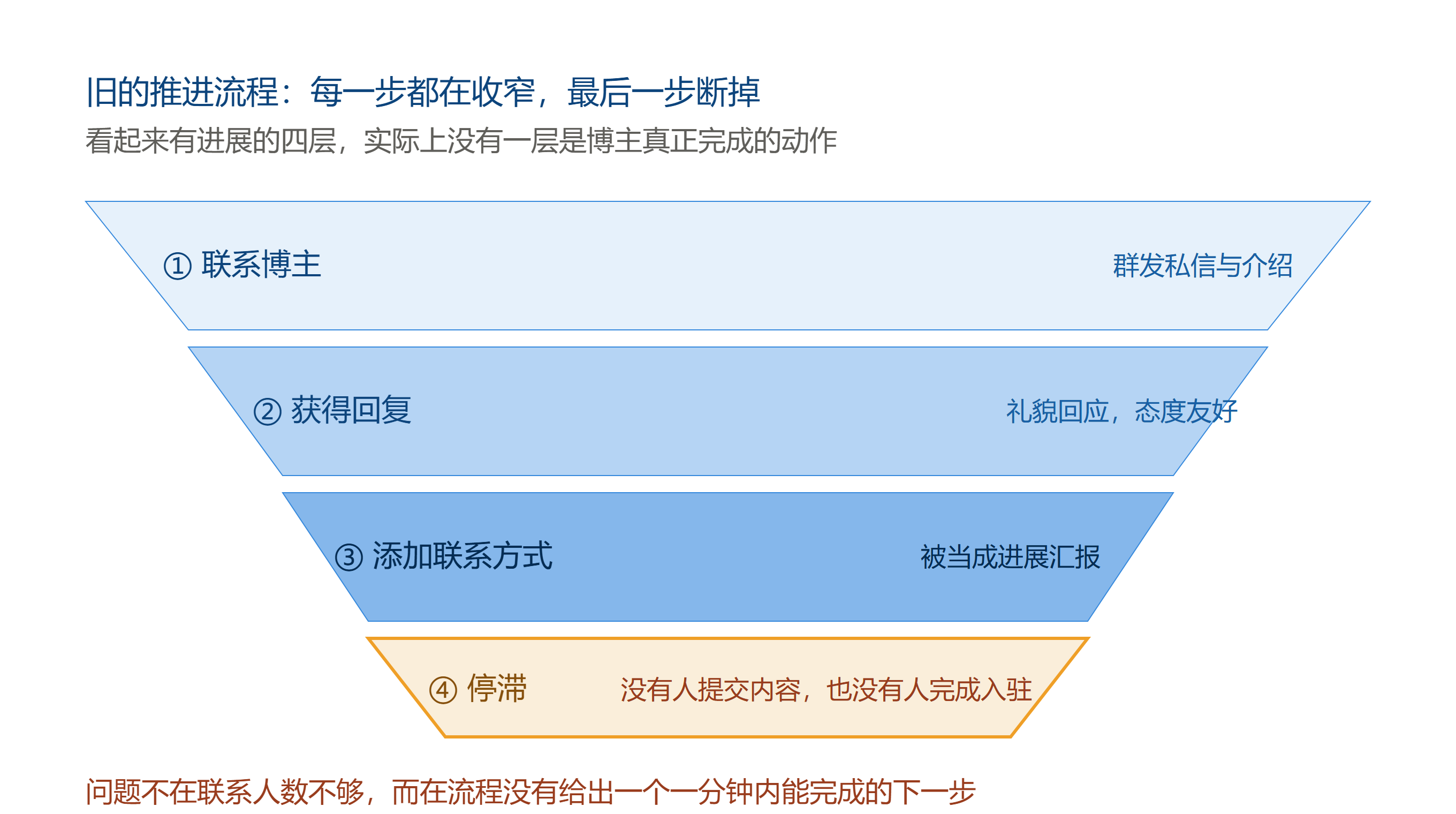 The old funnel had four layers: Contact, Reply, Exchange Contacts, then Stagnation. None of these layers represented an action truly completed by the blogger.
2. Why the Old Process Failed
During the review, we grouped all stalled conversations and found the failure reasons were highly concentrated and stemmed from process design, not lack of effort.
(1) Too Much Info at Once
Platform positioning, creator alliance, benefits system, community plans, and future commercial partnerships were crammed into one message. The recipient had to understand the entire project before making a judgment. The cognitive load was too high, causing many to shelve it after reading.
(2) First Ask Was Too Heavy
Before experiencing any value, they were asked to register, fill out profiles, migrate content, and decide on long-term onboarding. Making this series of decisions in minutes caused most people to instinctively delay.
(3) Value Appeared Too Late
The platform lacked sufficient traffic at the time, and our promises of future exposure and commercial deals couldn’t be proven immediately. They lacked a reason to continue acting, so they stayed on the sidelines.
(4) No Clear Next Step
After exchanging contacts, we continued explaining but didn’t provide a specific action completable in under a minute. Conversations naturally stopped—not because they were rejected, but because there was no reason to proceed.
Key Conclusion for This Section: The problem wasn’t necessarily unfriendly scripts, but a mismatch between the cost and benefit of the first exchange. They paid a lot upfront, while the return remained invisible.
3. Step 1: Redefining What Counts as Conversion
How: We changed the definition of "first effective conversion." Previously, we tracked WeChat adds, expressions of interest, or account registrations. Now, we track only one thing—a specific piece of content going live after author confirmation. Claiming a homepage, joining communities, or continuous submissions are categorized as second-stage or subsequent conversions, not the first.
Why It Works: Changing the definition changed the team’s actions. We were no longer misled by polite replies or felt good about "adding many people" without substance.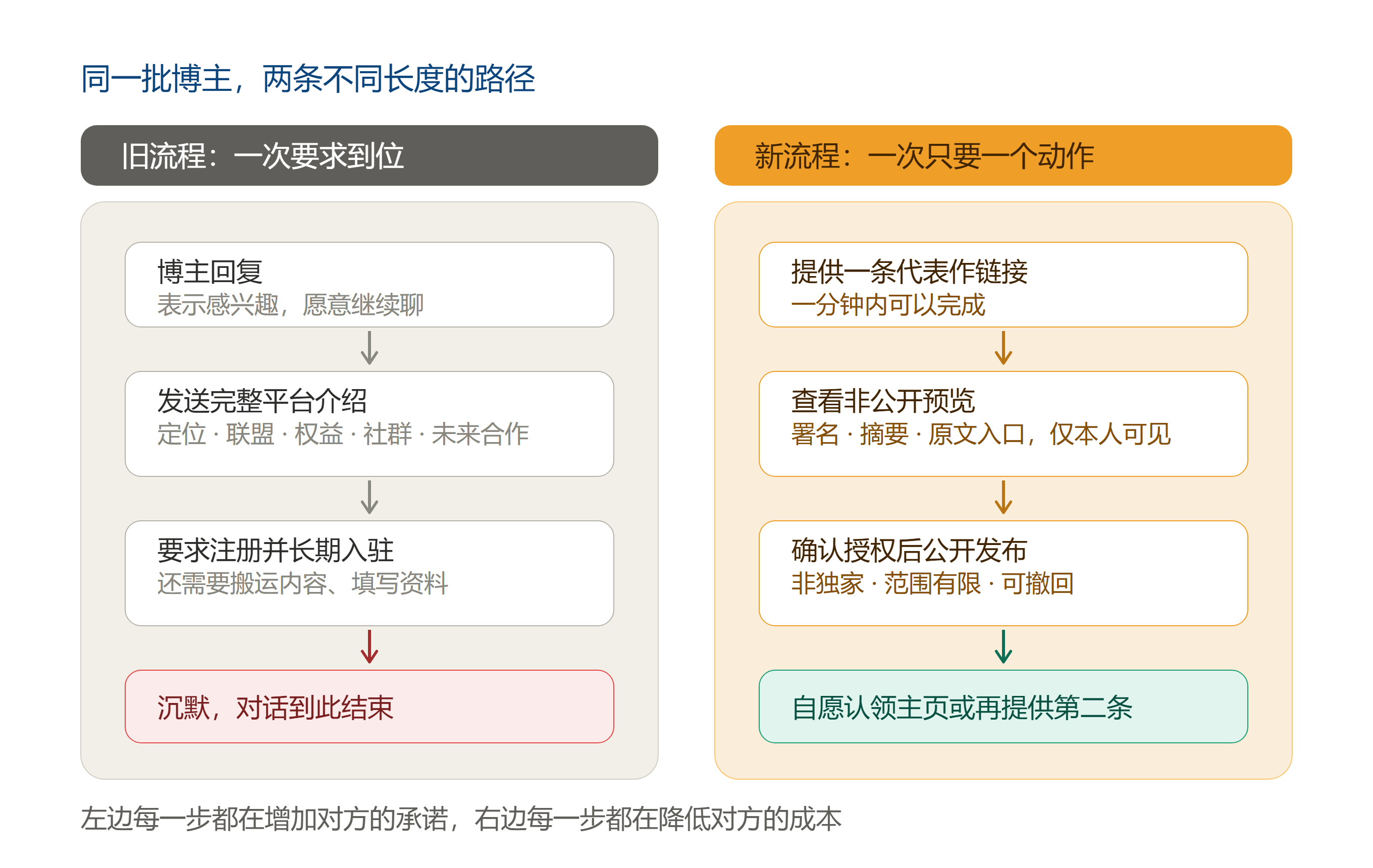 Left side: Every step increases commitment. Right side: Every step lowers cost.
4. Step 2: Lowering the Barrier for First Action
How: After a blogger replies, we no longer send lengthy project descriptions. We simply ask them to send a link to their most representative existing work. Participation doesn’t require rewriting, migrating, continuous updates, or prior registration.
Why It Works: Sending a link takes usually under a minute. The action is light enough that they’ll do it while interest is fresh, rather than delaying the decision.
Actual Script Used in Communication: My previous intro was a bit complex, let me clarify. This time, you don’t need to register, migrate content, or commit to updates. Just send me a link to your best work. We’ll create a free private preview for you to check. It only goes public after you confirm authorization.
5. Step 3: Deliver a Private Preview First
How: Upon receiving the link, we produce an author bio, content summary, attribution, and original source entry within 24 hours, generating a private page viewable only by the blogger. We ask them to check attribution, expression, and display effects, offering two clear options: Approve for publication, or Request edits.
Why It Works: Abstract platform pitches were replaced with concrete deliverables relevant to the blogger personally. The platform invested effort first, lowering wariness toward unfamiliar partnerships and allowing bloggers to retain content control.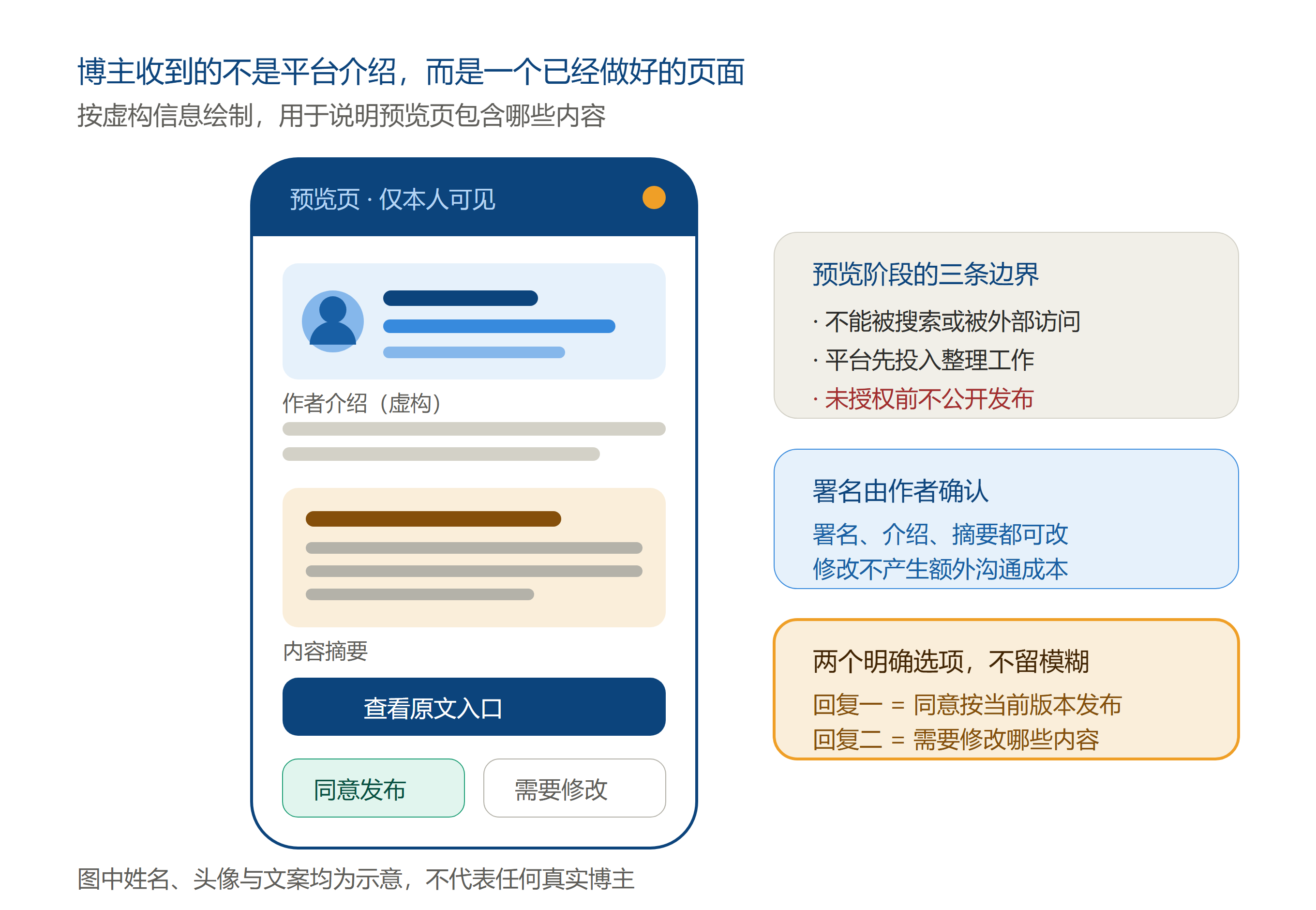 Preview page includes author bio, summary, attribution, and source link. All info in image is fictional for illustration, not representing real bloggers.
Boundaries to Clarify in This Step: The preview page cannot be searched or accessed externally. No content is published publicly until explicit authorization is given.
6. Step 4: Close the First Deal with Explicit Authorization
How: Ask the blogger to confirm specific works, attribution, and display scope. Publish only after they explicitly reply agreeing to release. Authorization is limited to specified works, non-exclusive, limited scope, revocable, and we...